 Guide On Map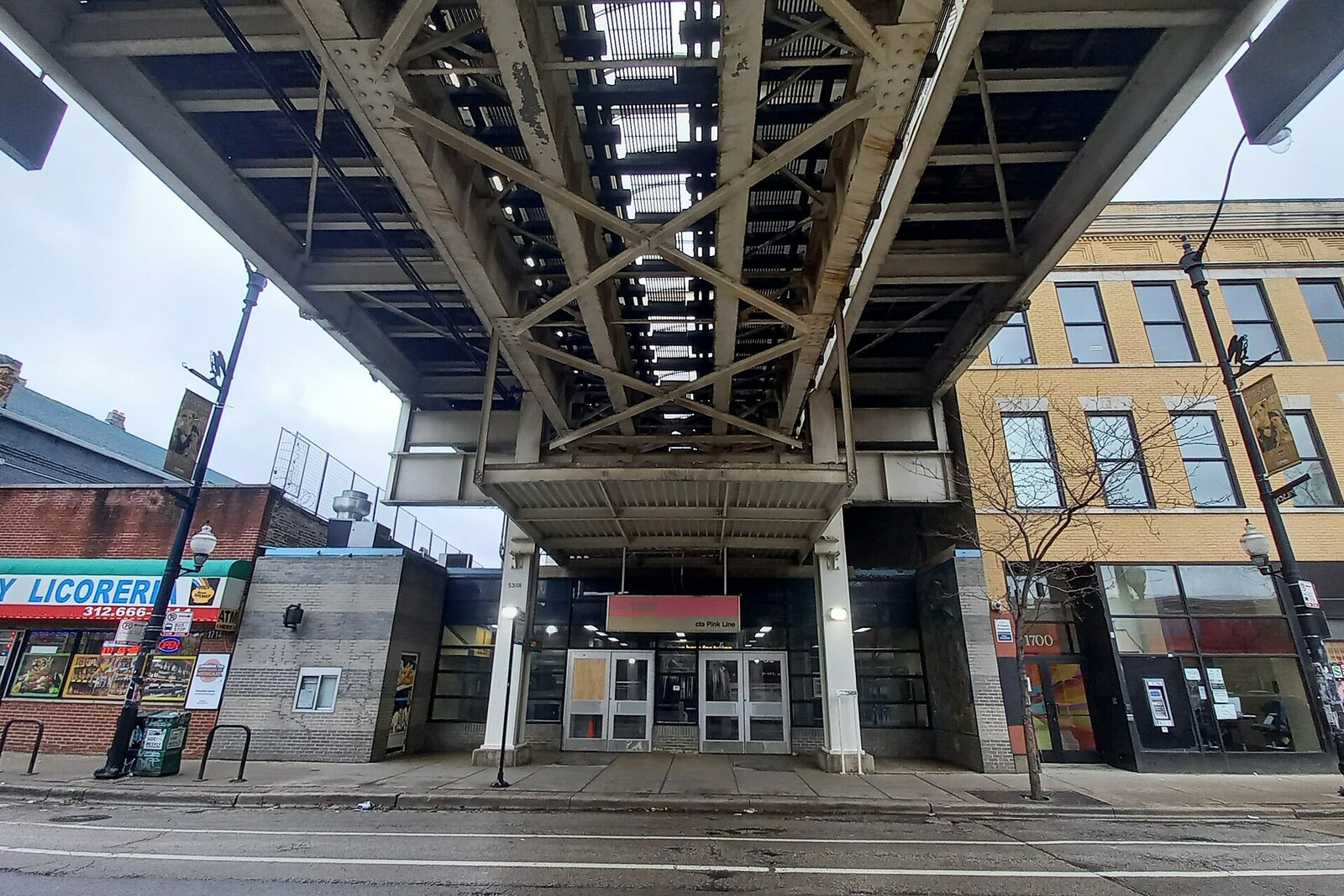

This place does not have an audited photo yet.
Selected place
18th station (Pink Line)
Local name: 18th Street Station
Shows how paid work for teenagers became part of the neighborhood’s entrance and what was preserved after damage.
Start with 31 highlights or open the complete catalog of 153 curated places.
Highlights include 18th station (Pink Line), Adler Planetarium, Art Institute of Chicago, Chicago Bee Building, Chicago Board of Trade Building, Chicago Cultural Center.
We have connected important places into ready-made walks with a clear order, stories and practical details.
Start with 31 highlights, or reveal all 153 curated places.
Local name: 18th Street Station
Shows how paid work for teenagers became part of the neighborhood’s entrance and what was preserved after damage.
Shows how paid work for teenagers became part of the neighborhood’s entrance and what was preserved after damage.
The final stop will connect a new city institution with the unfinished plan for artificial islands.
The museum offers a rare example of how an institution admitted controversial new art and found itself with a scandal inside its own school.
Here you can see what remains of a newspaper when its editorial office and almost all of its archive disappear.
The final stop will examine the moment when the exchange made the largest buyer retreat and itself set the limit of an acceptable transaction.
This is where the story begins of how a public campaign preserved a civic palace and found it a new purpose.
The fountain will explain how the long dispute over construction in the open center of Grant Park ended.
The sculpture will show how much engineering work was required to make a huge steel form look seamless.
Here, the temporary collections of the World’s Columbian Exposition become the story of a permanent museum and millions of preserved objects.
Here the route gets its name and begins at a place that had to be built anew.
Here the history of public investigation comes up against the fate of a private home archive.
This stop will show how a single donation changed the architect and enlarged the scale of a city concert venue.
The garden will help show how an architectural framework and perennial plants came together through the collaboration of two authors.
It will connect the station’s street art with an institution that grew out of a teachers’ initiative and has kept admission free.
This stop will show how several floors connected cosmetics manufacturing, offices, insurance, and banking money.
The aquarium will show why a separate support operation for a living collection had to be designed in advance behind the exhibition halls.
This stop will show how access to an ordinary addressing machine made it possible to test a major publishing idea.
Will explain why the immigrant theater retained its original layout after its owner lost it and after a long closure.
The enormous structure shows how the failure of an original plan became the foundation of someone else’s fortune.
Here, an architectural competition becomes both a newspaper event, a calculation for rental income, and a turning point in the winner's career.
Here, private initiative and newspaper pressure will move out of the offices and onto the neighborhood's main boulevard.
This stop connects everyday help for newcomers with the birth of historical publishing.
This stop will show how the building became an advertisement precisely after the decision not to put advertising on it.
Here you will understand how one crossing simultaneously changed the city's geography and gave a fugitive a few extra seconds.
The complex makes it possible to examine the dispute over whether workers' money can both save downtown and earn income for them.
The crossing will turn the story of a donation into a visible result—a direct, barrier-free connection between the park and the museum.
Reveals the park’s community role through an attempt to preserve a neighborhood truce and the memory of a slain mediator.
At the end, the meeting's participants will turn scattered discontent into organized pressure.
Brings together on one street a children’s mural from the seventies and a composition of women created forty years later.
It will show how young artists responded to vandalism not by giving up, but by completing the work.
The route concludes with an example of a mural whose concept depended on the shape of the wall but did not guarantee its preservation.
Nearest audio-route stop: Chicago Riverwalk — 10 m in a straight line, route Chicago Along the River: Bridges, Towers, and the Loop
Nearest audio-route stop: LaSalle Street Canyon — 10 m in a straight line, route Chicago Along the River: Bridges, Towers, and the Loop
Nearest audio-route stop: Marina City — 50 m in a straight line, route Chicago Along the River: Bridges, Towers, and the Loop
Nearest audio-route stop: Cloud Gate (“The Bean”) — 20 m in a straight line, route Parks and Museums of Chicago’s Lakefront
Nearest audio-route stop: DuSable Bridge (formerly Michigan Avenue Bridge) — 120 m in a straight line, route Chicago Along the River: Bridges, Towers, and the Loop
Nearest audio-route stop: Chicago Cultural Center — 90 m in a straight line, route Parks and Museums of Chicago’s Lakefront
Nearest audio-route stop: 18th station (Pink Line) — 60 m in a straight line, route Pilsen: Murals and Neighborhood History
Nearest audio-route stop: DuSable Bridge (formerly Michigan Avenue Bridge) — 100 m in a straight line, route Chicago Along the River: Bridges, Towers, and the Loop
Nearest audio-route stop: Clarence F. Buckingham Memorial Fountain — 40 m in a straight line, route Parks and Museums of Chicago’s Lakefront
Nearest audio-route stop: DuSable Bridge (formerly Michigan Avenue Bridge) — 120 m in a straight line, route Chicago Along the River: Bridges, Towers, and the Loop
Nearest audio-route stop: DuSable Bridge (formerly Michigan Avenue Bridge) — 20 m in a straight line, route Chicago Along the River: Bridges, Towers, and the Loop
Nearest audio-route stop: Jay Pritzker Pavilion — 40 m in a straight line, route Parks and Museums of Chicago’s Lakefront
Nearest audio-route stop: Shedd Aquarium — 130 m in a straight line, route Parks and Museums of Chicago’s Lakefront
Nearest audio-route stop: Chicago Riverwalk — 140 m in a straight line, route Chicago Along the River: Bridges, Towers, and the Loop
Nearest audio-route stop: Adler Planetarium — 50 m in a straight line, route Parks and Museums of Chicago’s Lakefront
Nearest audio-route stop: Art Institute of Chicago — 130 m in a straight line, route Parks and Museums of Chicago’s Lakefront
Nearest audio-route stop: Tribune Tower — 140 m in a straight line, route Chicago Along the River: Bridges, Towers, and the Loop
Nearest audio-route stop: Marina City — 130 m in a straight line, route Chicago Along the River: Bridges, Towers, and the Loop
Nearest audio-route stop: theMART — 130 m in a straight line, route Chicago Along the River: Bridges, Towers, and the Loop