 Guide On Map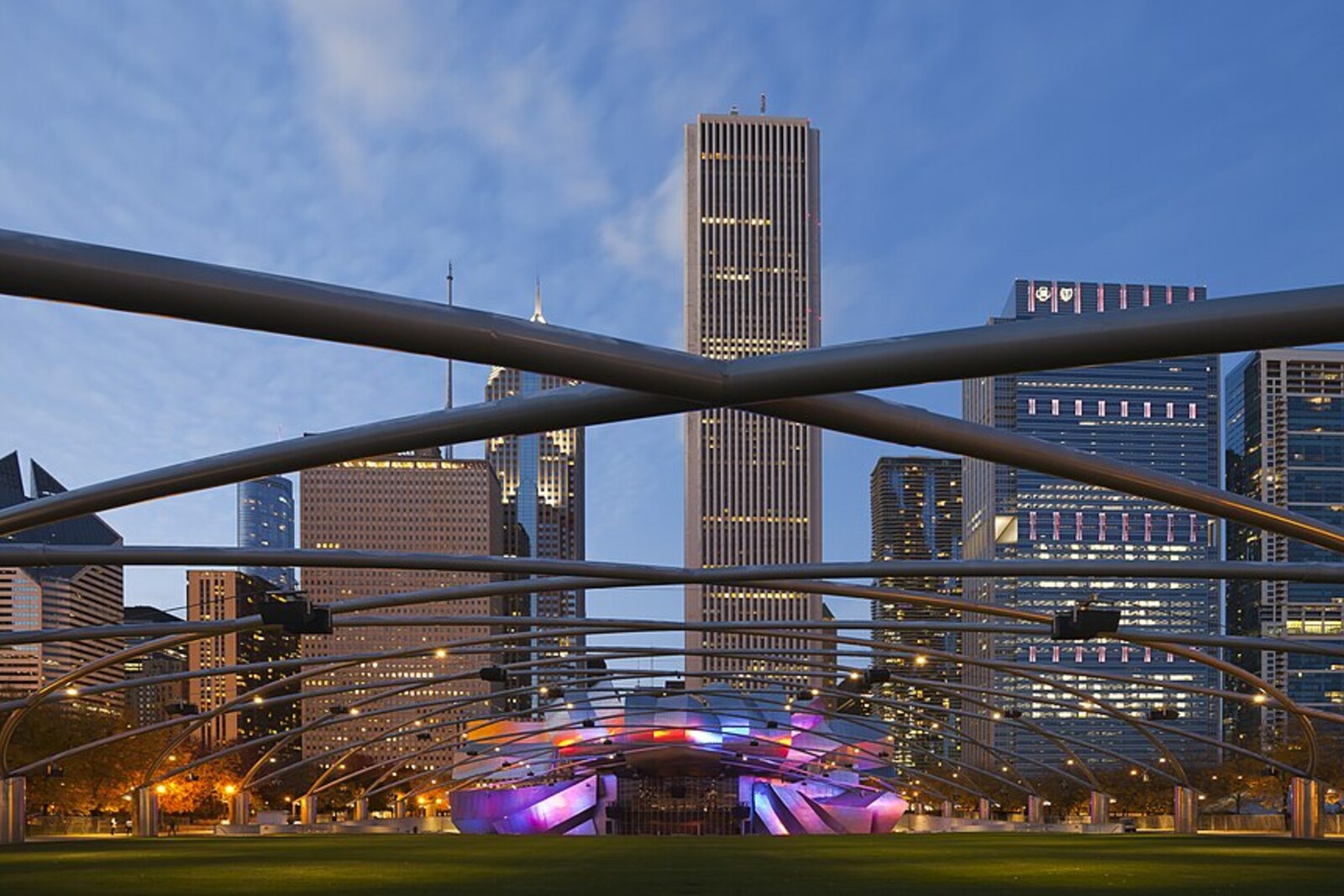
Look around first
What to notice
- Silver ribbons of the stage
- Steel trellis above the lawn
- Black loudspeakers
- Great Lawn
The story of the place
In the spring of nineteen ninety-nine, the future music pavilion already had a design: a relatively modest stage at the edge of the Great Lawn. It was intended as a new home for the Grant Park Music Festival—free summer concerts the city had held since nineteen thirty-five. Then Cindy Pritzker offered the organizers fifteen million dollars, but set two conditions: the pavilion would bear the name of her late husband Jay, and Frank Gehry would be commissioned for the design.
Jay Pritzker was a Chicago entrepreneur. Together with his brother, he created the Hyatt hotel chain and made the fortune from which the family financed architecture. In nineteen seventy-nine, Jay and Cindy established the Pritzker Architecture Prize. It is awarded to an architect for their body of work; later, the prize came to be compared with the Nobel Prize. In nineteen eighty-nine, Frank Gehry became its laureate.
Ten years later, Jay died. So the name on the pavilion identifies neither the owner of the concert venue nor a musician. Cindy commissioned, from one of the architects recognized by the prize she and Jay had established, a memorial to the man who sought public recognition for architects.
Gehry initially refused. He was busy with other commissions and thought it impossible to complete the pavilion by the start of the new millennium. According to a later account by the Pritzker family, city representatives even promised to postpone the park's opening. Gehry decided that he had not been told everything. When he learned that Cindy insisted on his involvement, he withdrew his refusal.
But he did not want to limit himself to decorating the front of the stage. Gehry demanded to design the entire concert venue: the stage shell, the steel trellis above the audience, and the connection to the neighboring bridge. Cindy rejected his first version as not bold enough, and the architect returned to the drawings. In the end, the pavilion cost about sixty million dollars. The Pritzkers' donation did not pay for the entire construction, but it changed the architect and the scale of the plan.
The most important part of the solution is above the lawn. The open-air amphitheater has no walls or ceiling that, in a concert hall, return sound to the listeners. Gehry, together with acousticians Rick Talaske and Johnathan Layne, suspended fifty-two pairs of loudspeakers from the curved trellis. A computer sends the signal to the distant speakers with a calculated delay, so that the sound is perceived as coming from the stage rather than from the nearest box above one's head. That is why the lawn beyond the four thousand fixed seats forms part of the concert space and accommodates about another seven thousand people.
In July two thousand four, the new home of the Grant Park Music Festival orchestra and chorus opened on this stage. Free symphonic programs, jazz, blues, and other city concerts now take place here. Silver ribbons frame the musicians, while black loudspeakers remain on the steel trellis year-round. Beneath them, music plays in the pavilion named for Jay Pritzker, designed by a laureate of the prize established by Jay and Cindy Pritzker.
Useful on site
Open park venue; access to the seats, stage, and lawn depends on concerts, rehearsals, and security.
Checked: July 1, 2026. Check the official source before visiting.During a concert, rehearsal, or setup, part of the lawn may be occupied; the structure of the space is also easy to make out from the paths.