 Guide On Map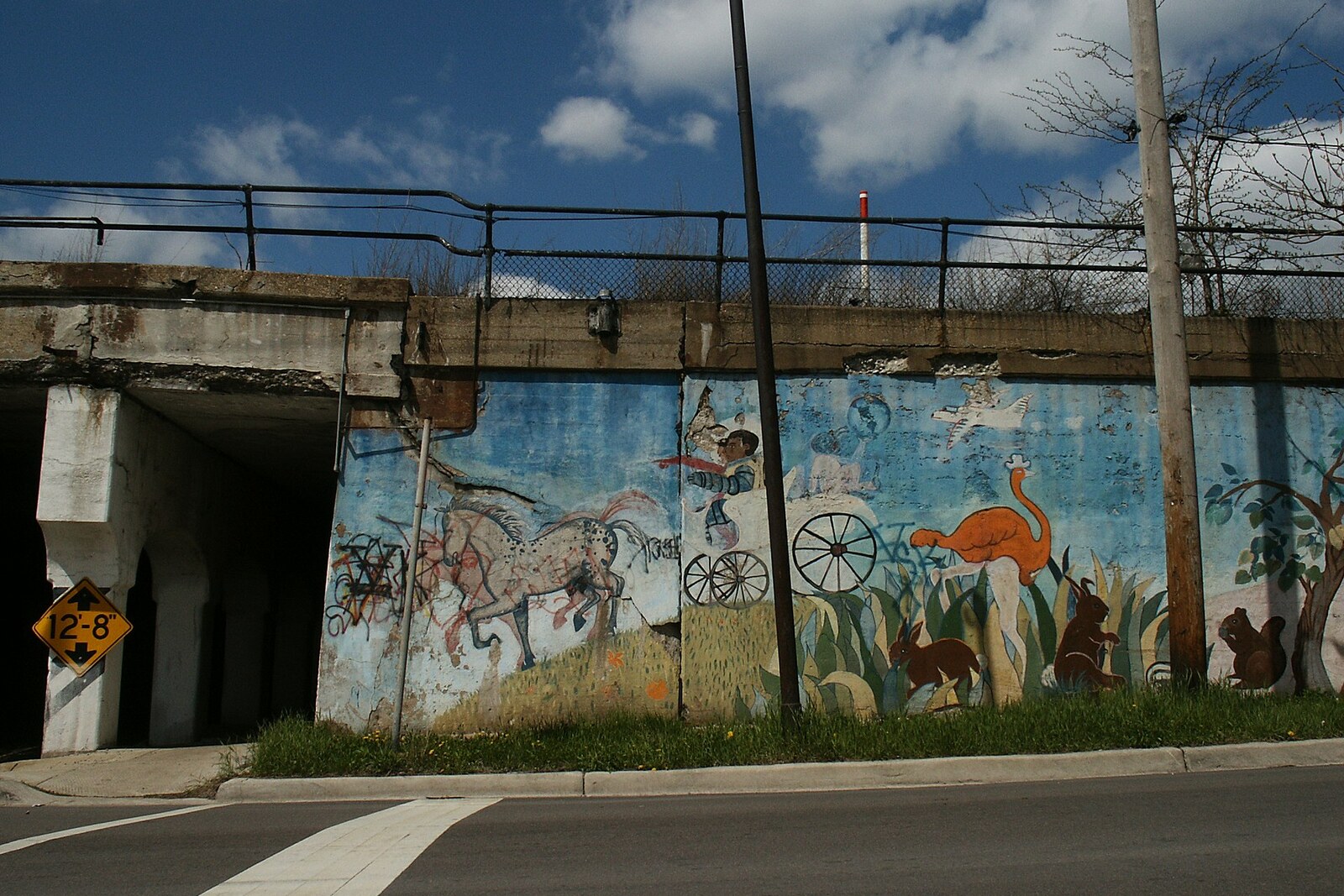
Look around first
What to notice
- Murals on concrete sections
- The wall's three-plane bend
- Joints between the planes
The story of the place
A railroad retaining wall runs along 16th Street. Intersections and bends divide it into dozens of separate sections. Murals appeared here spontaneously until, in two thousand twelve, the Chicago Urban Art Society and Pawn Works Gallery brought them together in the Art in Public Places program. Curators Nick Marzullo and Seth Mooney invited Chicago-based and visiting artists to paint the wall from Halsted Street to Western Avenue. The railroad embankment thus gained about fifty new works.
The project had little money. The first series of murals was supported by roughly ten thousand dollars and paint supplied by manufacturers. Marzullo said outright that with such a budget, the artists were effectively working for free, so it was worth inviting only those whose ideas the curators themselves wanted to see on this wall.
Among those invited was the Belgian artist ROA, known for enormous black-and-white animals. Between Laflin Street and Ashland Avenue, he found a section where the concrete surface turns and breaks into three planes. ROA built the image around this bend: he painted an opossum roughly six meters long, leaving a gap with red innards in the middle. From an ordinary viewpoint, the animal appeared severed. From one precisely chosen spot, the near and far sections of the wall joined its body back together. This work could not have been moved to a flat facade without losing its concept.
The opossum was often mistaken for a rat. Some residents decided that the giant dead rodent portrayed Pilsen as dirty and teeming with rats; complaints reached neighborhood organizations. The organizers replied that it was an opossum, an animal common in Chicago. The mural was not removed: as late as two thousand nineteen, it still occupied the same bend, although someone else's writing had already appeared between the parts of its body.
By two thousand twenty, the opossum had been painted over. Artists Henry Gonzalez and Antonio Hernandez applied a new composition to this concrete; at the edge, only a narrow strip of the earlier work remained at that time. The three-plane bend itself remained—the very one for which ROA had chosen this section of wall.
Useful on site
Street corridor; best visited during the day and along open sidewalks.
Checked: June 28, 2026. Check the official source before visiting.Walk along the accessible sidewalk, watch for traffic, and do not approach the tracks; some works may have been altered or covered.