 Guide On Map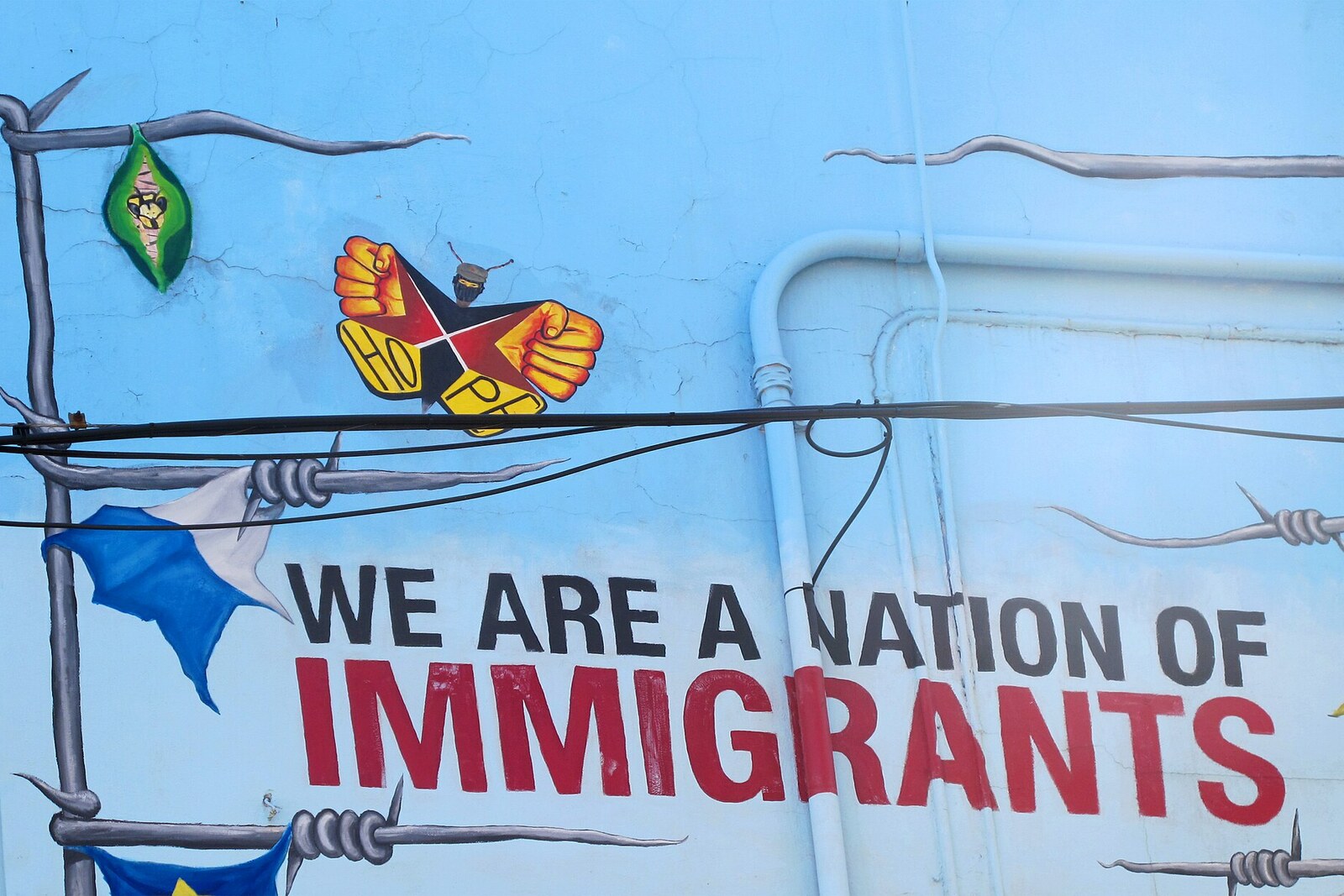
Look around first
What to notice
- Blue wall
- Large lines from the declaration
- Barbed wire with flags and butterflies
The story of the place
The largest phrase on the blue wall gave the mural its familiar name: “We Are a Nation of Immigrants.” The creators called the entire work the “Declaration of Immigration.” The words appeared here before the images.
On July fourth, two thousand eight, the National Museum of Mexican Art opened an exhibition about the lives of immigrants in the United States. For it, the museum gathered works by more than seventy artists and drafted a declaration on behalf of immigrant communities. The following year, the leaders of Yollocalli Arts Reach, the museum’s free art program, decided to put this text on the wall of their building. Here, Yollocalli Arts Reach shared space with Radio Arte, a bilingual radio station where teenagers prepared programs themselves.
The work was assigned to Salvador Jimenez, an instructor in the mural workshop and a graphic designer. About a dozen teenagers and young program participants joined him. They shortened the museum’s declaration to a few phrases; otherwise, the text could not have been read from the street on a wall about thirty feet wide.
Jimenez deliberately rejected the many human figures typical of Pilsen murals. He thought like an advertising designer: passersby were surrounded by signs, so they had to be addressed just as boldly and directly. First, Jimenez laid out the phrases on a computer to fit the facade, then the students transferred the outlines of the letters onto the two-story wall. Between the lines, they painted barbed wire with scraps of national flags and butterflies. The program’s private funding allowed them to choose the wording themselves: the group had no client who could demand a more cautious text.
Eight weeks were allotted for the entire work. While the mural was still unfinished, someone crossed it out with black paint at night and wrote in English: “Lie” and “Mexicans are racists.” Jimenez received a call in the morning. At first, he was angry: the students had spent several weeks at the wall that a stranger had ruined in a few minutes. Then he had to decide what to tell the group.
That day, Jimenez gathered the young artists and explained that the inscription had appeared because someone had read their text and wanted to drown it out. The students were angry too, but they did not abandon the work. They removed the stranger’s paint, restored the letters, and finished the mural on time. It was opened to the public on August eleventh, two thousand nine.
The vandalism gave the work an audience it had not had before: newspapers and radio stations reported on the teenagers, and many participants later returned for other Yollocalli Arts Reach classes. Jimenez turned the same large phrases into posters and free stickers. Two years later, he was still receiving photographs of these stickers from different parts of the country.
In two thousand thirteen, Yollocalli Arts Reach and Radio Arte vacated the building: maintaining it had become too expensive, and both programs moved to Little Village. On the southwest wall, their earlier work remained—the inscription that Jimenez’s students completed after the nighttime vandalism.
Useful on site
Street mural; view it from the sidewalk during the day.
Checked: June 28, 2026. Check the official source before visiting.This is a working environment: stay in the accessible pedestrian area and do not block driveways, doors, or loading areas.