 Guide On Map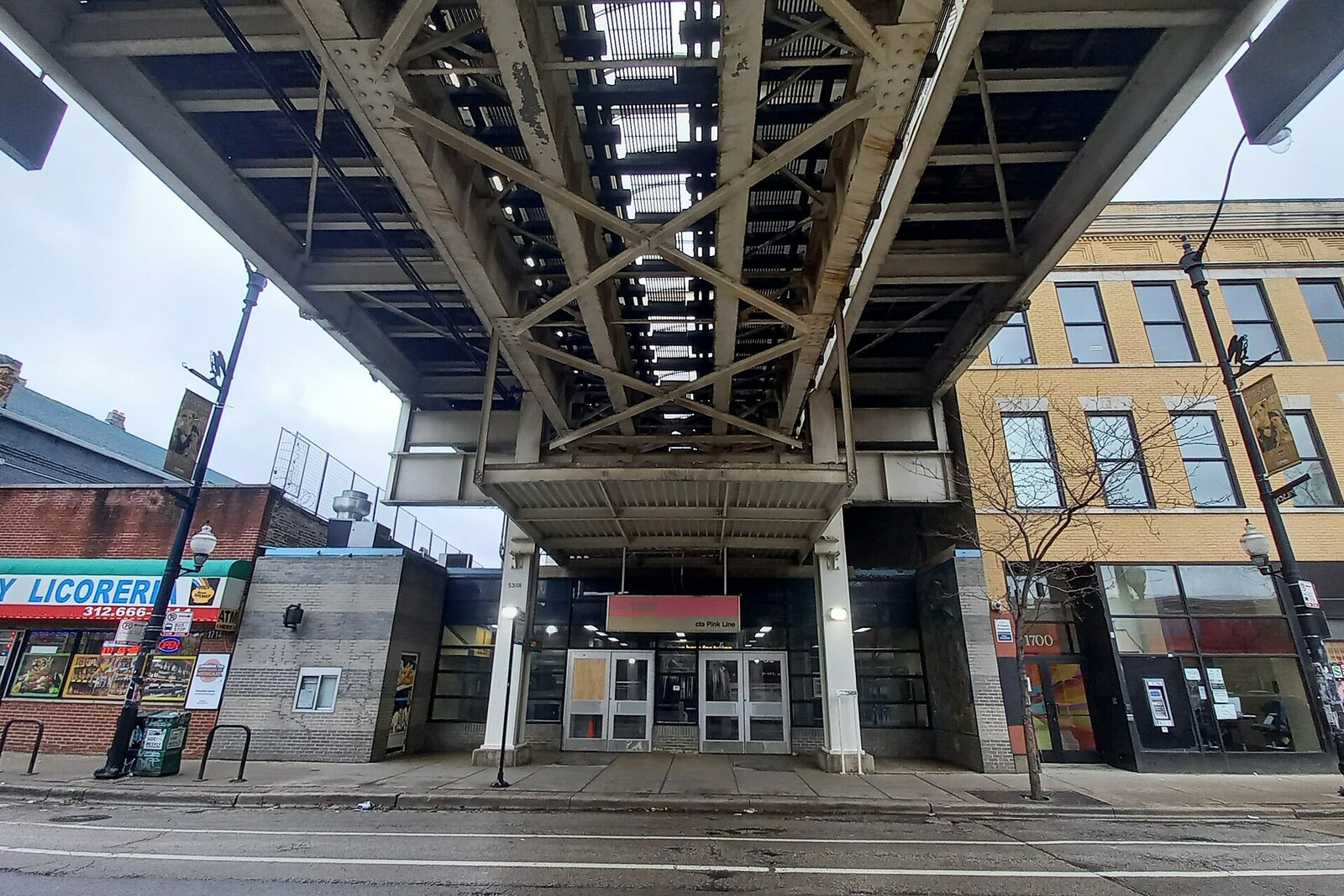
Look around first
What to notice
- Two Aztec stone disks
- Steel panels along the tracks
- Murals on the stairway walls
The story of the place
The station’s name is merely an address: Eighteenth Street. Pink Line trains stop here on the elevated tracks, while the stairs and platforms serve at once as an entrance to Pilsen and its first exhibition.
In nineteen ninety-eight, artist and schoolteacher Francisco Mendoza brought teenagers here from the city’s Gallery 37 program. The program hired young Chicagoans as paid apprentices: for several weeks, they worked alongside a professional artist and left the result in a public place. For many, it was the first job where they were paid specifically for their ability to draw.
Mendoza taught Pilsen children and wanted them to see Mexican history not only in a textbook. With support from what is now the National Museum of Mexican Art, his students received the stairway walls and steel panels along the tracks. Each was responsible for a separate section. This is how an ordinary passage to the train was filled with faces, ornaments, and images from Mexican history. Mendoza himself, together with the students, painted two large Aztec stone disks on the downtown-bound platform. Former project participants recognized their own panels years later and showed which part of the station they had painted as teenagers.
The works were created through the Adopt-A-Station program. Transit officials expected the decoration to turn the stop into a gateway to the neighborhood and show who lived around it. At the time, the murals were not considered permanent artworks. Rain, frost, and graffiti gradually damaged the paint, and in one thousand nineteen some damaged sections were painted white. Along with the inscriptions, parts of the students’ drawings disappeared as well. Mendoza could no longer restore them: he had died seven years earlier.
Roberto Valadez, an artist from Pilsen and Mendoza’s longtime friend, was commissioned to restore the main platform mural. The deceased artist’s family approved his candidacy. Valadez could have painted his own composition over the old one, but he preserved Mendoza’s design and only restored the lost areas and color. The work was completed in two thousand twenty-one.
The restored composition with the Aztec disks remains on the downtown-bound platform today. Nearby are panels of different ages: some still belong to Mendoza’s students, while others replaced what could not be saved. So authorship here is literally distributed across the walls: the teacher set the station’s design, the teenagers painted it in sections, and his friend brought back the main mural after the artist’s death.
Useful on site
An active Chicago Transit Authority station; check Pink Line alerts.
Checked: June 28, 2026. Check the official source before visiting.The station is active: look at the works without blocking passageways, stairs, or passenger boarding.