 Guide On Map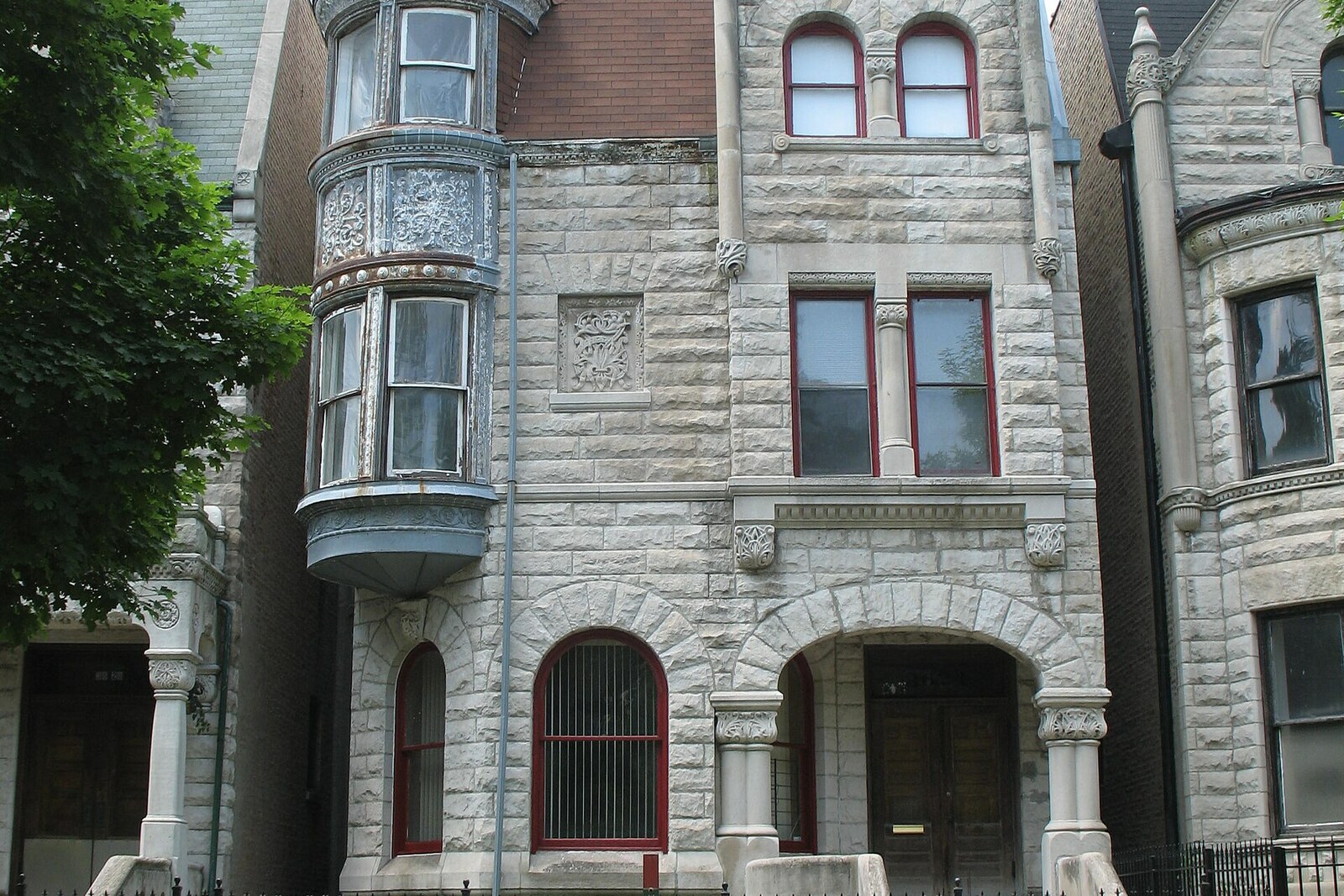
Look around first
What to notice
- Gray granite facade
- Two-story bay window
- Stone walls
The story of the place
The gray granite facade and the two-story projecting bay window identify this as a large city house, not a museum pavilion. Private apartments now stand behind the stone walls, so visitors are not allowed inside. Once, this home held not only a family but also the papers, letters, newspaper clippings, and working notes needed for journalistic investigations. The house’s appearance, preserved from the street, keeps in place the connection between private life and public work.
In nineteen nineteen, Ida B. Wells-Barnett and her husband Ferdinand Lee Barnett bought this fourteen-room stone house on Grand Boulevard—the name then used for what is now part of King Drive. Ferdinand was a lawyer and publisher; Ida was a journalist who pressed for the killings of Black people by mobs to be investigated and for the killers’ justifications to be checked against the facts. The couple moved here with their children: above all, the large house was a family home.
Wells’s working tools were newspaper clippings, witnesses’ letters, lists of the dead, and her own reports. She traveled to the sites of pogroms, paid for the trips from her own funds, donations, and newspaper advances, then published the information she gathered in articles and pamphlets. This work had already cost her her newsroom and income: in Memphis, a white mob wrecked the printing office of her newspaper and threatened to kill the journalist if she returned. Wells left for the North but continued her investigations. She kept the accumulated papers at home.
A fire occurred here in nineteen twenty-three. It was already the second fire in a Wells home in eight years; together, the two fires destroyed nearly all of her personal and professional papers. Letters, reports, and pamphlets about the pogroms she had investigated were lost. Later searches for copies in other archives yielded almost nothing. For a journalist accustomed to answering a convenient lie with a document, the evidence of years of work itself had burned.
A few years later, the children moved away, and the enormous house became too large for the three remaining residents. The family moved into a five-room apartment, and Wells decided to write down what could no longer be reconstructed from her archive. She wrote the first third of her autobiography by hand, dictated the rest to the secretary of her son, the lawyer Herman Kohlsaat Barnett, then proofread and corrected the manuscript. The book was not published during her lifetime. After her mother’s death, her younger daughter Alfreda M. Duster sorted through the manuscript, compared the surviving materials, and spent many years seeking publication. Crusade for Justice: The Autobiography of Ida B. Wells was published in nineteen seventy.
Today, private apartments stand behind the gray granite facade; you cannot enter as you would a museum. The house bears the name of Ida B. Wells-Barnett because she lived here with her family and the main part of her archive was lost here. Nearly all the papers disappeared, while the projecting two-story bay window and stone walls remain the only surviving Chicago residence directly connected with her life.
Useful on site
Private residence; not open to the public.
Checked: June 28, 2026. Check the official source before visiting.This is a private residence: stay on the public sidewalk, do not enter the property, and do not photograph residents.