 Guide On Map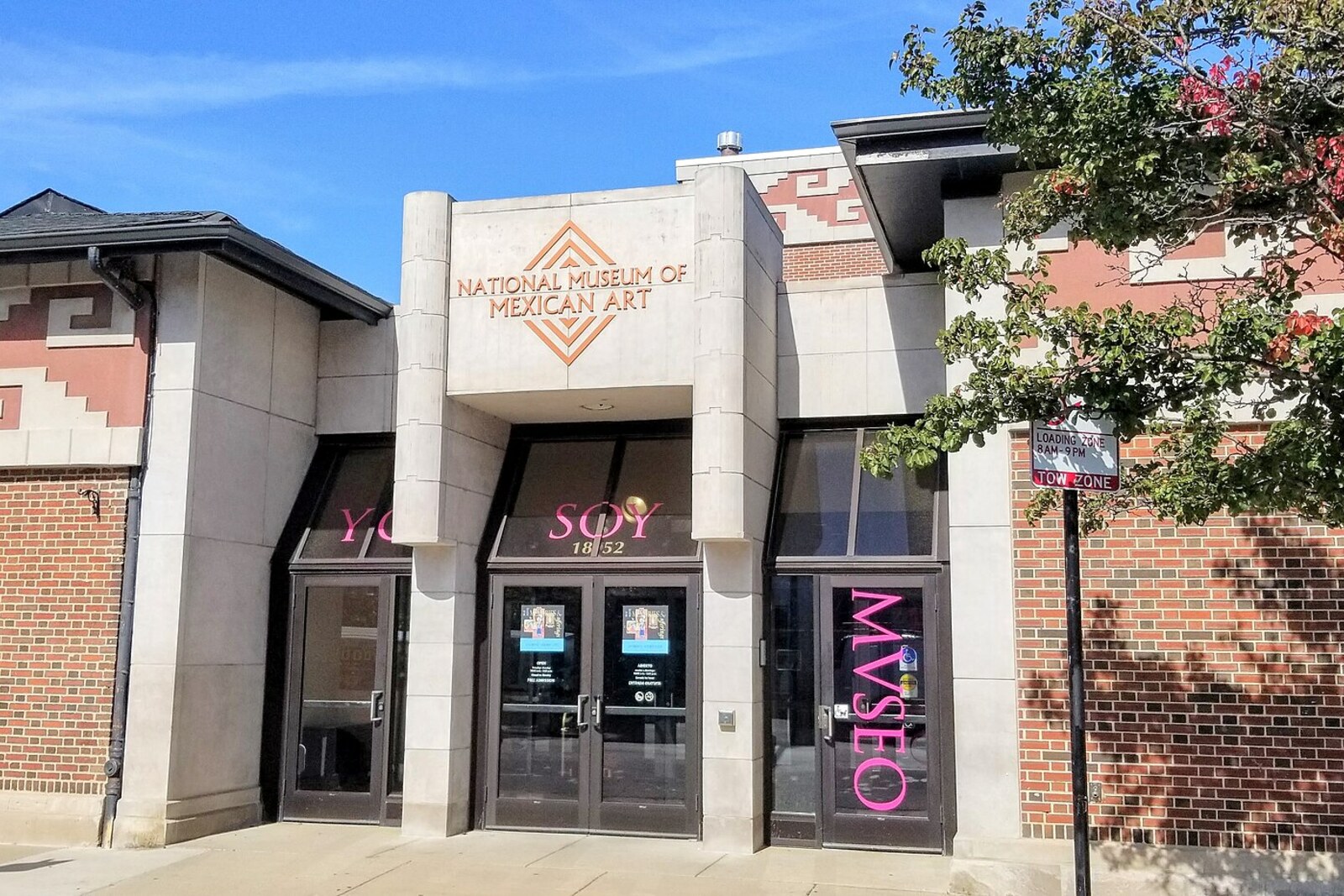
Look around first
What to notice
- The facade of the museum building
- The entrance from Harrison Park (Zapata Park)
- The expanded museum galleries
The story of the place
Behind the facade by Harrison Park (Zapata Park) are galleries where ancient Mexican art stands alongside works by artists of Mexican descent from different countries. The space has grown over time: additional galleries and storage were added, and exhibitions from here travel to cities in the United States and Mexico. In Pilsen, people come here not only for exhibitions but also for performances and classes for young people; admission remains free.
In nineteen eighty-six, Carlos Tortolero and five of his fellow teachers were given the use of the Chicago Park District workshop that stood here. Boats for Harrison Park (Zapata Park) were repaired in it. Tortolero recalled that the room was piled with sawdust, with rats stirring in it. The future art museum was given a service workshop.
At the time, Tortolero taught history at Bowen High School, a public school. He and his colleagues saw that students of Mexican descent rarely encountered their families’ history in the school curriculum or works by people with similar experiences in art institutions. The six educators decided to mount their own exhibitions. In nineteen eighty-two, they had nine hundred dollars; Tortolero continued to live on a teacher’s salary. For the first five years, there was no permanent space: the organizers made arrangements with other venues and moved exhibitions around Chicago.
Museum professionals doubted three things at once. Teachers without substantial capital were going to create a serious collection, house it in a working-class neighborhood, and charge no admission. Tortolero insisted on Pilsen: many of the families for whom the museum was being created lived here. The site in Harrison Park (Zapata Park) offered one more advantage. Part of the city’s property-tax revenue was directed to cultural institutions located on park land. That funding made it possible not to pass expenses on to visitors.
The founders converted the boat workshop, and in March nineteen eighty-seven the Mexican Fine Arts Center Museum opened here—the institution’s original name. That same year, its galleries showed sixty-eight contemporary works by women artists of Latin American descent from across the United States. The teachers began with the lack of Mexican art in education and gained a place of their own, where exhibitions, classes for schoolchildren, and support for artists became equal parts of the work.
In two thousand one, builders tripled the building’s floor area and added new galleries and storage. By two thousand six, exhibitions were already traveling through the United States and Mexico, and the leaders chose the current name—the National Museum of Mexican Art. The word “national” does not mean a federal institution or a branch of the Mexican state. It indicates the scope of the collection and programs: from the art of ancient Mexico to works by Mexican artists on both sides of the border.
Behind the expanded galleries, the original connection to the park and Pilsen has remained. Exhibitions, performances, and classes for young people still take place here, and admission remains free—a direct result of the six teachers’ decision to establish the museum in a boat-repair workshop.
Useful on site
Tue-Sun 10:00-17:00; admission free.
Checked: June 28, 2026. Check the official source before visiting.Check the opening hours before your visit; a full visit to the exhibitions may require separate time.