 Guide On Map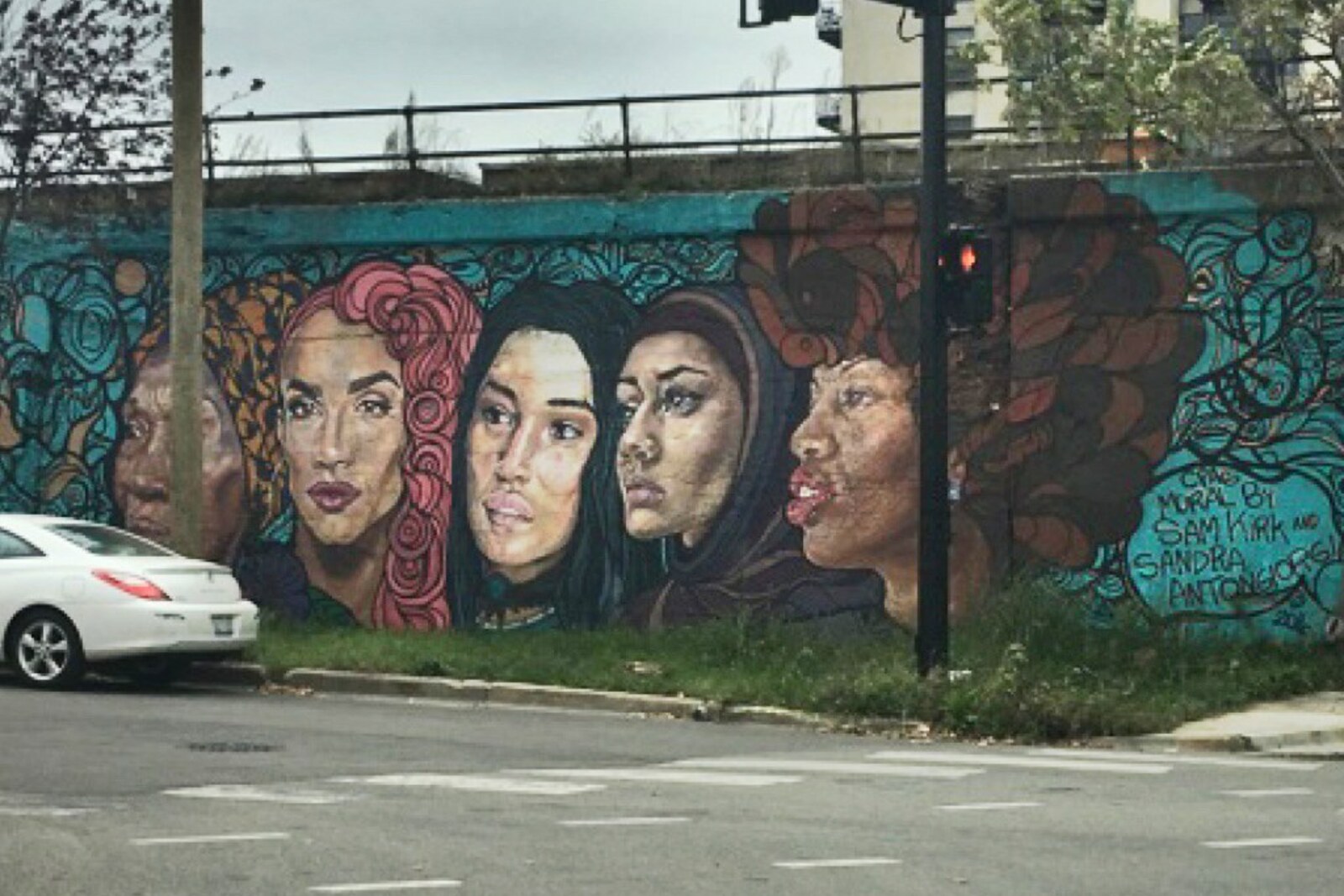
Look around first
What to notice
- Twenty-two male profiles
- Five female portraits
- The railroad wall
- Murals on either side of Blue Island Avenue
The story of the place
Along Blue Island Avenue, a concrete railroad wall serves as the neighborhood’s open gallery, without doors or exhibition halls. Lined up on it are twenty-two nearly three-meter male profiles, painted by artist Aurelio Diaz together with children from St. Procopius Parish. One face repeats in different colors and states, making the long wall seem like a sequence of frames.
In the mid-seventies, little Sandra Antongiorgi walked here along Blue Island Avenue to school. Her family had come from Puerto Rico and settled in Pilsen, among other Spanish-speaking families. Her mother led the children by the hand, and Sandra always paused to watch the artists at the railroad wall. It was the first time she had seen a human face grow to the size of a building.
At the time, artist Aurelio Diaz was creating Galería del Barrio—“the neighborhood gallery.” This gallery has no hall: in nineteen seventy-six, Diaz and twenty children from St. Procopius Parish painted twenty-two nearly three-meter male profiles on the concrete. The model was sixteen-year-old volunteer Robert Herrera. His face recurs in different colors: smiling, becoming somber, shouting; from the mouth of the final profile emerges the figure of an unborn child. In this way, Diaz showed the changing emotions and generations of the Mexican American neighborhood.
Forty years later, the paint had faded. In May two thousand sixteen, Chicago muralist Sam Kirk began the restoration. She found some of the children who had helped Diaz: now adults, they brought old photographs that made it possible to restore the lost colors. At the same time, the Chicago Public Art Group and a city council member’s office proposed that Kirk paint a female version of the “Gallery” opposite it.
For Kirk, this was her first commission obtained through the city and this organization. She agreed, but refused to copy the composition of the man simply because a female version was required. Kirk was after a different idea—to bring together women of different backgrounds, ages, and identities. For the portraits, she invited Sandra Antongiorgi, the very girl who had once watched Diaz at work on her way to school.
Kirk was responsible for the drawing, colored patterns, hair, and clothing; Antongiorgi painted the faces in an almost photographic manner. Their different styles had to be coordinated right on the wall: the background shade changed the color of the skin and shadows in the portrait. That is where the name Weaving Cultures comes from—in one composition, not only five women but also the working methods of two artists came together.
The original sketch changed during the painting itself. After the mass killing of visitors at the Pulse nightclub in Orlando, Kirk and Antongiorgi decided that the earlier hint was insufficient and repainted one of the figures. Then Sandra noticed that all the women depicted were young and insisted on a portrait of an elderly Caribbean woman. Of the five faces, only one belongs entirely to a specific person—Janice Bond, a curator who spent ten years connecting Chicago’s different arts communities. The artists composed the others from the features of several models.
They did not take the new versions back for approval, although the city commission required work based on an approved sketch. As project leader, Sam decided to take responsibility for the changes herself, and then secured credit for Sandra as the second lead author. In September, the mural was unveiled under two names.
On one side of Blue Island Avenue remained twenty-two versions of Robert Herrera’s face, which Sandra had watched as a child. On the other were five women whom, forty years later, she painted as a coauthor.
Useful on site
Street murals; view them from the sidewalk during the day.
Checked: June 28, 2026. Check the official source before visiting.View each wall from the sidewalk and cross the street only at a permitted place; do not step into the roadway for a photo.