 Guide On Map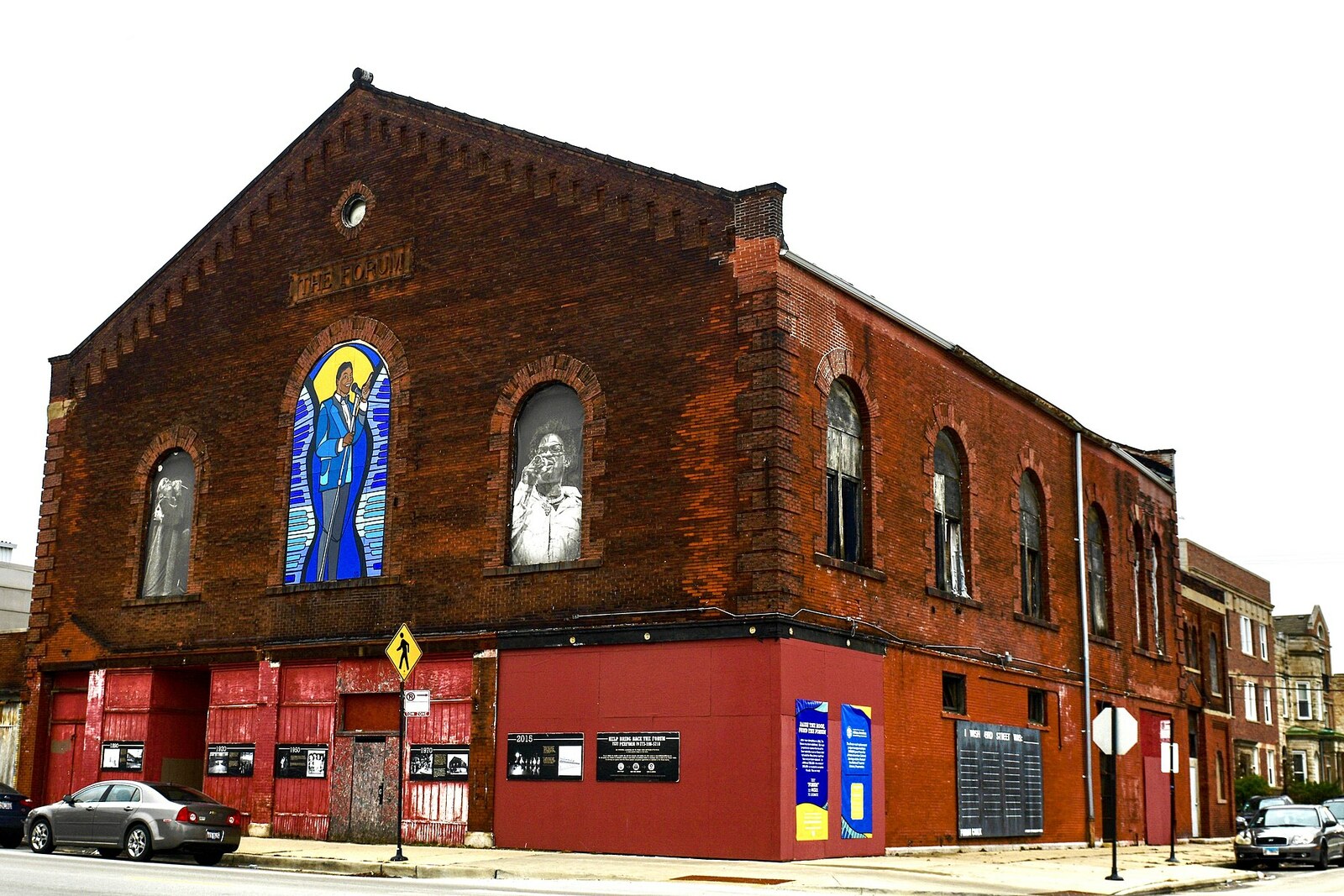
Look around first
What to notice
- Three tall arched windows
- West wing
- Ground-floor retail spaces
The story of the place
Three tall windows with arched tops light the large second-floor hall, while retail spaces occupy the building's lower level. Several hundred people could fit here, and the nearby elevated-train station made the hall convenient for Bronzeville residents. At a time when Black visitors were barred from many city venues, dance classes, concerts, and community meetings took place upstairs. The main hall later closed for restoration, but the restored west wing once again hosts concerts and gatherings.
Behind three tall arched windows is The Forum: a stage, balcony, and broad wooden dance floor on the second floor, with retail spaces below. Chicago city council member William E. Kent and his father Albert E. Kent commissioned this complex in eighteen ninety-seven for meetings, performances, and celebrations. The name “Forum” literally described the building's purpose.
This arrangement became especially important after the Great Migration, when Bronzeville became the center of Black Chicago. Black visitors were excluded from many city halls, but here, beside an elevated-train station, several hundred people could gather. The same floor hosted dance classes, Nat King Cole concerts, and community conferences.
In February nineteen forty-three, organizers from Chicago stockyard unions came here. They were seeking admission for Black athletes to Major League Baseball. Talented players then earned their living in the Negro Leagues—separate professional championships created because of the racial barrier. Pitcher Nate Moreland could have been drafted to fight for the United States, but no major-league club in his own country would agree to hire him.
No official rule prohibited such contracts. Team owners followed an unwritten agreement. When ten union leaders demanded a meeting with baseball commissioner Kenesaw Mountain Landis, he refused to receive them. Philip K. Wrigley, owner of the Chicago Cubs, spoke with them separately and confirmed that players were excluded under an agreement among club owners. There was nothing to repeal—it was necessary to force sixteen owners to abandon their shared silence.
At The Forum, unions brought together civil-rights, religious, and community organizations. The participants adopted a resolution demanding that Major League Baseball be opened and sent it to Landis, team owners, and President Franklin D. Roosevelt. A petition campaign began here and gathered about one hundred fifty thousand signatures.
No immediate concession followed. Late that same year, the owners for the first time heard a delegation of Black publishers and former football player Paul Robeson, who were seeking contracts for Black baseball players. The team owners applauded and hired no one. Sports journalists, unions, and civil-rights organizations kept up the pressure. In the fall of nineteen forty-five, Brooklyn Dodgers executive Branch Rickey signed Jackie Robinson, and in the spring of nineteen forty-seven, Robinson took the field in Major League Baseball.
The Forum closed in the nineteen seventies. The main space is still being restored, while individual meetings and concerts are already being held in the restored west wing. Behind the arched windows, the stage, balcony, and the very wooden floor where signatures were gathered in nineteen forty-three have survived.
Useful on site
A space for events and community that is being restored; entry only for events or under the current access arrangement.
Checked: June 28, 2026. Check the official source before visiting.Do not enter areas under restoration or closed areas without permission; access to the hall and wooden floor is possible only by separate arrangement or at an event.