 Guide On Map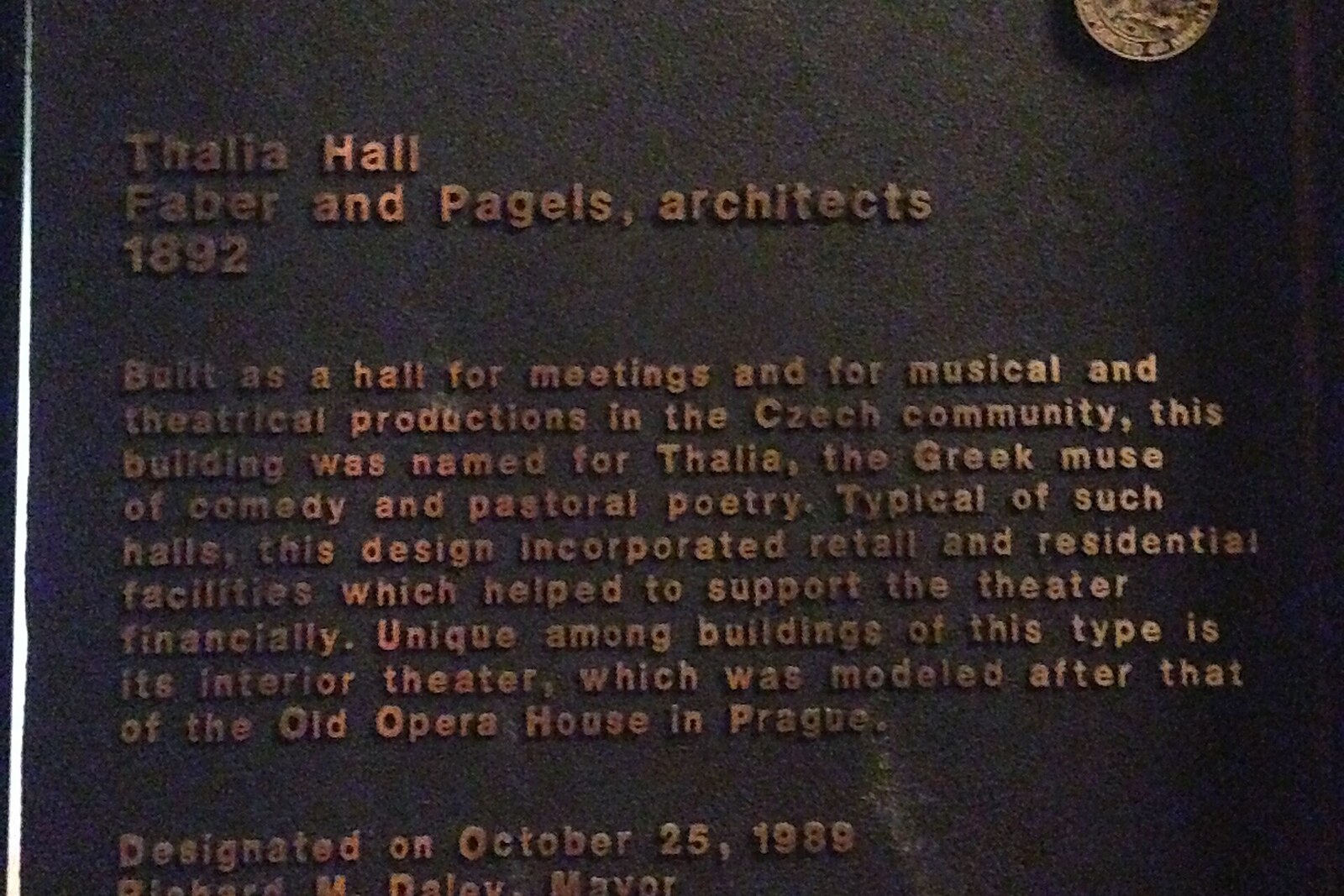
Look around first
What to notice
- The name “Thalia Hall” on the facade
- The auditorium balcony
- Six boxes
- The metal trim of the boxes
The story of the place
The auditorium, with its balcony and six boxes, rises above floors intended to generate daily income. Retail spaces and a drinking establishment operated below, living quarters stood alongside, and people gathered above for performances, meetings, and celebrations. The metal trim of the boxes still recalls this complex interior layout: today, a restaurant and bar occupy the lower levels, while music still sounds a floor above.
The name “Thalia Hall” is carved into the facade. Thalia is the Greek muse of comedy and idyllic poetry. The name was chosen by Czech immigrant John Dusek, a saloon owner who wanted to bring performers from Bohemia to Pilsen and give his neighbors a stage of their own.
Dusek lived here with his wife Agnes and their children, supporting the family with income from the drinking establishment. In eighteen ninety-two, he invested in a far riskier venture. The first floor housed a saloon and retail spaces, with living quarters alongside them, and above them stood a large theater with a balcony and six boxes. The income-producing parts of the building were meant to stand alongside a hall for performances, meetings, and celebrations.
The calculation on an audience paid off. In eighteen ninety-five, two thousand people came here to hear talks on labor and women’s advancement in society. That same year, actors from Prague performed Romeo and Juliet here in Czech. For immigrants, the stage served two purposes at once: they could watch familiar theater here and discuss community affairs without leaving their neighborhood.
Full houses did not save Dusek from financial failure. In nineteen oh two, the building was sold after foreclosure on the mortgage, for far less than its original cost. Dusek lost the building he had created. Its new owner, Thomas Lyon, did not close the stage: Czech troupes continued to perform here, and Dusek’s idea was succeeding without him.
The public stopped being admitted to the auditorium in the nineteen sixties. It remained closed for almost half a century. In two thousand thirteen, Bruce Finkelman and Craig Golden, owners of Chicago music venues, bought the building from a bank to hold concerts here again. Finkelman refused to paint over every trace of neglect: the original metal trim of the boxes was preserved, and the missing plaster details around the stage were recreated. In May two thousand fourteen, the hall welcomed the public again.
Today, a restaurant occupies the first floor, a bar the basement, and concerts take place above them. It is the same spatial layout on which John Dusek staked his family’s livelihood: retail and drinking below, Thalia’s stage above.
Useful on site
Facade visible from the street; interior only during events and business hours.
Checked: June 28, 2026. Check the official source before visiting.You can listen to the facade’s history from outside; plan a concert, restaurant, or interior visit separately.