 Guide On Map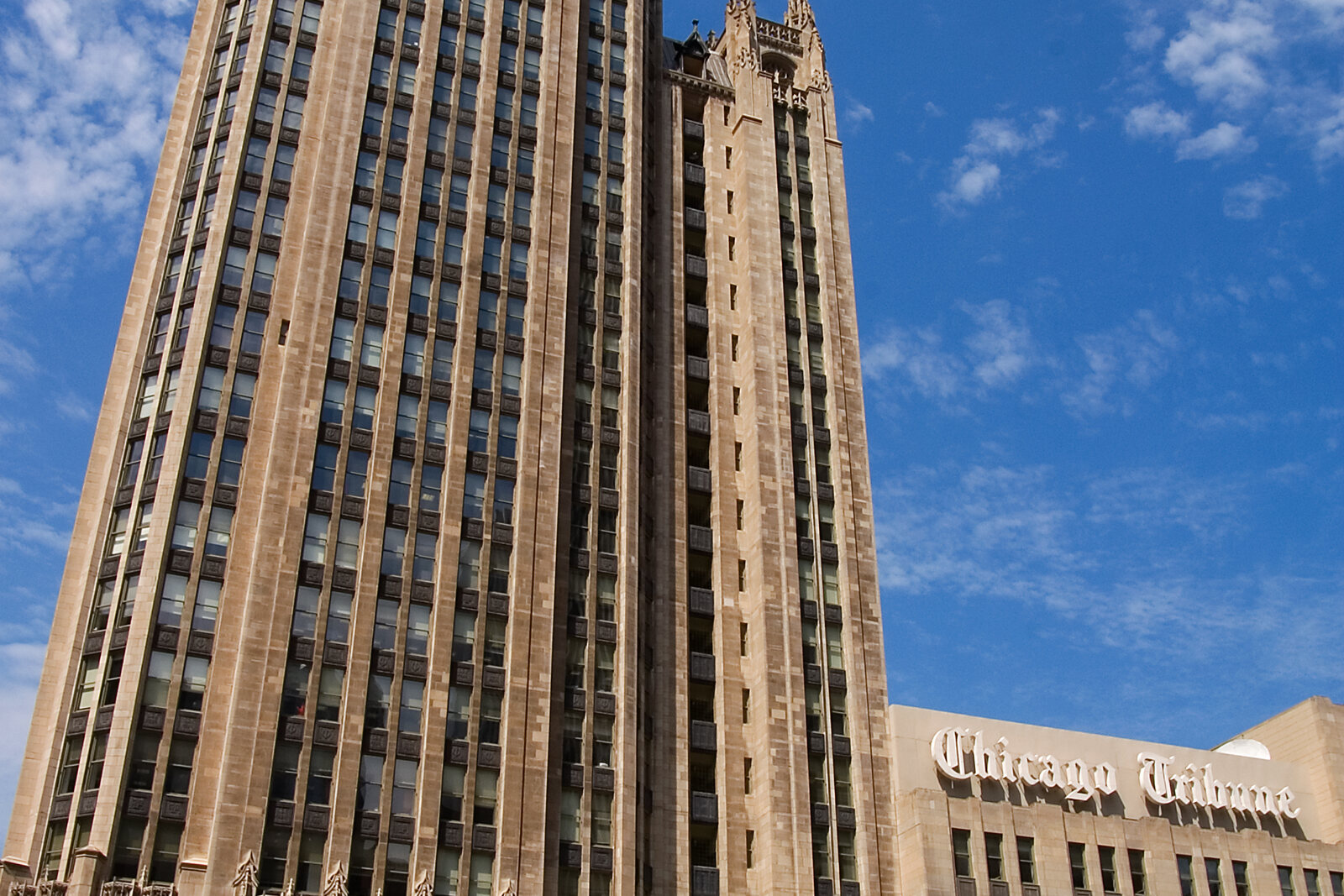
Look around first
What to notice
- Gothic crown
- Flying buttresses
- Stone howling dog
- Figurine of Robin Hood
The story of the place
The name “Tribune” remains from the newspaper whose editors, journalists, and managers occupied this tower by the north exit from the bridge for nearly a century. The publication's printing building already stood nearby, while the tall building brought editorial offices and business offices together under one roof. Above the ordinary office floors rises a Gothic crown with flying buttresses, like those of a medieval cathedral tower. The newspaper has long since gone: the editorial floors were converted into apartments, but a howling dog and Robin Hood still hide in the stone ornament by the entrance.
By age forty-one, New York architect Raymond Hood, one of the future designers of the Tribune Tower standing here, was still struggling to find commissions. To earn money, he designed radiator covers and entered competitions. In nineteen twenty-two, architect John Mead Howells received an invitation to compete for a new Chicago skyscraper and asked Hood to lead the project.
The clients were Robert R. McCormick and Joseph Medill Patterson, publishers and editors of the Chicago Tribune. The newspaper was turning seventy-five. Its printing building already stood here, by the north exit from the bridge, and next to it there was a need for a headquarters with an editorial office and business offices. McCormick and Patterson decided to turn the choice of architect into an international event: they promised a total of one hundred thousand dollars for the design of “the most beautiful office building in the world.” Half that sum was intended for the winner.
More than two hundred sixty designs arrived from twenty-three countries. Architects proposed glass towers, an enormous arch, and even a skyscraper in the shape of a Doric column. Hood and Howells took a more practical approach. They filled the permitted volume with ordinary office floors that could be used or rented out, and placed above them a Gothic crown with flying buttresses, recalling the medieval tower of Rouen Cathedral. The publishers would get both income-producing real estate and a silhouette resembling an old urban symbol.
McCormick and Patterson themselves served on the jury. In December, they awarded first place to Hood and Howells. The winners received fifty thousand dollars, and their design was built by nineteen twenty-five. For Hood, this commission ended years of professional uncertainty: after the Chicago victory, he began receiving commissions for major office towers.
The building's name directly states its original occupation. The Tribune was the newspaper whose editors, journalists, and managers worked here for nearly a century. In two thousand eighteen, the newspaper moved out, and the former editorial floors were converted into private apartments. It is now a residential building, although the former owner's name remains on the tower.
Hood and Howells left their own signatures by the main entrance. A howling dog is hidden in the stone ornament of one corner—an English play on the surname Howells—and a figurine of Robin Hood stands in the other. There are no longer any newspaper offices behind the facade, but the two architects whose competition gave them the major commission of their lives are still marked above the door.
Useful on site
Exterior viewing daily; interior areas are private or subject to the building's current rules.
Checked: June 29, 2026. Check the official source before visiting.The stone collection is easiest to examine up close without blocking the entrances. The tower has become residential, so the account does not require visiting the interior.