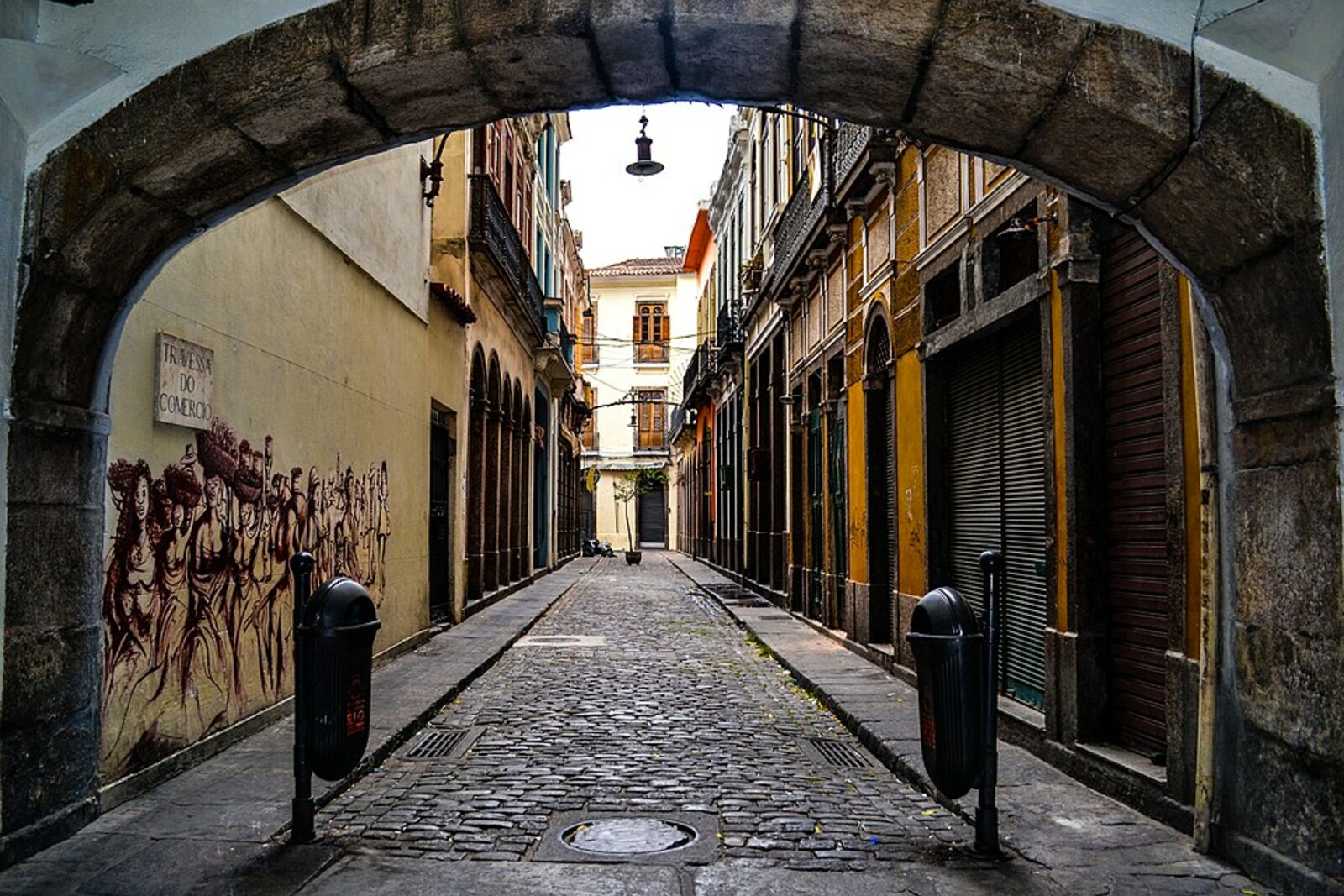
Arco do Teles and Travessa do Comércio History Arco do Teles and Travessa do Comércio: story on the “Old Rio Center: Empire, Trade, and Republic” route The surviving passage will become evidence of an attempt to destroy the city’s rights along with its archive.
Candelária Church History Candelária Church: story on the “Old Rio Center: Empire, Trade, and Republic” route Here, a legend of a maritime vow meets a dispute over ownership that lasted for generations.
Carioca Aqueduct (Lapa Arches) History Carioca Aqueduct (Lapa Arches): story on the “Lapa and Santa Teresa: The Road Uphill” route Here the story of the climb up the hill begins, and the first change in the purpose of an urban structure becomes visible.
Cinelândia and Theatro Municipal History Cinelândia and Theatro Municipal: story on the “Old Rio Center: Empire, Trade, and Republic” route The finale will compare the district of mass cinema with the theater that did not fulfill its original promise.
Confeitaria Colombo History Confeitaria Colombo: story on the “Old Rio Center: Empire, Trade, and Republic” route The confectionery will show how tolerance for a not-very-prosperous group turned into publicity for the city.
Escadaria Selarón History Escadaria Selarón: story on the “Lapa and Santa Teresa: The Road Uphill” route This stop will show how one person's work became a city street and a protected work.
Largo da Carioca and Rua da Carioca History Largo da Carioca and Rua da Carioca: story on the “Old Rio Center: Empire, Trade, and Republic” route The square links a vanished water source, a newspaper stunt, and a city refrain.
Largo de São Francisco da Prainha History Largo de São Francisco da Prainha: story on the “Little Africa and Port Rio” route This stop will bring the vanished shoreline back to the neighborhood and show the cost of defending Rio de Janeiro in 1710.
Largo do Curvelo History Largo do Curvelo: story on the “Lapa and Santa Teresa: The Road Uphill” route Here, the tram's story will shift from the convenience of the climb to the cost of a technical error and a long restoration.
Largo dos Guimarães History Largo dos Guimarães: story on the “Lapa and Santa Teresa: The Road Uphill” route The final stop brings together the road, the tram, and the estate divided into plots.
Mauá Square History · built 1910 Mauá Square: story on the “Little Africa and Port Rio” route It will trace the former shoreline and explain why the first railway journey began where there were no rails.
Museu da Chácara do Céu History Museu da Chácara do Céu: story on the “Lapa and Santa Teresa: The Road Uphill” route This stop will explain how the collector prepared his house in advance for its transformation into a museum.
Museum of Tomorrow History Museum of Tomorrow: story on the “Little Africa and Port Rio” route The pier makes it possible to trace how an underused port platform was turned into a museum without a ready-made answer about the future.
Paço Imperial History Paço Imperial: story on the “Old Rio Center: Empire, Trade, and Republic” route This stop will show how a city petition changed the position of a prince and the palace itself.
Parque Glória Maria History Parque Glória Maria: story on the “Lapa and Santa Teresa: The Road Uphill” route Here, a private salon will link music from the beginning of the last century with a contemporary cultural space.
Pedra do Sal History Pedra do Sal: story on the “Little Africa and Port Rio” route Here port labor and courtyard processions come together in the prehistory of samba schools.
Praça XV and Mestre Valentim Fountain History Praça XV and Mestre Valentim Fountain: story on the “Old Rio Center: Empire, Trade, and Republic” route Here, the old shoreline will connect the city water system, the port, and the labor of water carriers.
Pretos Novos Cemetery History Pretos Novos Cemetery: story on the “Little Africa and Port Rio” route The finale brings the port's larger history inside a house where an ordinary renovation was halted by a discovery beneath the floor.
Rio Art Museum (MAR) History Rio Art Museum (MAR): story on the “Little Africa and Port Rio” route A municipal collection, not envisioned in the museum's original plan, will appear here.
Rua do Ouvidor and Church of Our Lady of Lapa of the Merchants History Rua do Ouvidor and Church of Our Lady of Lapa of the Merchants: story on the “Old Rio Center: Empire, Trade, and Republic” route This stop explains how a difference in wealth divided the worshippers of a single image.
Valongo Hanging Garden History Valongo Hanging Garden: story on the “Little Africa and Port Rio” route The garden will explain where the decoration from the disappearing wharf was moved during the redevelopment of the port district.
Valongo Wharf History · built 1811 Valongo Wharf: story on the “Little Africa and Port Rio” route The excavated site reveals two versions of the shoreline, laid one above the other.
America Football Club History AquaRio History Avenida Almirante Silvio de Noronha (Rio de Janeiro) Streets and squares Avenida Infante Dom Henrique Streets and squares Avenida Rio Branco Streets and squares Nearest audio-route stop: Confeitaria Colombo — 130 m in a straight line, route Old Rio Center: Empire, Trade, and Republic
Avenida Rodrigues Alves Streets and squares Basilica of the Immaculate Conception Sacred sites Baths of King João VI at Caju Museums Brazilian Academy of Letters Museums Brazilian Historic and Geographic Institute Museums Buraco do Lume Streets and squares Nearest audio-route stop: Confeitaria Colombo — 90 m in a straight line, route Old Rio Center: Empire, Trade, and Republic
Campo de Santana Streets and squares Candelária Church Sacred sites Nearest audio-route stop: Candelária Church — 120 m in a straight line, route Old Rio Center: Empire, Trade, and Republic
Carmen Miranda Museum Museums Casa da Marquesa de Santos History Castelinho do Flamengo History Catete Palace History Cemitério dos Ingleses History Centro Nacional de Folclore e Cultura Popular Museums Christ Church, Rio de Janeiro Sacred sites Christ the Redeemer History Church and Convent of Saint Teresa Sacred sites Nearest audio-route stop: Escadaria Selarón — 110 m in a straight line, route Lapa and Santa Teresa: The Road Uphill
Church of Our Lady of Lapa dos Mercadores Sacred sites Nearest audio-route stop: Rua do Ouvidor and Church of Our Lady of Lapa of the Merchants — 80 m in a straight line, route Old Rio Center: Empire, Trade, and Republic
Church of Our Lady of the Conception and Good Death Sacred sites Church of Our Lady of the Rosary of the Black People and Saint Benedict Sacred sites Church of Saint Francis of Paola Sacred sites Nearest audio-route stop: Largo da Carioca and Rua da Carioca — 150 m in a straight line, route Old Rio Center: Empire, Trade, and Republic
Church of Saint Francis of Prainha Sacred sites Nearest audio-route stop: Largo de São Francisco da Prainha — 60 m in a straight line, route Little Africa and Port Rio
Church of Saint Joseph Sacred sites Nearest audio-route stop: Paço Imperial — 140 m in a straight line, route Old Rio Center: Empire, Trade, and Republic
Church of Saint Lucy Sacred sites Church of the Blessed Sacrament Sacred sites Church of the Holy Cross of the Military Sacred sites Nearest audio-route stop: Rua do Ouvidor and Church of Our Lady of Lapa of the Merchants — 40 m in a straight line, route Old Rio Center: Empire, Trade, and Republic
Church of the Order Terceira do Carmo Sacred sites Nearest audio-route stop: Rua do Ouvidor and Church of Our Lady of Lapa of the Merchants — 100 m in a straight line, route Old Rio Center: Empire, Trade, and Republic
Church of the Third Order of Saint Francis of Penitence Sacred sites Cinelândia District Streets and squares Nearest audio-route stop: Cinelândia and Theatro Municipal — 110 m in a straight line, route Old Rio Center: Empire, Trade, and Republic
Civil Police Museum Museums Convent of Santo Antônio Sacred sites Earth Sciences Museum Museums Espaço Cultural da Marinha Museums Estádio das Laranjeiras With children Estádio General Severiano With children Flamengo Park Parks Fort Coligny History Fortaleza de Nossa Senhora da Conceição History Fortaleza de São João History Galeota Real History Good Jesus of Coluna church Sacred sites Guanabara Palace History Gustavo Capanema Palace History Historic Garden of Catete Palace Parks Igreja de Nossa Senhora da Glória do Outeiro Sacred sites Igreja de Nossa Senhora do Terço Sacred sites Igreja de Santa Mártir Zenaide Sacred sites Igreja de Santo Elesbão e Santa Efigênia Sacred sites Igreja de São Gonçalo Garcia e São Jorge Sacred sites Igreja Nossa Senhora do Carmo da Lapa do Desterro Sacred sites Igreja Nossa Senhora Lampadosa, cidade do Rio de Janeiro, Brasil Sacred sites Igreja Nossa Senhora Mãe dos Homens (Rio de Janeiro) Sacred sites Igreja São João Batista da Lagoa Sacred sites Igreja São Judas Tadeu, Rio de Janeiro Sacred sites Ilha da Laje Parks Ilha das Cobras Parks Ilha das Enxadas Parks Ilha Fiscal History Instituto Benjamin Constant History Instituto de Pesquisa e Memória Pretos Novos Museums Nearest audio-route stop: Pretos Novos Cemetery — 10 m in a straight line, route Little Africa and Port Rio
Laranjeiras Palace History Largo da Misericórdia Streets and squares Largo da Prainha Streets and squares Nearest audio-route stop: Largo de São Francisco da Prainha — 10 m in a straight line, route Little Africa and Port Rio
Largo de São Francisco de Paula Streets and squares Largo do Boticário Streets and squares Largo do Machado Streets and squares Largo dos Leões Streets and squares Leopoldina Station History Marak'anà Village Museums Monument to the dead of World War II History Monumento ao Almirante Barroso History Mosteiro de São Bento Sacred sites Museu Casa de Rui Barbosa Museums Museu da Chácara do Céu Museums Nearest audio-route stop: Parque Glória Maria — 10 m in a straight line, route Lapa and Santa Teresa: The Road Uphill
Museu da Imagem e do Som do Rio de Janeiro Museums Museu Internacional de Arte Naïf do Brasil Museums Museu Militar Conde de Linhares Museums Museu Nacional Museums Museu Nacional de Belas Artes Museums Museu Nacional dos Povos Indígenas Museums Museu Penitenciário do Estado do Rio de Janeiro Museums Museu Villa-Lobos Museums Museum Dom João VI Museums Museum of Astronomy and Related Sciences Museums Museum of Modern Art, Rio de Janeiro Museums Museum of the Republic Museums Museum of Tomorrow Museums Nearest audio-route stop: Museum of Tomorrow — 10 m in a straight line, route Little Africa and Port Rio
National Historical Museum Museums Naval Museum Museums Nearest audio-route stop: Paço Imperial — 40 m in a straight line, route Old Rio Center: Empire, Trade, and Republic
Old Cathedral of Rio de Janeiro Sacred sites Nearest audio-route stop: Rua do Ouvidor and Church of Our Lady of Lapa of the Merchants — 120 m in a straight line, route Old Rio Center: Empire, Trade, and Republic
Paço Imperial Museums Nearest audio-route stop: Paço Imperial — 120 m in a straight line, route Old Rio Center: Empire, Trade, and Republic
Palace of Conde dos Arcos History Palace of Itamaraty History Palácio de São Clemente History Palácio Episcopal (Rio de Janeiro) History Paris Square Streets and squares Paróquia Matriz de Nossa Senhora da Glória Sacred sites Parque Guinle Parks Passeio Público Parks Pedro Ernesto Palace History Praça da Cruz Vermelha Streets and squares Praça da Harmonia Streets and squares Nearest audio-route stop: Pretos Novos Cemetery — 140 m in a straight line, route Little Africa and Port Rio
Praça dos Estivadores Streets and squares Nearest audio-route stop: Valongo Hanging Garden — 80 m in a straight line, route Little Africa and Port Rio
Praça José de Alencar Streets and squares Praça Marechal Âncora Streets and squares Praça Mauá Streets and squares Nearest audio-route stop: Mauá Square — 60 m in a straight line, route Little Africa and Port Rio
Praça São Salvador Streets and squares Praça Tiradentes Streets and squares Praça XV de Novembro Streets and squares Nearest audio-route stop: Paço Imperial — 100 m in a straight line, route Old Rio Center: Empire, Trade, and Republic
Presbyterian Cathedral of Rio of Janeiro Sacred sites Nearest audio-route stop: Largo da Carioca and Rua da Carioca — 140 m in a straight line, route Old Rio Center: Empire, Trade, and Republic
Quinta da Boa Vista Parks Restaurante Albamar (torreão do antigo Mercado Municipal) History Rio Art Museum Museums Nearest audio-route stop: Rio Art Museum (MAR) — 30 m in a straight line, route Little Africa and Port Rio
Rio de Janeiro Cathedral Sacred sites Rio Star History Rua da Carioca Streets and squares Nearest audio-route stop: Largo da Carioca and Rua da Carioca — 10 m in a straight line, route Old Rio Center: Empire, Trade, and Republic
Sambadrome Marquês de Sapucaí Streets and squares Sanctuary of Saint Rita of Cascia Sacred sites Santa Casa da Misericórdia and Church of Our Lady of Good Success Sacred sites Santa Teresa Tram History Nearest audio-route stop: Carioca Aqueduct (Lapa Arches) — 30 m in a straight line, route Lapa and Santa Teresa: The Road Uphill
St Anthony Parish of the Poor Sacred sites Teatro Carlos Gomes History Templo em Ruinas ou de Apolo Sacred sites Tiradentes Palace History Nearest audio-route stop: Paço Imperial — 90 m in a straight line, route Old Rio Center: Empire, Trade, and Republic
Urca History  Guide On Map