 Guide On Map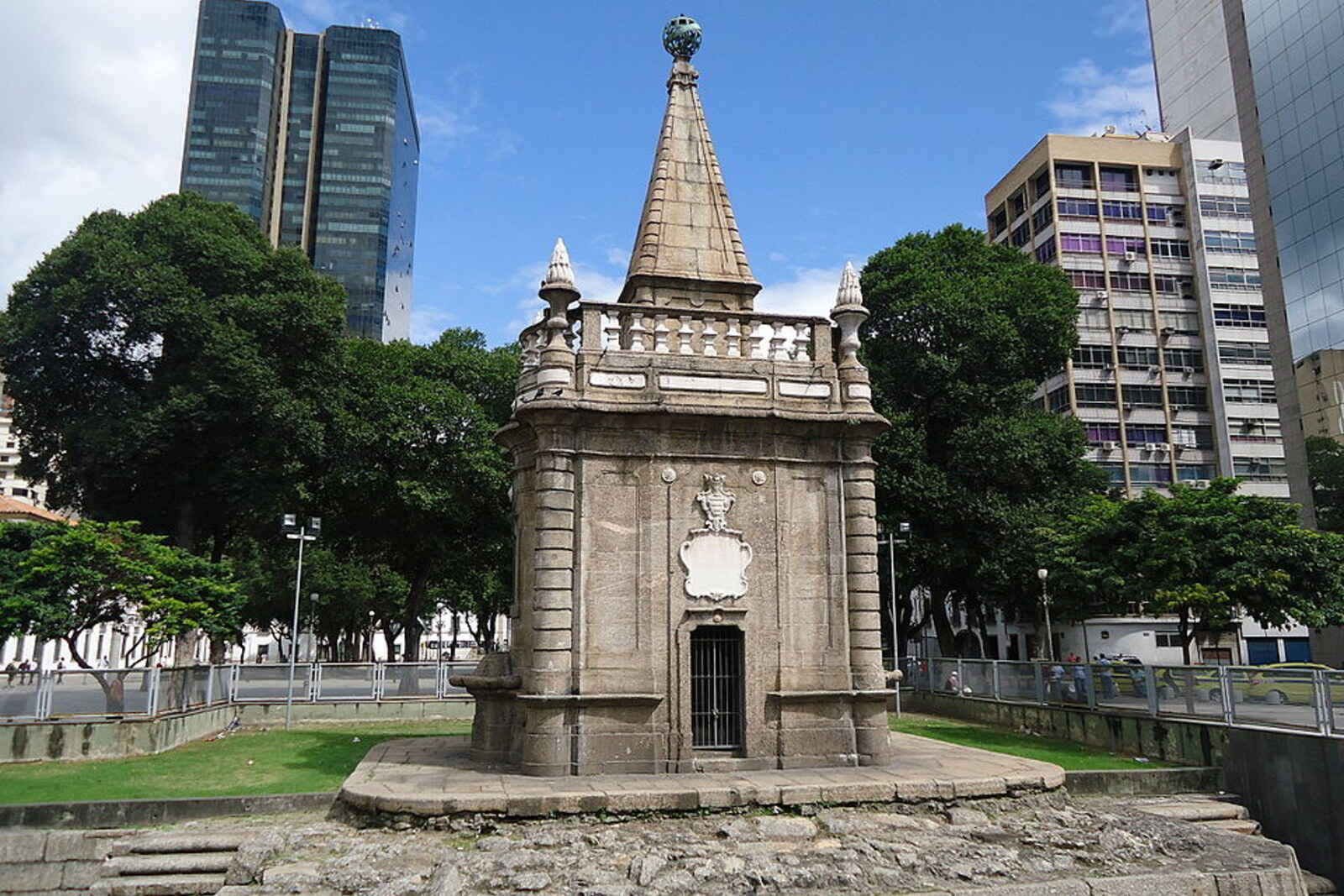
Look around first
What to notice
- White stone tower
- Four-sided pyramid
- Armillary sphere
- Stone steps of the old pier
The story of the place
Stone shells remain on three sides of the white stone tower, where water jets once sprang out. Water from the Carioca River was brought here by aqueduct, then drawn into barrels for homes and ships. The fountain was a place of hard daily work: water carriers distributed water throughout the city and paid their owners a set share of their earnings. Above the shells rise a balustrade, a pyramid, and an armillary sphere, a symbol of the Portuguese Crown.
The white stone tower beneath a four-sided pyramid was built right by the water. When the fountain was completed in seventeen eighty-nine, the sea reached its steps, and vessels moored nearby.
The Portuguese governor Luís de Vasconcelos e Sousa, who governed the colony, wanted to clear the middle of the square for military formations and make it easier to supply ships with fresh water. The old fountain stood in the middle of the square and was worn out. The governor commissioned Valentim da Fonseca e Silva to install a new one by the pier.
Mestre is a Portuguese title for a master. Valentim was born in Minas Gerais to an enslaved woman, Amatilda, moved to Rio de Janeiro, and maintained his own workshop here. He earned his living from church carving and commissions for city structures. Vasconcelos entrusted the Black sculptor with several major works, including this fountain. Water jets emerged from stone shells on three facades; above them, Valentim raised a balustrade and a pyramid with an armillary sphere—an ancient astronomical instrument and a symbol of the Portuguese Crown. The commissions brought him fame, but he did not accumulate a great fortune: after his death, a small house, old tools, and a workshop remained.
Water arrived here from the Carioca River through the aqueduct, today’s Lapa Arches. Another, human part of the water system began at the fountain. Enslaved water carriers filled barrels and carried them to homes; sailors took supplies onto ships. Some water carriers worked under a fee arrangement: the owner demanded a set amount per day or week, they were allowed to keep the remainder, and they could be punished for any shortfall.
A drawing from eighteen twenty-seven preserved a scene at this very fountain: Black water carriers fight beside barrels, and a soldier disperses them. People on whom the city’s daily supply depended gathered here, yet most of them could control neither their earnings nor their own time. The fountain supplied water until the eighteen eighties.
At that time, the square was called Largo do Paço—the square by the palace. In eighteen ninety, the republican government gave it its current name in honor of November fifteenth, eighteen eighty-nine. On that day, Marshal Deodoro da Fonseca led troops against the imperial cabinet at Campo de Santana, in another part of the center. The date was brought here in the name to remove the reminder of the imperial palace.
After the shoreline was filled in, the water receded from the fountain, and the old steps of the pier were buried underground. Archaeologists uncovered them again at the end of the twentieth century. Vessels still leave the neighboring terminal across the bay, while the stone steps beside the tower show where they docked in Mestre Valentim’s time.
Useful on site
The square and fountain are available as public space throughout the day; the site is best viewed in daylight.
Checked: June 17, 2026. Check the official source before visiting.Walk around the fountain and look from it toward the bay: the open space matters more than a single viewpoint.