 Guide On Map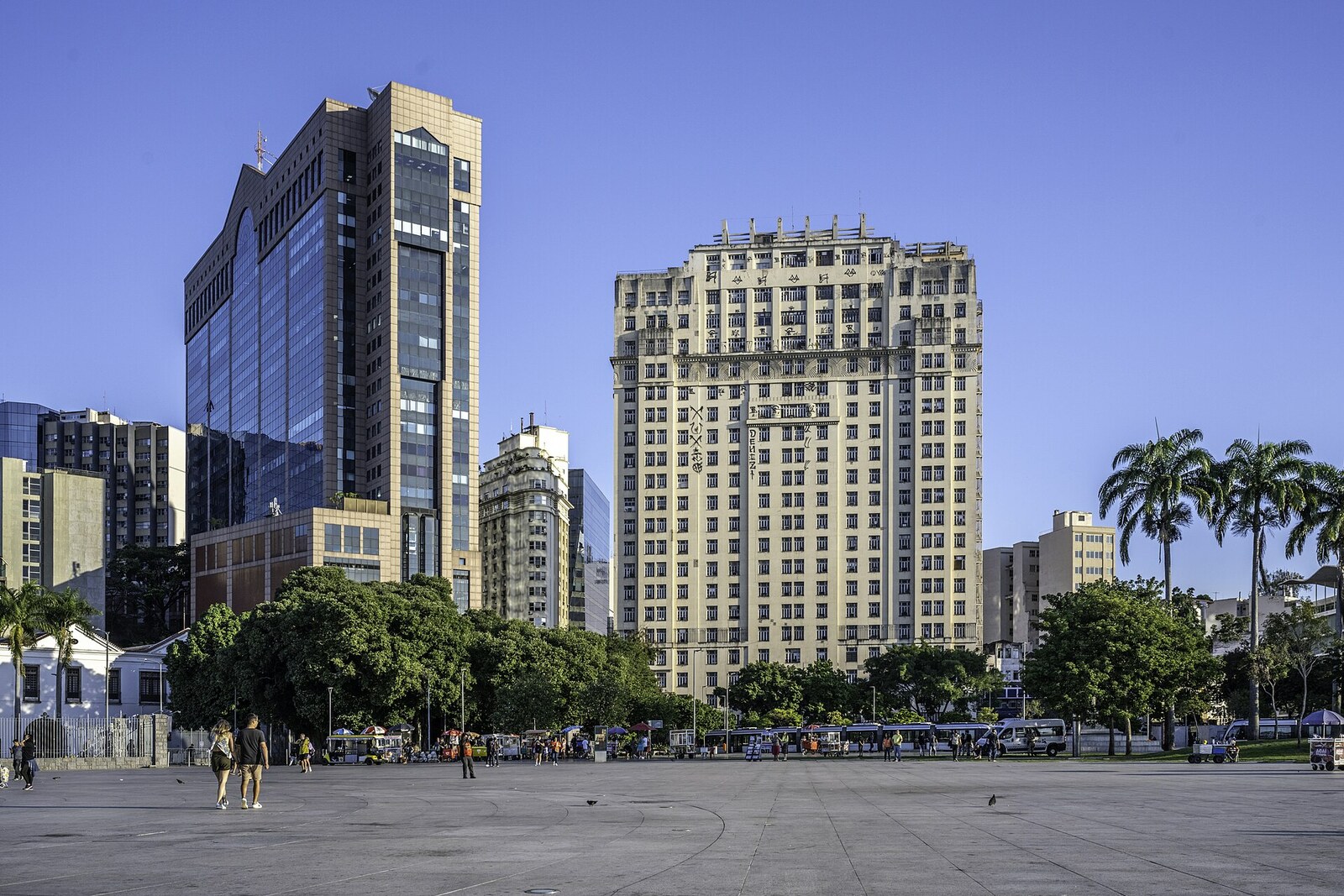
Look around first
What to notice
- Bronze figure of Irineu
- Tall column
- Tram tracks
- Guanabara Bay
The story of the place
Mauá Square occupies an open corner between the port piers and the beginning of Avenida Rio Branco; tram tracks cross it. At the beginning of the twentieth century, the builders of the new port dismantled the old pier and laid out a city square in its place. Today, people pass through here to reach the waterfront and the port's two museums.
Mauá is not the surname of the bronze man on the tall column. His name was Irineu Evangelista de Sousa. Mauá was the title that Brazilian Emperor Pedro II granted him on the day the country's first railway opened. Half a century later, the title became the name of the square from which the whole journey began.
In the middle of the nineteenth century, this was Largo da Prainha—a square by Prainha. The shoreline ran much closer, with warehouses and wooden piers along the water. Irineu, a merchant, banker, and shipowner, wanted to link Rio de Janeiro, the capital, with Petrópolis and the coffee-growing districts beyond the mountains. The railway could not begin in the city center: Guanabara Bay lay between Rio de Janeiro and the foot of the mountain range. So Irineu devised a route in three parts.
In eighteen fifty-two, he received the exclusive right to carry passengers by steamship from Rio de Janeiro to the settlement of Estrela on the opposite shore. Here, his company built Mauá Pier, warehouses, and boarding bridges. The steamship crossed the bay, passengers disembarked near present-day Magé, and transferred to a train. The first fourteen and a half kilometers of rails ran to Fragoso, at the foot of the mountains; from there, they continued up to Petrópolis by carriage.
There were never any rails on the present-day square. But the railway journey began right here—with a ticket and boarding a steamship. Irineu invested his own funds in the enterprise, along with money from shareholders he had brought in. Before him, attempts to build a Brazilian railway had failed for lack of financing; now one owner was responsible for the pier, the vessels, and the train.
On April thirtieth, eighteen fifty-four, on the far shore, Pedro II opened the railway and granted Irineu the title Baron of Mauá, after that port. The following day, the line opened to ordinary passengers, and six months later it began accepting freight. The enterprise was profitable until eighteen sixty-seven, after which a new state railway and a highway took over the main traffic. By the time the rails finally reached Petrópolis itself, the company already belonged to other owners.
Mauá Pier remained here until the beginning of the twentieth century. Then the builders of the new port filled in the old shoreline, straightened the waterfront line, and dismantled the pier in nineteen oh six. On the cleared site, they laid out a square at the start of Avenida Rio Branco. In nineteen ten, Clube de Engenharia installed there a bronze figure of Irineu by Rodolfo Bernardelli. The entrepreneur himself had died twenty-one years earlier.
Today, people cross the square to reach the port piers, the Museum of Tomorrow, and Rio Art Museum (MAR), and tram tracks run across it. Nothing remains of Irineu's pier. His statue stands at the beginning of the avenue, facing the bay, beyond which passengers once transferred from his steamship to Brazil's first train.
Useful on site
Open square; it is more comfortable to explore the site during the day or in the early evening.
Checked: date not specified. Check the official source before visiting.Explore the square on foot, staying clear of the VLT tracks and bicycle traffic; you do not need to enter any buildings for this stop.