 Guide On Map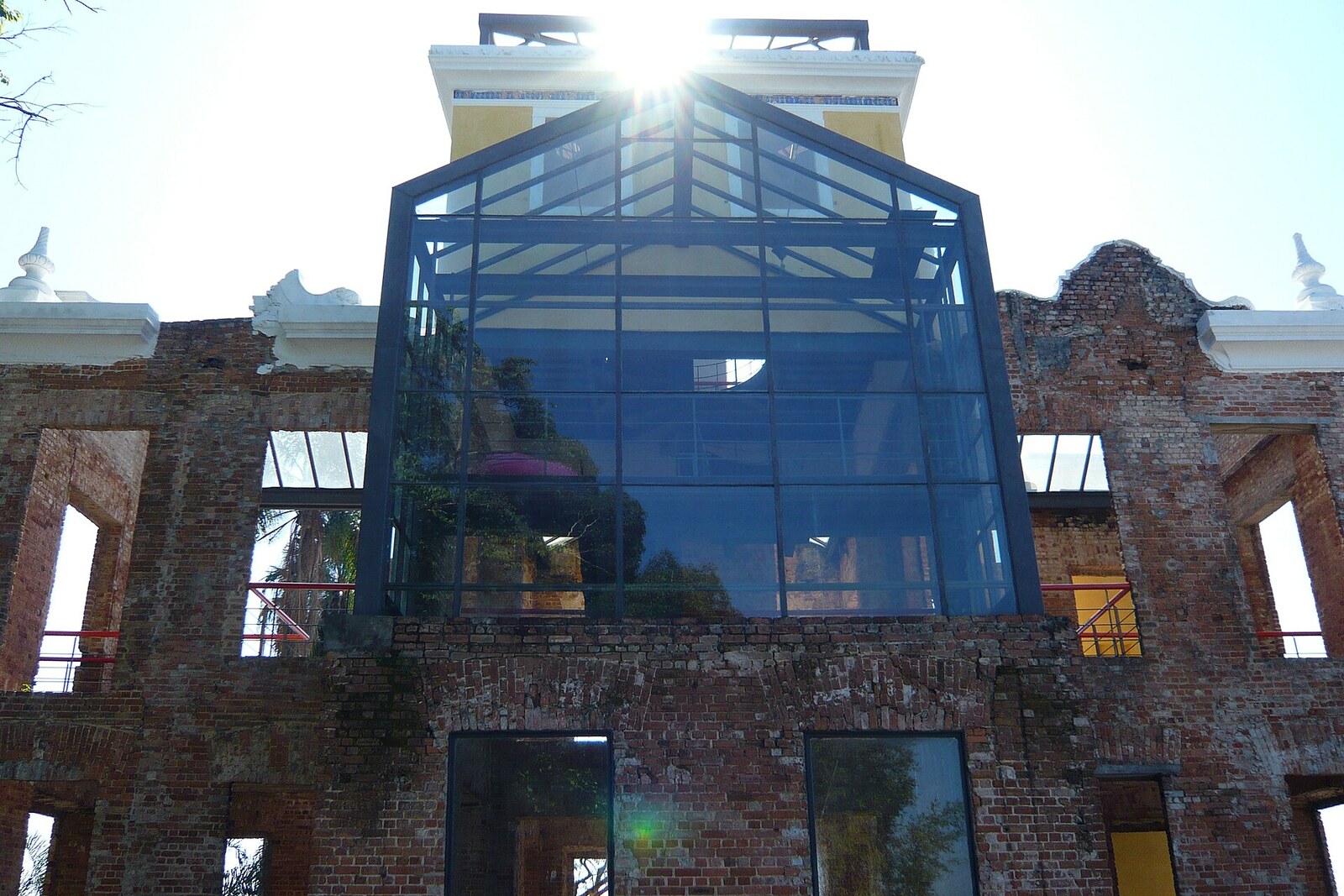
Look around first
What to notice
- Open brick walls
- Steel staircases and walkways
- Glass inserts
- Portrait of Glória Maria
The story of the place
Steel staircases and walkways cut through the old brick masonry, while some of the empty window openings are filled with glass. The architects did not restore the lost rooms: they reinforced the masonry and placed an exhibition hall, a stage, and spaces for concerts between the walls. This is how Parque Glória Maria opened here at the end of the last century. Later, the park was given the name of the journalist Glória Maria, and a four-meter portrait of her was placed in the square.
Only the shell remains of the brick walls of the former mansion. Furniture, paintings, and a grand piano once stood inside, and the hostess decided who would enter these rooms and whom they would meet here.
In nineteen eleven, Laurinda Santos Lobo inherited the house and the enormous fortune of her uncle, Joaquim Murtinho. The money came from family businesses, above all the mate trade. Laurinda could have lived on her inheritance, but she also used it as a patron: she held regular receptions at the mansion with music, poetry, and dancing. Such gatherings were then called salons. For an emerging artist, an invitation meant meeting newspaper critics, diplomats, and people ready to pay for a concert or a trip.
One of the guests was Heitor Villa-Lobos, a composer seeking performances of his new music. In nineteen twenty, he was still earning a living as a cellist in theaters, movie theaters, cafés, and cabarets. Laurinda organized concerts of his works and became part of the circle of wealthy patrons raising money for his work and travel.
In nineteen twenty-one, Villa-Lobos dedicated Quartet — Impressions of Secular Life to her, for female voices, flute, saxophone, celesta, and harp. Its premiere took place in the hall of the newspaper Jornal do Commercio, not in this house. But it was in the salon here that the composer received the support and listeners without whom a public concert might never have happened. Already in February nineteen twenty-two, the same Quartet was performed at Modern Art Week in São Paulo, and in May nineteen twenty-four, in Paris under the composer's direction. The dedication to Laurinda remained in the score.
After Laurinda's death in nineteen forty-six, the receptions stopped. She had no children; she left the house and collection to a homeopathic society, which was unable to maintain the property. The mansion stood empty, was looted, and was occupied by outsiders. By the nineteen nineties, all that remained of the salons were walls with empty openings.
Architects Ernani Freire and Sônia Lopes did not reinvent the lost interiors. They reinforced the old masonry with steel, ran staircases and walkways through it, and closed some of the openings with glass. In nineteen ninety-seven, Parque Glória Maria opened here with an exhibition hall, a stage, and spaces for concerts. The word “ruins” was a literal name for the building material the architects preserved.
Officially, the park now bears the name of Glória Maria. She did not live in the mansion, though she worked here once: she filmed the two thousand eleven television Retrospectiva. Glória Maria was a Black Brazilian journalist who, in nineteen seventy-seven, presented the country's first live color television report—from Avenida Brasil, where she showed a traffic jam. Her appearance on screen opened the profession to viewers who had previously scarcely seen Black women in the role of television reporter.
A few months after the journalist's death, in two thousand twenty-three, the city gave this popular cultural park her name, directly naming as the reason her contribution to journalism and her importance to several generations of Black women. Later, a four-meter portrait of Glória Maria holding a globe was installed in the square. Behind it rise the open walls of Laurinda Santos Lobo's salon.
Useful on site
Access inside depends on the park's current operations, which are best checked in advance. In the open areas, stay on the marked paths and keep in mind that the stairs and walkways may be uncomfortable if you are afraid of heights.