 Guide On Map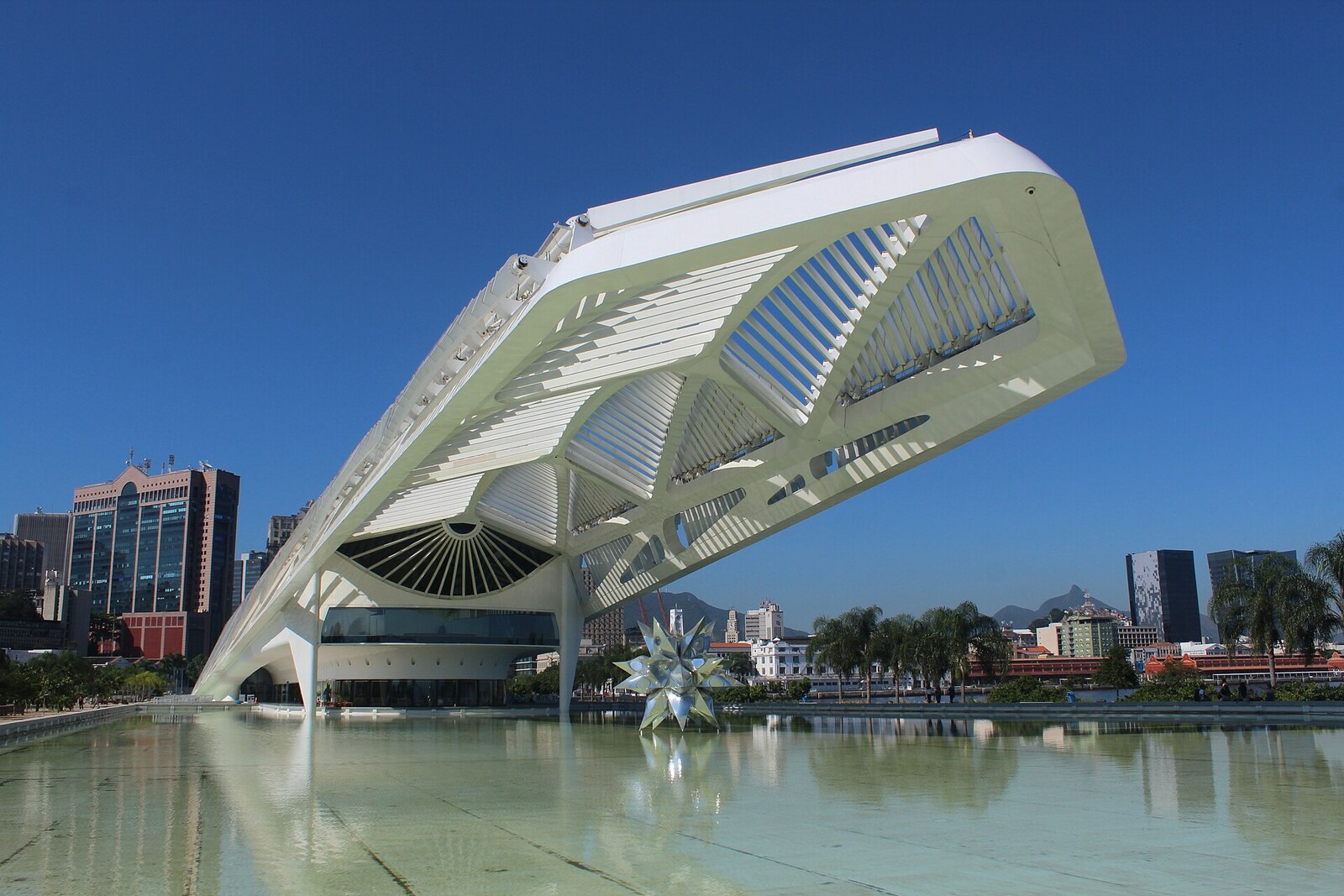
Look around first
What to notice
- The long white building
- Movable roof panels
- The concrete pier
- São Bento Monastery
The story of the place
On the vacant port pier, the Museum of Tomorrow stretches out as a long white building: water comes up to it from three sides, while the line of sight toward São Bento Monastery remains open. No tall tower was built here, so the museum lies almost along the quay; panels move across the roof, turning with the sun. Water from the bay is drawn in to cool the building, purified, and returned, while inside, the digital halls constantly receive new scientific data.
The white building stands on a concrete pier built for an event its creator did not live to see. In nineteen forty-eight, engineer Oscar Weinschenk supervised the expansion of the port of Rio de Janeiro. Transatlantic liners carrying foreign football fans were expected here for the World Cup, and Weinschenk designed a new berthing platform for them.
In nineteen forty-nine, the engineer died. The work continued without him, but the pier was not finished in time for the championship. The expected flow of passengers did not materialize either. Builders completed the structure only in nineteen fifty-three, after which the enormous platform remained underused for decades. Later, it was closed because of structural damage. In two thousand two, the pier was officially given Oscar Weinschenk's name, although in the city it is usually called Pier Mauá.
The first Museum of Tomorrow project was to be housed in two port warehouses. In two thousand nine, the organizers moved it to the vacant pier. Architect Santiago Calatrava received a long strip of land surrounded by water on three sides, along with the requirement to keep the view of São Bento Monastery open. So he did not build the museum upward, but stretched it out along the quay. Engineers built movable panels into the roof, designed to turn with the sun, and water from the bay began to be drawn in to cool the building, filtered, and returned.
A more difficult question had to be resolved before the opening: what to exhibit in a museum devoted to a time that has not yet arrived. Luiz Alberto Oliveira was responsible for the content—a physicist and cosmologist, a researcher at the Brazilian Center for Research in Physics, and a teacher of the history and philosophy of science. From two thousand ten onward, he argued that this place should not predict a ready-made future. Any such forecast could become outdated before the exhibition itself.
Oliveira and the invited scientists chose a different principle: to show causal connections over the next fifty years. Different decisions produce different consequences, so this place speaks not of one tomorrow, but of several possible ones. Visitors are led through five questions: where we came from, who we are, where we are, where we are headed, and how we want to get there. In the section on the present, human activity is considered a force on a planetary scale; farther on, interactive models allow visitors to change the initial conditions and obtain different scenarios.
To keep the content from becoming fixed, the staff linked the digital display cases to data from research centers. In the first eleven months after opening, they made more than eighty updates: among other things, they added new information about the human microbiome and the detection of gravitational waves. One million people came here in eight months, although the original estimate was about half a million visitors a year. According to the first surveys, about one hundred thousand of them had never visited museums before.
At the end of the main exhibition, the curators nevertheless placed one material object—an Australian churinga, a carved wooden plaque from the eighteenth to nineteenth centuries. Through such objects, elders passed on the stories and knowledge of their people to younger generations. The churinga is mounted in the center of the final hall; staff continue to replace the scientific data around it as new research appears. Beneath the hall remains the pier that officially bears engineer Weinschenk's name.
Useful on site
From the outside, it reads as part of the waterfront; for entry, check the museum's hours and tickets.
Checked: date not specified. Check the official source before visiting.First walk around the museum from the outside; it is better to plan the full exhibition as a separate visit and check the entry conditions in advance.