 Guide On Map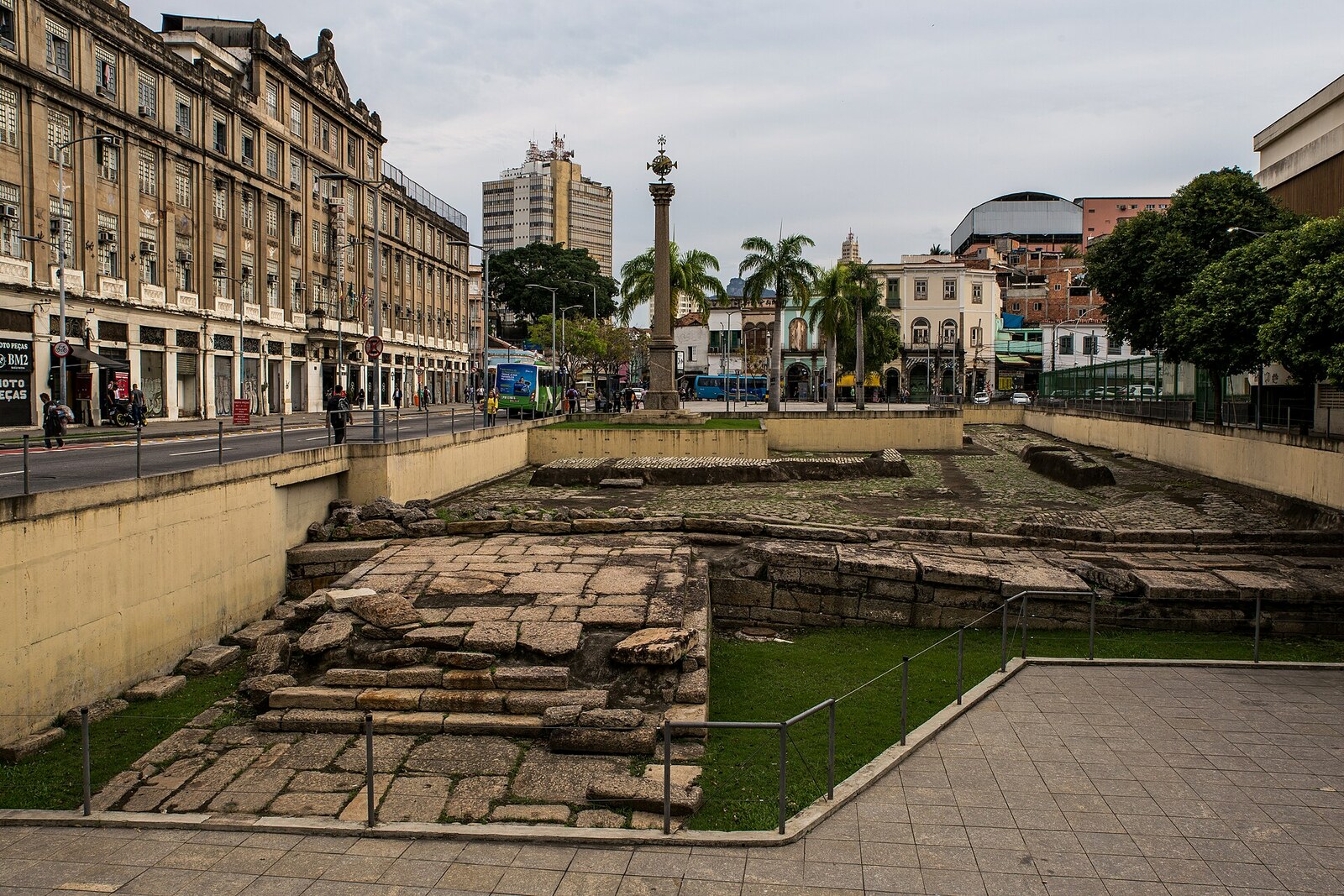
Look around first
What to notice
- Lower paving of rounded stones
- Upper paving of granite slabs
- Stone steps
- Archaeological excavation pit
The story of the place
At the bottom of the archaeological excavation pit, Valongo Wharf survives, built on the low shore between Morro da Conceição and Morro do Livramento. Its rough rounded stones were laid directly on the sand, while steps and a gentle ramp received boats bringing people here after customs inspection. Later, this shore was covered over and a ceremonial entrance for the emperor’s wife was built above it, and in the early twentieth century it was hidden beneath new port fill. The water is now far from here, though these steps once led directly to it.
The lower, uneven paving at this excavated site appeared because traders in human beings were forced to leave Rio’s business center. Until seventeen seventy-four, recently arrived Africans were sold near Rua Direita—today’s Rua Primeiro de Março. City councilors demanded the transfer: they were concerned about disease, exhausted naked people on the main streets, and complaints from wealthy townspeople. The slave traders resisted. They made their living by reselling captives, and their warehouses stood near the customs house and the buyers.
Luís de Almeida, Marquis of Lavradio—the viceroy who sought to remove this market from the center—ended the dispute. His decree gave no one freedom. It changed the route of sale in detail. After registration at the customs house, captives were to be put back into boats and sent to Valongo, “separated from all communication.” Buyers had to come here themselves and then bring no more than four or five purchased people into the city at a time, and only once they were dressed.
Valongo is a shortening of “vale-longo,” meaning “long valley.” This was the name for the low ground between Morro da Conceição and Morro do Livramento. The hills separated it from the city of that time, while the shore allowed small vessels to come alongside. Merchants moved the trade here and filled the street with warehouses where people were kept until inspection and sale.
The name “port of arrival” is sometimes understood too literally. Large slave ships first underwent customs control elsewhere. Africans were brought by boat to the Valongo shore for final unloading. From here, buyers were no longer concerned with their overall journey. Some were taken to mines and plantations, while others were kept as servants or sent to work in the city. By varying estimates, between five hundred thousand and nine hundred thousand people passed through the entire Valongo complex.
Beginning in eighteen eleven, officials of the General Police of the Court began building a permanent stone wharf here. Uneven stones were laid directly on the sand along the curve of the beach; steps and a gentle ramp descended to the water. Small vessels came alongside after customs clearance. In eighteen thirty-one, the importation of people from Africa was banned by law, and this wharf’s official operation ended. Illegal trade continued along other stretches of the coast.
Twelve years later, city officials were preparing a ceremonial reception here for the Neapolitan princess Teresa Cristina, chosen as the wife of the young emperor Pedro II. The old paving was covered with a layer of earth and rubble about sixty centimeters thick. Smooth granite slabs were laid above it, and a new wharf was built. The princess stepped ashore there, after which the wharf received the name Empress's Wharf. The stones on which captives had been unloaded remained beneath her ceremonial entrance.
During construction of the new port in the early twentieth century, workers buried both wharves beneath another fill layer. In nineteen eleven, Praça Jornal do Comércio appeared above them. Archaeologists uncovered the site in two thousand eleven and found the two wharves, one above the other.
The lower rounded stones belong to Valongo Wharf. The smoother upper paving belongs to Empress's Wharf. And the steps that once descended to the water now lie three hundred forty-four meters from the shore.
Useful on site
Open archaeological site; do not step onto the stone remains.
Checked: date not specified. Check the official source before visiting.View the wharf only from the permitted area, and do not step onto the archaeological paving. There is little shelter here, and the nature of the site calls for quiet, respectful behavior.