 Guide On Map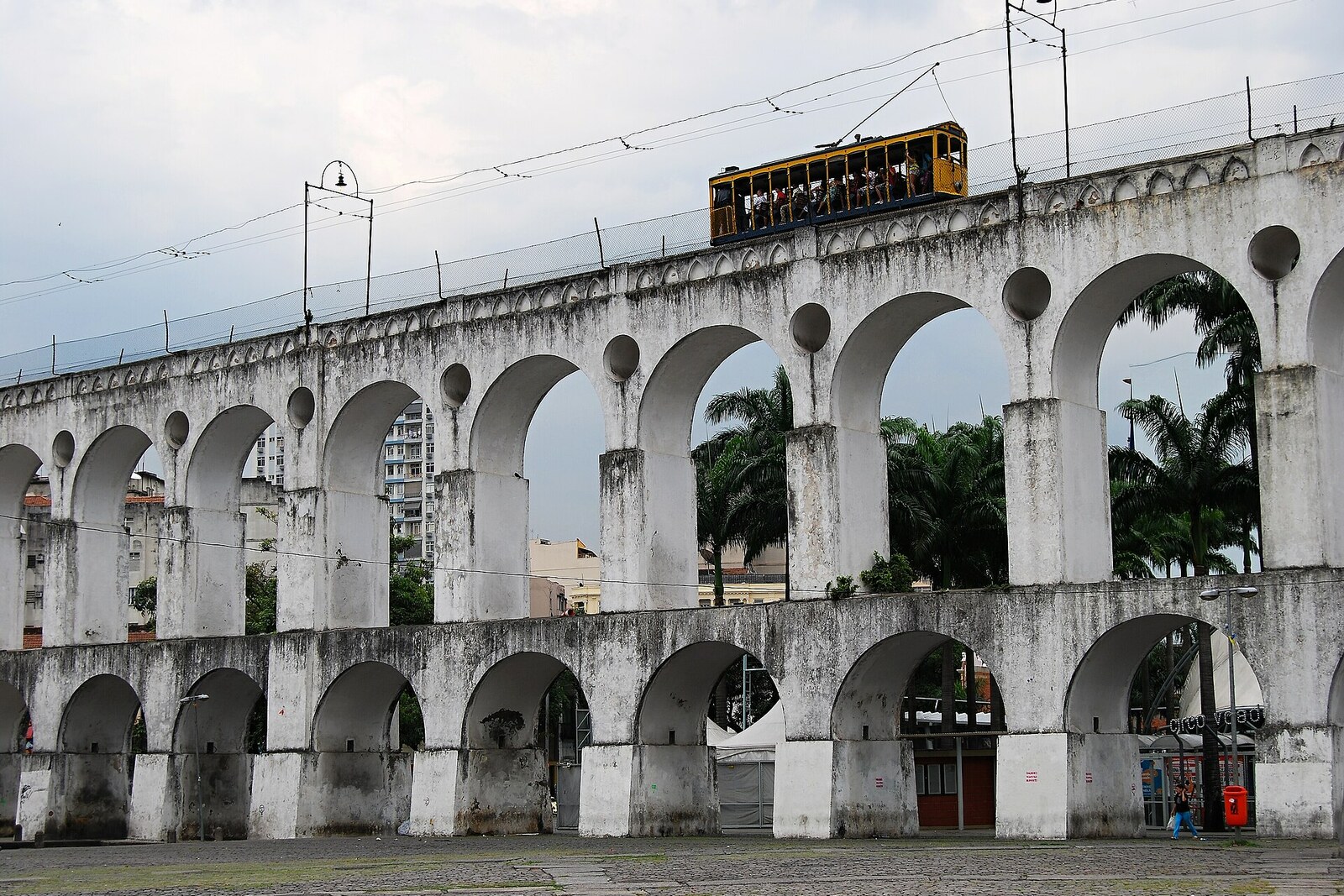
Look around first
What to notice
- Double stone arcade
- Rails on the upper level
- Yellow tram
The story of the place
Two stone rows of arches stand above the square, and a yellow tram runs along the rails at the top. Inside the upper tier, there was once an enclosed brick water channel: it carried water from Santa Teresa Hill across the lowland to the city's fountains. In the colonial city, which grew on drained marshes and lagoons, there were almost no good wells, so enslaved Africans and Indigenous people carried the stone and mortar for this structure. When the old source was no longer enough for the growing city, the former water route became a tram line between the center and the hill.
In eighteen forty-six, the American traveler Thomas Ewbank waited here for horses and a guide to climb Santa Teresa Hill. Within a few minutes, he counted no fewer than two dozen enslaved men and women by the wall of the Convent of Santa Teresa. They filled barrels from pipes projecting from the wall. Some lifted the load onto their shoulders; others pulled a huge barrel on a low wheeled platform. Some carried water back up the slope, from which it had just descended through the aqueduct.
These people delivered water to their owners' homes. The lower part of colonial Rio de Janeiro grew on drained marshes and lagoons, where it was difficult to make good wells. Fresh water came from the Carioca River, which began on the slope of Corcovado. Before the aqueduct appeared, enslaved water carriers had to travel a long distance to the river.
In seventeen forty-four, Gomes Freire de Andrade, governor of colonial Rio de Janeiro, ordered the worn-out channel rebuilt and water carried over the lowland between two hills. To protect against leaks and unauthorized diversions, the channel was enclosed in brick vaults. Enslaved Africans and Indigenous people hauled and laid the stone and mortar.
By seventeen fifty, the present double arcade had appeared: forty-two pairs of spans stretched for about two hundred seventy meters. Along the upper level, water ran from Morro do Desterro—the name then used for Santa Teresa Hill—to Morro de Santo Antônio and farther on, to the public fountain at Largo da Carioca. The structure's official name, the Carioca Aqueduct, came from the river. It came to be called the Lapa Arches after the neighborhood around the Church of Our Lady of Lapa do Desterro.
The aqueduct brought water to the city's fountains, but residents did not get household taps. Water carriers still covered the final stretch. Owners sent enslaved people for every barrel, and the city depended on their daily journeys. The pipes Ewbank saw by the convent wall were part of the same system: a vessel could be filled here without going all the way to the main fountain.
In the second half of the nineteenth century, the population grew, engineers connected new sources, and the old aqueduct was no longer enough. In eighteen ninety-two, the municipality signed a contract with the Ferro-Carril Carioca tram company, which needed to run a direct line between the center and Santa Teresa. The contract specifically stated that the route had to pass along the former aqueduct and that the cars had to switch to electric power.
On September first, eighteen ninety-six, an electric tram crossed the upper level of the arches for the first time. The trip between the center and the hill became much shorter, and country estates along the line began to be divided into urban plots. This is how a route appeared above the square that Santa Teresa residents still use today.
The pipes near which Ewbank saw water carriers are gone, as is the old fountain at Largo da Carioca. What remains is the stone arcade built for water. Along its upper level, where the enclosed channel once ran, rails and yellow trams now pass.
Useful on site
View the structure from the ground and do not step onto the tracks. For a wide view, move far enough away from the arches while staying clear of cars and tram traffic.