 Guide On Map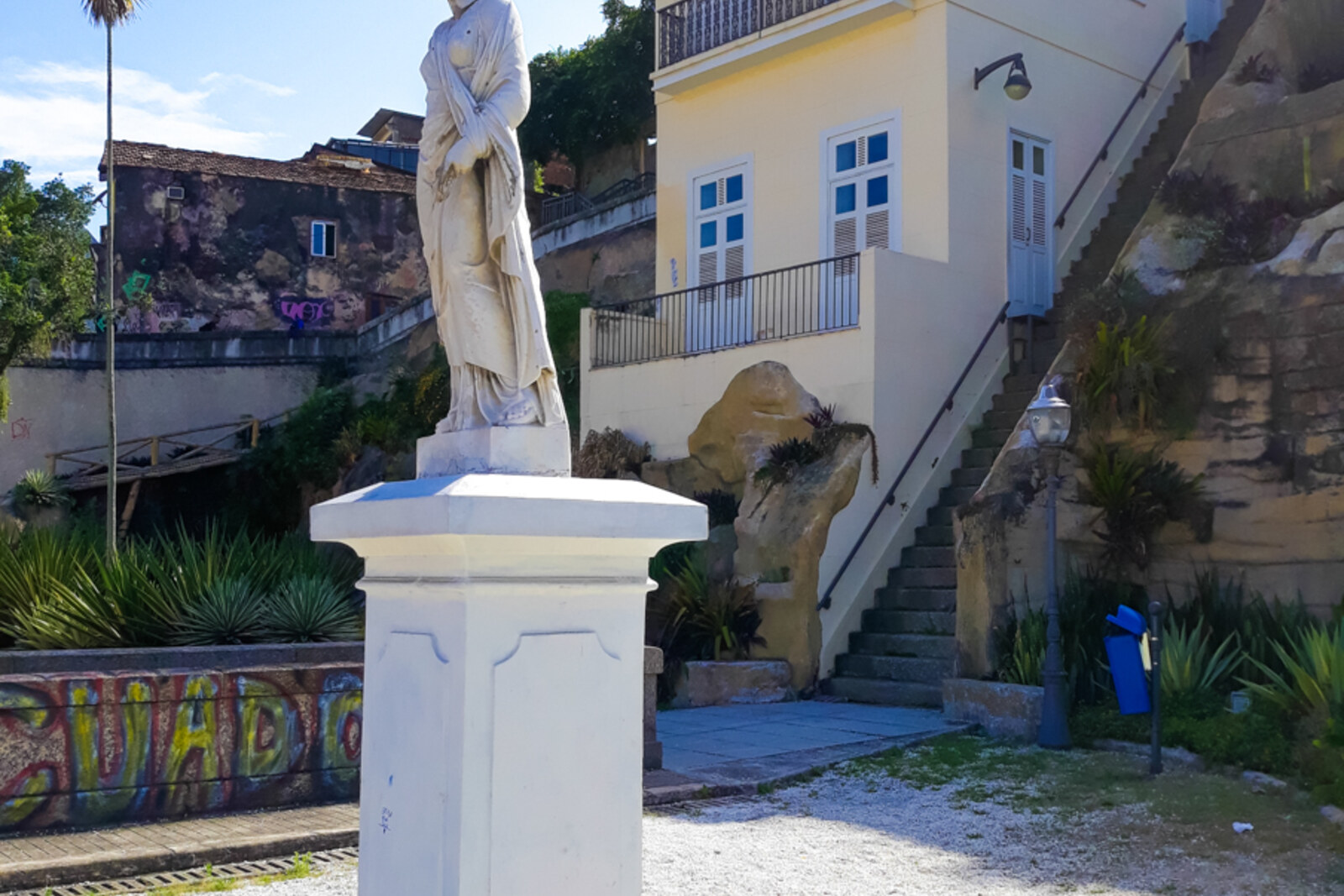
Look around first
What to notice
- Tall retaining wall
- Winding paths
- Artificial cascade
- Four statues
The story of the place
The garden rises seven meters above the street because its foundation was built as a retaining wall. In December nineteen oh three, engineer and mayor Francisco Pereira Passos ordered the former Valongo Street to be made seventeen meters wide. He needed a road along which goods from the new port could be taken to the city center.
Houses, warehouses, and shops stood along the planned line. Owners, residents, and shopkeepers left the buildings affected by expropriation; almost all the development along the section being widened was demolished. At the foot of Morro da Conceição, workers came up against bedrock. They cut away part of the slope, but a steep escarpment remained above the new carriageway: without reinforcement, the soil could slide onto the road.
Passos assigned Jean Louis Rey to design the top of the retaining wall. The Frenchman Rey came to Rio de Janeiro as a draftsman and made a living from designs for municipal gardens. After his supervisor died in nineteen oh five, he took up the post of the city's landscape architect. Now he was to turn the newly cut hillside into a place for strolling.
Rey laid out winding paths above the wall, created flower beds, an irrigation reservoir, and an artificial cascade. Cement was made to look like rough stone—a technique called rocailles. Gas lamps, a caretaker's house, and stairways from the street appeared. The garden opened in nineteen oh six, and Rey remained the city's landscape architect for another five years.
For the new garden, officials took four marble statues from Empress's Wharf, which they were preparing to hide beneath port fill. Ceres, Minerva, Mercury, and Mars were moved here and placed among the paths. This is how the decoration of the disappearing wharf survived; its masonry remained underground, while the figures received a new place above the former Valongo Street.
Later, the originals were taken to Palácio da Cidade. After the garden was restored in two thousand twelve, copies were placed on the pedestals. Beneath them, the retaining wall for which Passos had invited Rey is still there: the flower beds and cascade rest on the structure holding the cut slope above the widened street.
Useful on site
A garden terrace with steps; access on site may depend on the current condition of the gates.
Checked: date not specified. Check the official source before visiting.Access to the terrace may be restricted; if the gates are closed, view the garden from the street. Take care on the steps and decorative stone after rain.