 Guide On Map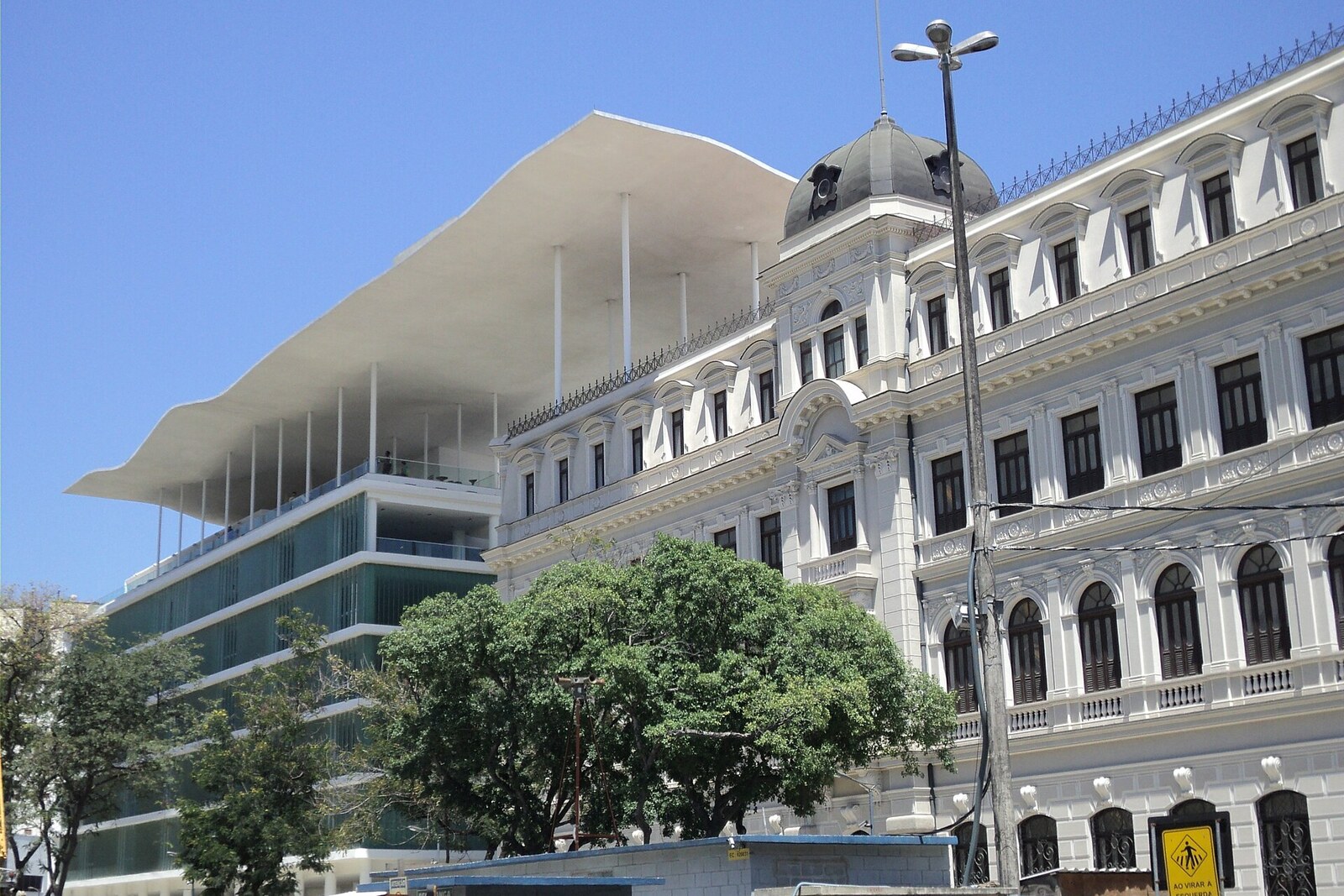
Look around first
What to notice
- Eclectic building
- Modernist building
- Passageway between the buildings
- Undulating concrete roof
The story of the place
Port officials needed a building from which they could manage the new port of Rio de Janeiro. The eclectic building for the inspection of ports, rivers, and canals was constructed between nineteen thirteen and nineteen sixteen, and after the authority closed, it stood empty. The exhibition halls of Rio Art Museum (MAR) are now housed inside it, while in the neighboring modernist building, the School of the Gaze works with teachers, museum mediators, and city residents. The passageway between the buildings is covered by a shared undulating concrete roof.
For more than a year, Paulo Herkenhoff helped create this museum for free. Curatorial work was his profession, but here he remained a volunteer and stressed that he was not seeking a position. Much more important to him was changing the original plan: the organizers intended to open a museum without its own collection—with halls for temporary exhibitions and paintings belonging to others.
Shortly before the opening, Herkenhoff was nevertheless invited to become the first cultural director. He agreed and insisted that the museum begin collecting objects for the city. There was no money to buy a large collection, so the curator turned to artists, gallery owners, and private collectors. They were asked to transfer works permanently, rather than lend them until the end of an exhibition. For the owner, that meant parting with an object; for the museum, accepting the obligation to preserve it and make it accessible to the public.
By March first, two thousand thirteen, when Rio Art Museum (MAR) opened, donors had already transferred or promised to transfer around three thousand works. These were used not to form a chronological sequence of masterpieces, but thematic collections. Alongside paintings were maps, documents on slavery, advertising photographs, postcards, tourist souvenirs, and even a shoeshine box that belonged to a teenager from Maré. This is how Herkenhoff defined this museum's task: to collect everything through which residents imagined Rio de Janeiro and themselves.
The site for such a collection was chosen in the former port district. The eclectic building was constructed between nineteen thirteen and nineteen sixteen for the inspection of ports, rivers, and canals: from here, officials managed the new port of Rio de Janeiro. After the port authority closed, the building stood empty. It was given over to the exhibition halls of Rio Art Museum (MAR), while the neighboring modernist building was given to the School of the Gaze, where teachers, museum mediators, and city residents take part. The buildings were connected by a passageway and covered with a shared concrete wave. In Portuguese, the abbreviation “MAR” means “sea.”
The collection not envisioned in the original plan grew to tens of thousands of objects and became the first art collection created specifically for the municipality of Rio de Janeiro. On the first floor of the former port administration, part of the museum storage is separated off by glass: behind it, staff preserve the objects that Herkenhoff once began collecting for a museum that had not yet opened.
Useful on site
The facade and square are accessible from outside; for museum entry, check the current schedule of Rio Art Museum (MAR).
Checked: date not specified. Check the official source before visiting.The difference between the parts of the complex can be seen from the square; if you are going to the exhibitions, allow extra time and check access separately.