 Guide On Map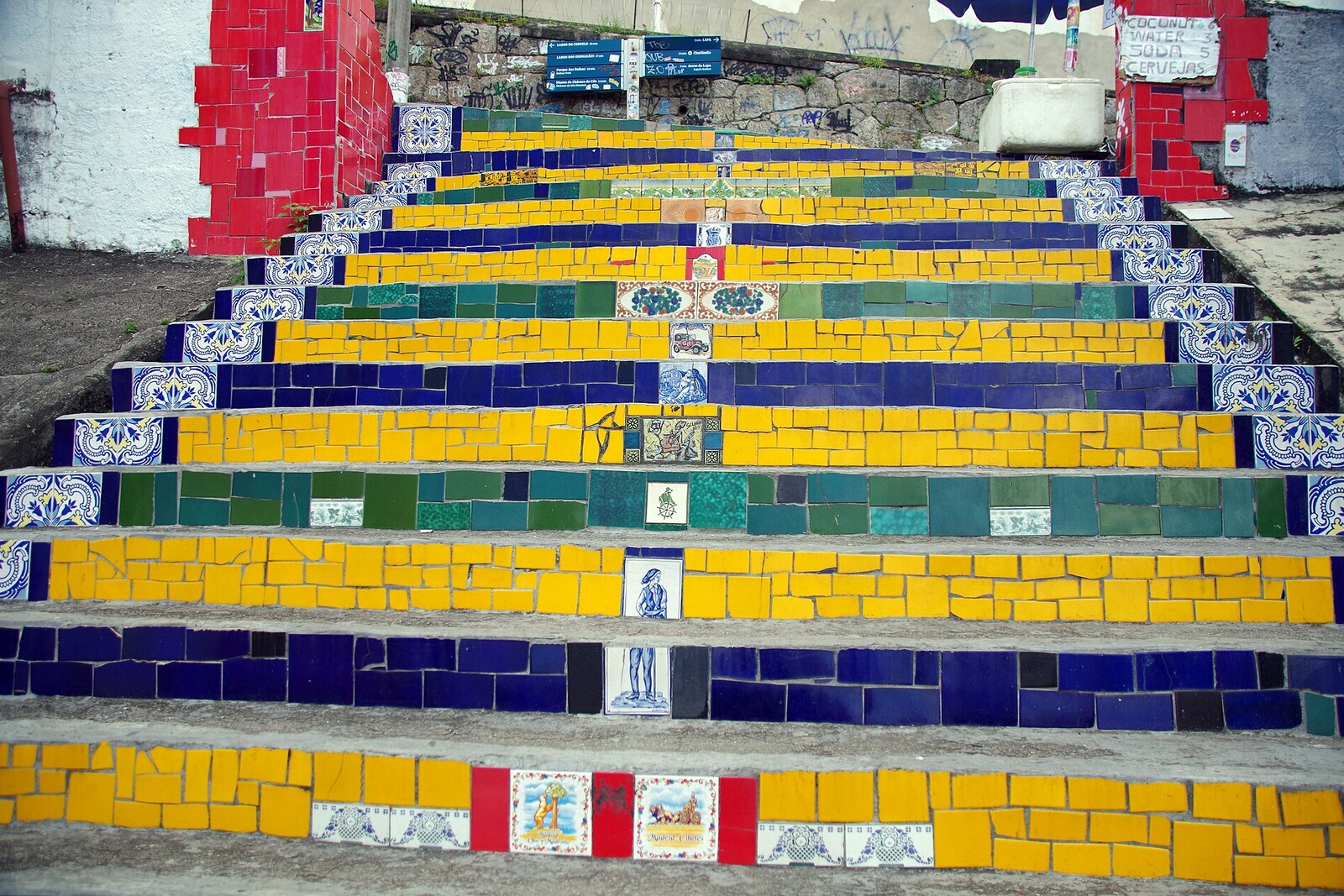
Look around first
What to notice
- Ceramic steps
- Tiles with a female figure
- Coats of arms and city names
- Mosaic walls
The story of the place
Ceramics were brought here from many cities and countries, and earlier pieces of mosaic were removed even after they had been laid. The long staircase between the facades is made up of steps and mosaic walls, so it has never had a single final arrangement. Coats of arms and city names stand beside the recurring female figure; it came from the artist's painting and does not mark the country from which the tile was sent.
These two hundred fifteen steps, one hundred twenty-five meters long, remain a city street: people climb them from Lapa to Santa Teresa while tourists linger by the mosaics. Officially, the passage belongs to Rua Manuel Carneiro. It was once called the staircase of the Convent of Santa Teresa, but Selarón's name became attached to it thanks to the man who lived and worked in one of the houses by the steps.
In nineteen ninety, the Chilean artist Jorge Selarón moved here. He earned money by selling small paintings: he carried them around Lapa's restaurants and offered them to diners right at their tables. The dilapidated staircase ran past his door. Selarón took a bucket of cement and a trowel and began covering the steps with tiles. He had no client, no assistants, and no steady funding either. When he needed materials, the artist sold another painting; the staircase was both taking away his income and bringing buyers to his studio.
At first Selarón used green, yellow, and blue tiles—the colors of the Brazilian flag. Then visitors began sending him ceramics from their cities and countries. He incorporated the gifts, removed earlier fragments, and altered sections that had already been finished. The idea was precisely one of constant reworking: Selarón did not want to fix a single final version.
However, after ten years the artist was troubled that people recognized the staircase but did not see his own painting in it. In an interview, he recalled that the work was already famous, but Selarón's name and his personal mark were not yet on it. He then transferred onto ceramics a figure he had been painting since nineteen seventy-seven—a pregnant dark-skinned woman. When he saw the first such tile after firing, the artist burst into tears. He refused to explain the image's origin and called it only a personal story from the past. These women appeared on hundreds of tiles and linked the street mosaic to the paintings whose sales Selarón used to pay for the work.
In two thousand five, municipal authorities placed both the steps and the mosaic under protection. The document stated separately that tiles could be changed by Selarón himself or by a person with his written permission and with the consent of the city heritage preservation council. That same year, the artist was named an honorary citizen of Rio de Janeiro. Thus, his habit of reworking his own work received legal protection, and the author's surname displaced the old convent name from everyday speech.
Selarón continued replacing and adding fragments until January tenth, two thousand thirteen, when he was found dead on this staircase. The cause of his death remained the subject of conflicting versions. A few months later, specialists from the municipal service measured the steps, facades, and joints, photographed every tile, and transferred even the outlines of individual shards into drawings in order to preserve the final arrangement made by the author.
Among coats of arms, city names, and gift ceramics, the pregnant dark-skinned woman still recurs. It is not a symbol of the country that sent the tile. This is how Jorge Selarón wrote his name into the staircase even before people began calling it Escadaria Selarón.
Useful on site
The staircase remains a passageway, so do not block the steps and let residents pass. Watch your footing, especially after rain, and keep your personal belongings close in the dense crowd.