 Guide On Map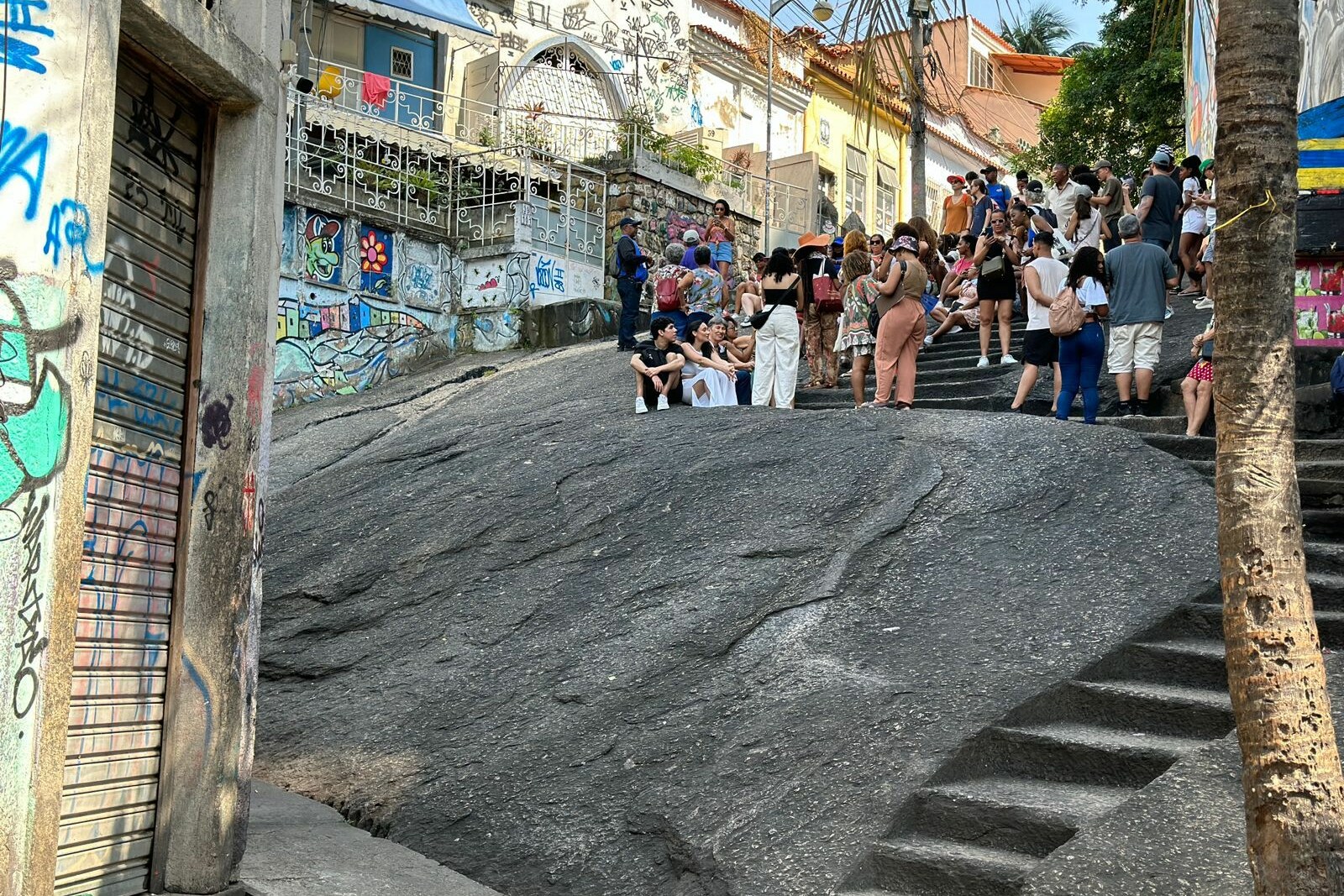
Look around first
What to notice
- Steps cut into the rock
- Hilário’s mosaic portrait
- Rua João Inácio
- Platform at the foot of the rock
The story of the place
When slavery was abolished, freed Black people and migrants from Bahia settled in the houses along this ascent: the port provided work, and nearby housing was inexpensive. Those who ran communal houses gave newcomers lodging for the night, put food before them, and gathered fellow countrymen for ceremonies and celebrations. The ascent runs along a low rock with steps cut into the stone; a platform remains at its foot. Musicians of samba now gather there, and the steps serve as rows for listeners.
Before reclaimed land pushed the shoreline back, the sea reached the foot of this rock. Salt brought from Portugal was unloaded here. Enslaved Africans took sacks off the vessels and carried them to the port warehouses; steps cut into the smooth stone helped them climb. The rock was then called Pedra da Prainha—the Rock by the Little Beach. Trade gave it its present name: Pedra do Sal, the Salt Rock.
The warehouses needed dockworkers, carpenters, and boatmen. It was possible to rent a place nearby cheaply, so after the abolition of slavery, freed Black people and arrivals from Bahia settled here. The women who ran communal houses fed fellow countrymen, gave them lodging, and arranged religious ceremonies and celebrations. Music emerged within this network: the same people worked in the port, took part in services, danced, and organized street processions. Later, port districts with such a dense Black population would be called Little Africa.
One of the arrivals, Hilário Jovino Ferreira, grew up in Salvador and came to Rio de Janeiro to work as a ship carpenter. By day he worked at the Rio de Janeiro Naval Arsenal on Ilha das Cobras, while his first lodging was here, on the ascent to Morro da Conceição, on Rua João Inácio. His earnings depended on hard manual work; he had no house of his own and lived among fellow migrants.
At number seventeen on the street, “Dois de Ouros”—the “Two of Diamonds”—was already gathering. It was a rancho: a festive procession with musicians, costumed participants, and a banner. Such groups came out on January sixth, Epiphany, and reenacted the journey of the three kings to the infant Christ. Hilário joined his neighbors, but soon decided to bring the Bahian form familiar to him into Carnival.
In eighteen ninety-three, he held a dance evening at his home and assembled a new rancho—“Rei de Ouros,” the “King of Diamonds.” Black street gatherings constantly drew the attention of city guards, who here were nicknamed “bats.” Hilário obtained police permission for the procession in advance: the document allowed the neighborhood venture to leave the street for city streets and gave the participants protection from immediate dispersal.
According to Hilário’s own later account, it was precisely the “King of Diamonds” that was the first among local ranchos to come out during Carnival with a fully organized procession. Musicians played percussion, string, and wind instruments; the participants followed a single storyline, and a banner was carried at the front. Hilário danced beside the banner bearer as mestre-sala—a master of ceremonies who represented and protected the group’s symbol. This pair later gave rise to the mestre-sala and porta-bandeira, without whom a samba-school parade still does not manage.
The success of the “King of Diamonds” brought about new ranchos. Hilário himself created subsequent groups, while other organizers adopted their arrangement. In time, the ranchos gave way to samba schools, but passed on to them the procession with a theme, a banner, costumed sections, and a dancing pair at the head. This is how the music of port courtyards acquired a form capable of making its way across the whole city.
On Rua João Inácio there is now a five-meter mosaic portrait of Hilário, installed in two thousand twenty-two where he lived. Contemporary samba circles gather at the foot of the rock, and the steps up which sacks of salt were once carried become rows of seats around the musicians.
Useful on site
Open steps and square; proceed carefully after rain.
Checked: date not specified. Check the official source before visiting.The rock and steps are uneven, especially after rain. During the day, the place is convenient to explore at leisure; musical evenings have their own schedules and require separate checking.