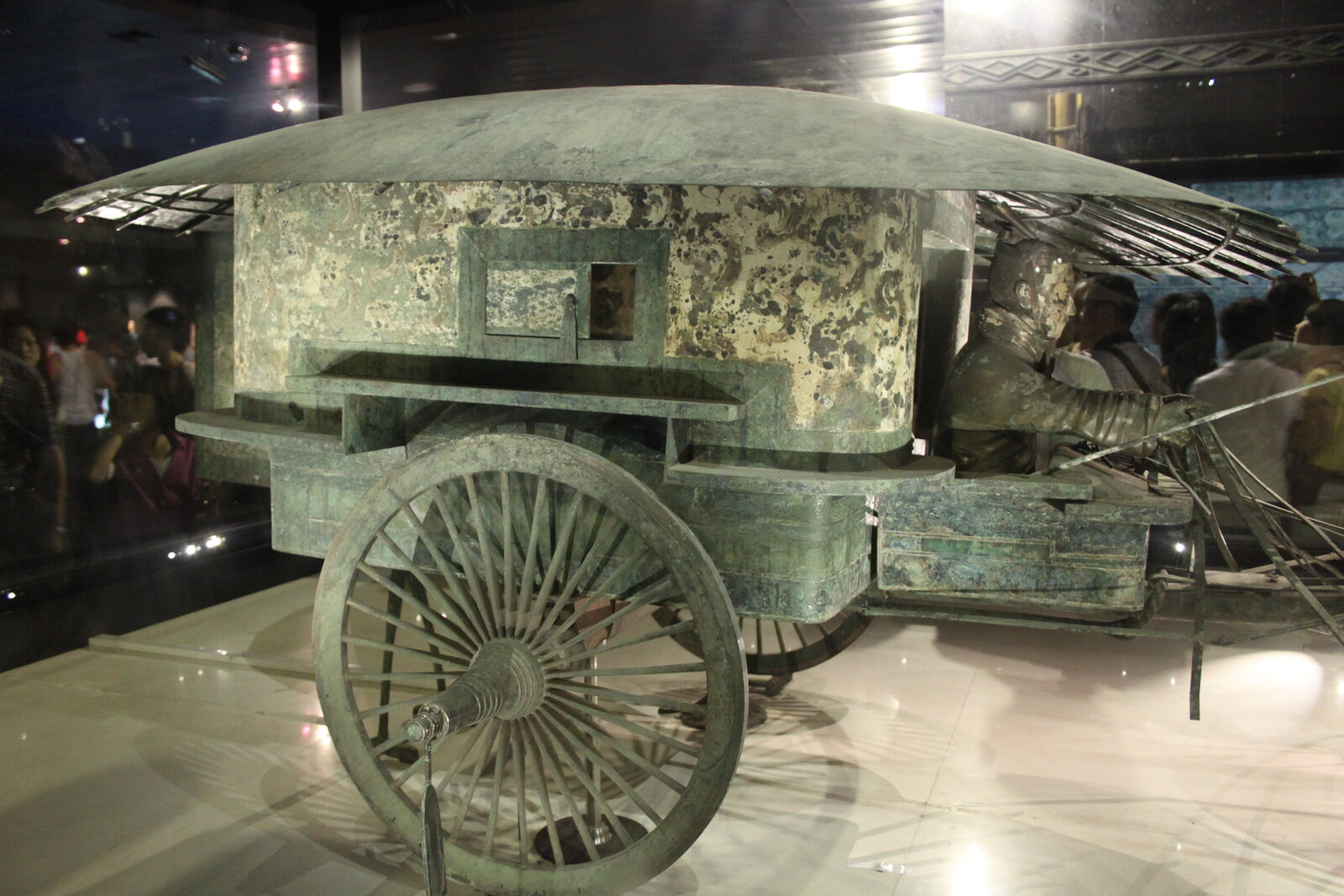
Chariots and Officials: The Mechanism of Imperial Power History Chariots and Officials: The Mechanism of Imperial Power: story on the “Terracotta Army and the Mausoleum of Qin Shi Huang” route This stop connects court objects with the struggle for power after the first emperor’s death.
Datang Everbright City History Datang Everbright City: story on the “Giant Wild Goose Pagoda and the “city without night”” route Here, the shift becomes visible: from stylized development to a street that keeps people there with performances.
Defu Alley and Xiangzi Temple History Defu Alley and Xiangzi Temple: story on the “The Wall and Towers of Old Xi'an” route Here, the route shifts from military history to the entrepreneurial turnaround of a single alley.
Entrance to Daci'en Temple History Entrance to Daci'en Temple: story on the “Giant Wild Goose Pagoda and the “city without night”” route This point will show why the current entrance belongs to a later, reduced version of the monastery.
Giant Wild Goose Pagoda History Giant Wild Goose Pagoda: story on the “Giant Wild Goose Pagoda and the “city without night”” route Here you will learn what cargo the tower was built to hold and why the structure before you is no longer the first one.
Kaiyuan Square History Kaiyuan Square: story on the “Giant Wild Goose Pagoda and the “city without night”” route The finale will explain which historical era the square's creators turned into a modern stage.
Main Hall of Daci'en Temple History Main Hall of Daci'en Temple: story on the “Giant Wild Goose Pagoda and the “city without night”” route The hall will return the pagoda to its setting beside an active monastic community, rather than museum scenery.
Mausoleum of Qin Shi Huang History Mausoleum of Qin Shi Huang: story on the “Terracotta Army and the Mausoleum of Qin Shi Huang” route The route ends where research ran up against preserving the unopened chamber.
North Gate: Entrance to the Underground State History North Gate: Entrance to the Underground State: story on the “Terracotta Army and the Mausoleum of Qin Shi Huang” route Here you will understand why an entire museum had to be built over an unfinished excavation.
North Square Musical Fountain History North Square Musical Fountain: story on the “Giant Wild Goose Pagoda and the “city without night”” route This is where the story begins of how the outskirts around the pagoda were transformed into the city’s main walking district.
Pit 1 History Pit 1: story on the “Terracotta Army and the Mausoleum of Qin Shi Huang” route This stop will show the Terracotta Army as the result of lengthy sorting and assembly, rather than a discovery found intact.
Pit 2 History Pit 2: story on the “Terracotta Army and the Mausoleum of Qin Shi Huang” route Here, color, poses, and differences between the figures will have to be separated from popular museum myths.
Pit 3 History Pit 3: story on the “Terracotta Army and the Mausoleum of Qin Shi Huang” route Here, the absence of a single figure changes the reading of the entire underground command post.
Pit of Acrobats History Pit of Acrobats: story on the “Terracotta Army and the Mausoleum of Qin Shi Huang” route This stop will show the limits of restoration: a body position can be restored, but the name of a move cannot always be.
Southern Moat History Southern Moat: story on the “The Wall and Towers of Old Xi'an” route The moat helps explain a military ruse in which visible fire concealed untouched supplies.
Statue of Xuanzang and the South Square of Giant Wild Goose Pagoda History Statue of Xuanzang and the South Square of Giant Wild Goose Pagoda: story on the “Giant Wild Goose Pagoda and the “city without night”” route The monument will show how the translator was brought out of monastic history and into urban space.
The Axis Between the Xi'an Bell Tower and Xi'an Drum Tower History The Axis Between the Xi'an Bell Tower and Xi'an Drum Tower: story on the “The Wall and Towers of Old Xi'an” route Here you will understand the cost of clearing the direct view between the two towers.
The Wall above Yongning Gate History The Wall above Yongning Gate: story on the “The Wall and Towers of Old Xi'an” route This stop shows the scale of what remained after Chang'an was reduced.
Xi'an Bell Tower History · wheelchair — no Xi'an Bell Tower: story on the “The Wall and Towers of Old Xi'an” route This stop will examine what in Xi'an was actually moved and what was built anew.
Xi'an Drum Tower and Beiyuanmen Street History Xi'an Drum Tower and Beiyuanmen Street: story on the “The Wall and Towers of Old Xi'an” route The finale will connect the road to the imperial court with the commercial fate of Beiyuanmen Street.
Yongningmen South Square History Yongningmen South Square: story on the “The Wall and Towers of Old Xi'an” route Here, the ceremonial entrance to the city becomes the starting point for the story of the defense of Yongning Gate.
1st Dianzi Rd. Streets and squares 2nd Dianzi Road Streets and squares Baling History Banpo History Baqiao District Streets and squares Baqiao Site History Beilin District Streets and squares Beiyuanmen Streets and squares Daci'en Temple Sacred sites Nearest audio-route stop: Main Hall of Daci'en Temple — 40 m in a straight line, route Giant Wild Goose Pagoda and the “city without night”
Daming Palace History Daxingshan Temple Sacred sites Daxuexixiang Mosque Sacred sites Dongweiqiao Site History Duling History Emperor Qinshihuang's Mausoleum Site Museum Museums Nearest audio-route stop: Pit 1 — 10 m in a straight line, route Terracotta Army and the Mausoleum of Qin Shi Huang
Former office of Eighth Route Army in Xi'an History Giant Wild Goose Pagoda History Nearest audio-route stop: Giant Wild Goose Pagoda — 10 m in a straight line, route Giant Wild Goose Pagoda and the “city without night”
Great Mosque of Xi'an Sacred sites Guangren Temple Sacred sites Huaqing Chi History Huaqing Palace History Jianfu Temple Sacred sites Jiangzhai site History Lianhu District Streets and squares Lingyan Pavilion History Lintong District Streets and squares Lü Family Cemetery, Lantian History Matengkong North Tombs History Mausoleum of Empress Dowager Bo History Mausoleum of the First Qin Emperor History Nearest audio-route stop: Mausoleum of Qin Shi Huang — 30 m in a straight line, route Terracotta Army and the Mausoleum of Qin Shi Huang
Qinglong Temple Sacred sites Qujiang Pond Site Park Parks Revolution Park Parks Shaanxi History Museum Museums Shaanxi Province Art Museum Museums Shaanxi Province Stadium With children Site of Huanqiu History Sites of the Xi'an Incident History Small Wild Goose Pagoda Sacred sites St. Francis Cathedral of Xi'an Sacred sites Stele Forest Museums Taiji Palace History Tang Dynasty Palace Museums Tang Paradise Parks Temple of the Eight Immortals (Ba Xian An) Sacred sites Terracotta Army Museums Nearest audio-route stop: Pit 1 — 10 m in a straight line, route Terracotta Army and the Mausoleum of Qin Shi Huang
Theater of Yisushe History Tomb of An Jia History Tomb of Li Shou History Tombs of Ming Princes of Qin History Weiyang District Streets and squares Wolong Temple Sacred sites Xi'an History Nearest audio-route stop: Xi'an Bell Tower — 70 m in a straight line, route The Wall and Towers of Old Xi'an
Xi'an Art Museum Museums Xi'an Botanical Garden Parks Xi'an City God Temple History Xi'an City People's Stadium With children Xian Banpo Museum Museums Xiaopiyuan Mosque Sacred sites Xincheng District Streets and squares Yanta District Streets and squares "Tuo Ling Legend" Show Museums Anrenfang Ruins Exhibition Hall Museums Archeological Exploration Center Museums Banpo Museum Museums Bell Tower Museums Nearest audio-route stop: Xi'an Bell Tower — 80 m in a straight line, route The Wall and Towers of Old Xi'an
Daming Palace Heritage Museum Museums Duchenghuang Temple of Xi'an Sacred sites Huijing Temple Sacred sites Municipal Youth Activity Center Museums Putaihe Chinese Medicine Museum Museums Qian Xueshen Library Museums Shaanxi Grand Theatre Museums Shaanxi Library Museums Shaanxi Provincial Cultural Center Museums South Church of the Diocese of Xi'an Sacred sites Tang Du Stele Forest Art Museum Museums Temple of the Eight Immortals Sacred sites Terracotta Warriors Museums The Great Mosque of Xi'an Sacred sites Xi'an Concert Hall Museums Xi'an Drum Tower Museum Museums Nearest audio-route stop: Xi'an Drum Tower and Beiyuanmen Street — 30 m in a straight line, route The Wall and Towers of Old Xi'an
Xi'an Huaxia Cultural Tourism Grand Theater Museums Xi'an Incident Memorial Museums Xi'an Museum Museums Xi'an Qujiang Museum of Fine Arts Museums Nearest audio-route stop: Datang Everbright City — 60 m in a straight line, route Giant Wild Goose Pagoda and the “city without night”
Xi'an Science and Technology Museum Museums Xi'an Stele Forest Museum Museums Xi'an Tang Dynasty City Wall Hanguangmen Site Museum Museums Xiangzi Temple Sacred sites Yong Ning International Art museum Museums Nearest audio-route stop: The Wall above Yongning Gate — 120 m in a straight line, route The Wall and Towers of Old Xi'an
三秦书画研究院 Museums 世界八大奇迹馆 Museums 世界电影放映机收藏博物馆 Museums 东岳庙 Sacred sites 中国秦腔艺术博物馆 Museums 临潼博物馆 Museums 亮宝楼 Museums 人民剧院 Museums 仁宗庙 Sacred sites 仁祖庙 Sacred sites 关公殿 Sacred sites 千佛殿 Sacred sites 卧龙禅寺 Sacred sites 大皮院清真寺 Sacred sites 大皮院清真寺北院 Sacred sites 大雄宝殿 Sacred sites 大雄宝殿 Sacred sites 大雄宝殿 Sacred sites 大雄宝殿 Sacred sites Nearest audio-route stop: Main Hall of Daci'en Temple — 40 m in a straight line, route Giant Wild Goose Pagoda and the “city without night”
天王殿 Sacred sites 天王殿 Sacred sites 天王殿 Sacred sites 小学习巷清真中寺 Sacred sites 护法金刚殿 Sacred sites 文殊台 Sacred sites 文殊殿 Sacred sites 普贤殿 Sacred sites 清真中寺 Sacred sites 清真古寺 Sacred sites 清真寺 Sacred sites 清真寺文化中心 Sacred sites 清真新寺 Sacred sites 清真西寺 Sacred sites 罔极寺 Sacred sites 老母宫 Sacred sites 藏经阁 Sacred sites 西仓清真寺 Sacred sites 西安市基督教北堂 Sacred sites 观音大士殿 Sacred sites 财神殿 Sacred sites 都城隍庙 Sacred sites 钟楼 Sacred sites 长寿殿 Sacred sites 鼓楼 Sacred sites  Guide On Map