 Guide On Map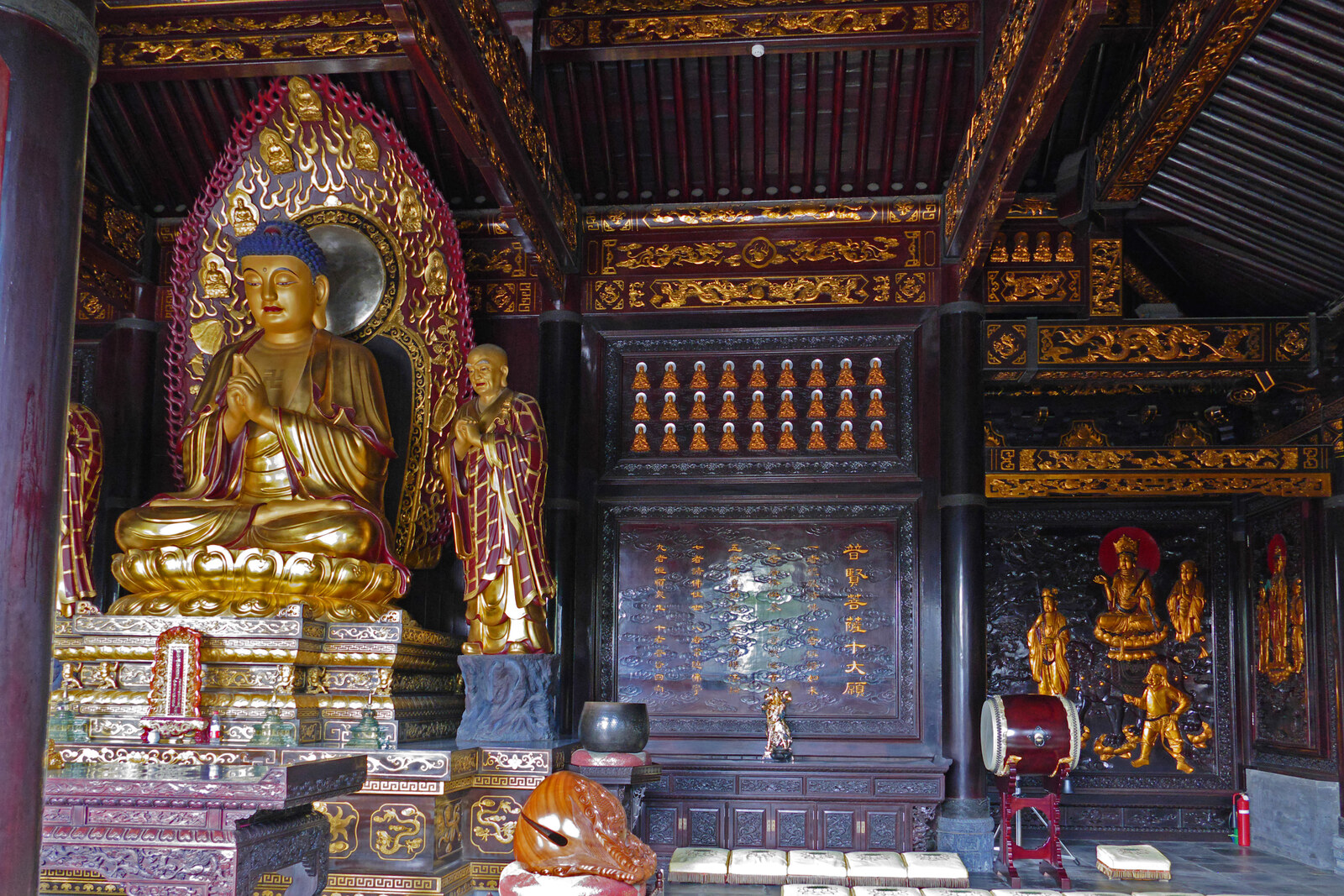
Look around first
What to notice
- The inscription “Daxiong Baodian”
- An image of Shakyamuni
- The hall’s wooden frame
The story of the place
Above the entrance is the inscription “Daxiong Baodian”—“Precious Hall of the Great Hero.” The Great Hero is neither a military commander nor the builder of the monastery. This is what Buddhists call Shakyamuni: he defeated Mara, the embodiment of fear, desire, and death. That is why his image stands at the center of the hall, and why the building serves as the main place for collective services and worship.
The monastery’s name tells another part of its origin. “Daci'en” means “great maternal kindness.” In six forty-eight, the heir to the throne, Li Zhi, ordered the monastery built for the posthumous well-being of his mother, Empress Wende. She died when he was eight years old. At the consecration, Li Zhi bowed before images of the Buddha, then explained to the invited monks for whose sake he had founded the monastery, and wept. The monastery became an offering from a son who could no longer repay his mother during her lifetime.
By the beginning of the twentieth century, little more than a poor monastic community remained of the wealthy imperial monastery. It had almost no land or income, and the buildings were deteriorating. In nineteen thirty-one, Zhu Ziqiao, a former general and organizer of charitable fundraising, came to Shaanxi Province, which had suffered from famine. He knew how to obtain money and supplies from Buddhist associations and private donors—his work in Shaanxi Province depended on this network of assistance.
Zhu’s Buddhist biographers recalled that in his youth he had been hostile toward temples and had even taken part in their destruction. After converting to Buddhism, he considered restoring monasteries a way to compensate for the harm he had caused. At Daci'en Temple, Zhu saw a community with nothing to support its monks and decided to restore its everyday life. He invited the monk Baosheng from Mount Wutai to become abbot, provided funds for food and dormitories, and then raised donations to repair the main hall. Collective services and monastic meals began to be held here again.
Zhu did not stop there. Together with local Buddhists, he opened a school at Daci'en Temple, assembled collections of canonical texts for it, and invited teachers. The school was later moved to another monastery, but Daci'en Temple ceased to be an impoverished courtyard around a famous pagoda: people once again lived, studied, and held religious services here.
The beams Zhu Ziqiao repaired are no longer before us. By the nineteen eighties, the old wooden frame had shifted because of a fault running beneath the monastery and was at risk of collapse. The monks and heritage conservation specialists agreed on a new reconstruction. In the autumn of two thousand nine, nine abbots and more than three hundred monks consecrated the newly made statues. The present hall received its wooden frame during this work; Shakyamuni once again sits at its center, and the services that Zhu Ziqiao restored to Daci'en Temple almost eighty years earlier are held before him.
Useful on site
The temple section operates under the complex’s rules; check access to the halls on site.
Checked: date not specified. Check the official source before visiting.Do not play audio through a speaker, do not block entrances, and do not take photographs where it is forbidden. Remember that this is a religious space, not scenery for a story.