 Guide On Map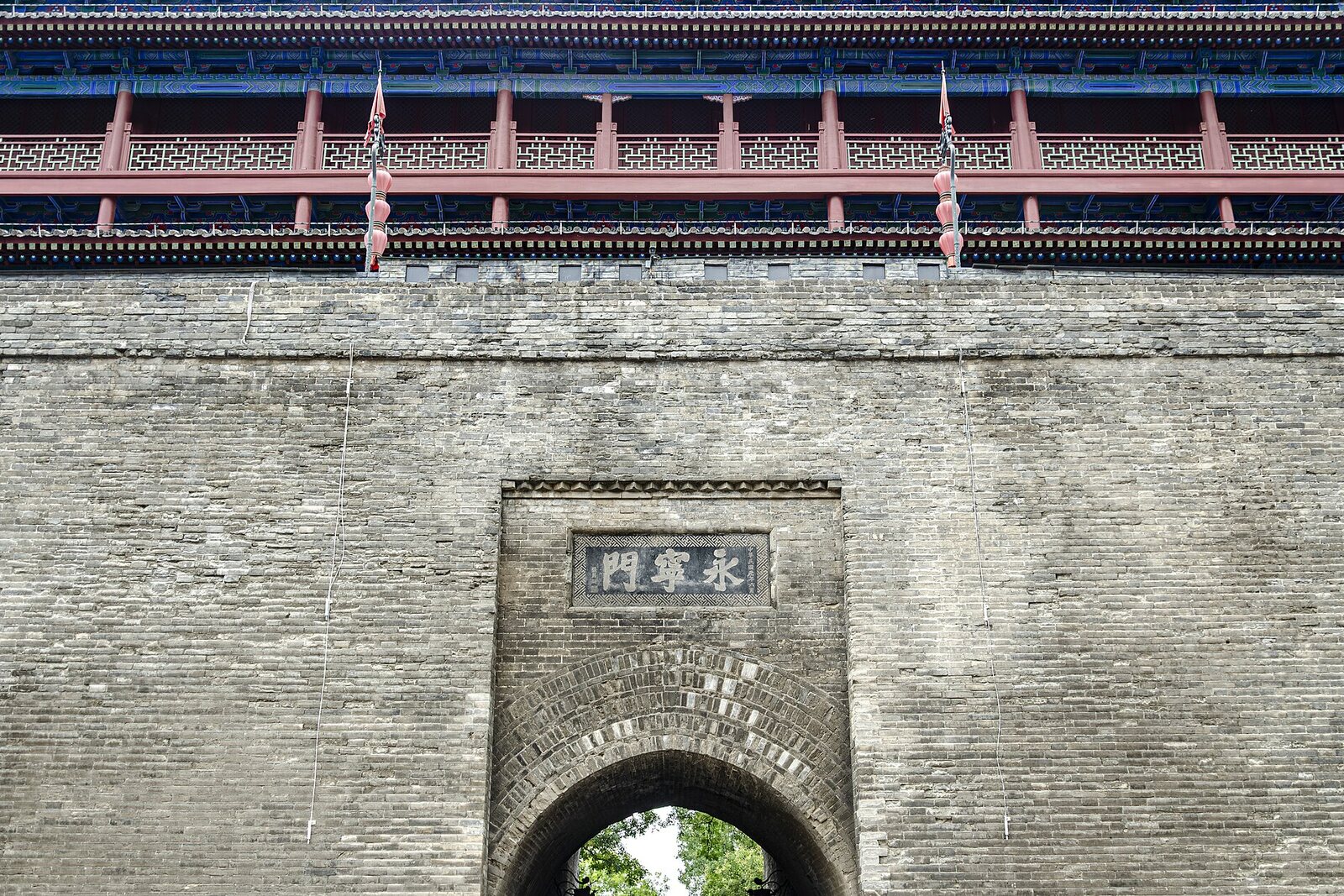
Look around first
What to notice
- Brick parapet
- Southern line of the wall
- Opening of Yongning Gate
- Wards south of the wall
The story of the place
The deck and brick parapet above Yongning Gate lie on the southern boundary of Chang'an's former imperial city. Tang administrative offices and departments stood to the north, while residential wards extended to the south; the present wall later followed this old boundary. The base of the passage goes back to the eastern Anshang Gate, a side entrance to the officials' district, and after the internal walls were abolished, trading was permitted here not in designated markets but throughout the compact city. In the fourteenth century, Ming builders expanded Xi'an to the north and east, retained the southern line, and combined the three portals of Anshang Gate into the single brick vault of Yongning Gate.
In nine hundred four, the warlord Zhu Wen, seeking the complete submission of the Tang court, forced the emperor to move the capital from Chang'an to Luoyang. Residents were relocated according to lists. Palaces, government buildings, and private homes were dismantled, and the beams were floated down the Wei River. Three years later, Zhu Wen abolished the Tang dynasty and founded his own. Abandoned Chang'an was left without the court, without most of its residents, and without the means to maintain an enormous capital.
The military governor Han Jian inherited a city whose perimeter his garrison could no longer defend. He abandoned the ruined palace complex and the outer residential wards. For the new fortress, Han Jian chose the former imperial city—the district of Tang administrative offices and departments. After the reduction, about one-sixteenth of Chang'an's former area remained within the walls.
The people who had not left for Luoyang found themselves gathered in this cramped core. Han Jian ordered the demolition of the internal walls that had previously divided the residential wards and abolished designated market areas. Trade was now permitted throughout the new city: an arrangement devised for a populous capital hindered the survival of a small military center.
There were three gates in the southern wall of the former imperial city. Han Jian walled up the central Zhuque Gate, through which state ceremonies had once passed, but preserved the eastern Anshang Gate. Its foundation lies beneath present-day Yongning Gate. Thus a secondary entrance to an administrative district became one of the city's main gates.
In the fourteenth century, builders of the Ming dynasty expanded Xi'an to the north and east, while leaving Han Jian's southern line in its original place. They remade the old Anshang Gate from three rectangular passages into a single brick vault and named it Yongning Gate—“Gate of Eternal Peace.”
South of this wall, Chang'an's residential wards still extended in Tang times. Han Jian left them outside and drew the boundary of the former officials' city where the deck above Yongning Gate now lies.
Useful on site
Paid access to the top. Local information for Yongning Gate from 2026 gives 8:00–22:00; official historical material gives the same basic schedule, but events and ticket offices should be checked on site.
Checked: June 29, 2026. Check the official source before visiting.Access to the top may require payment and involves stairs; inside, it can be windy and there is little shade. A full circuit of the wall is not needed for this route.