 Guide On Map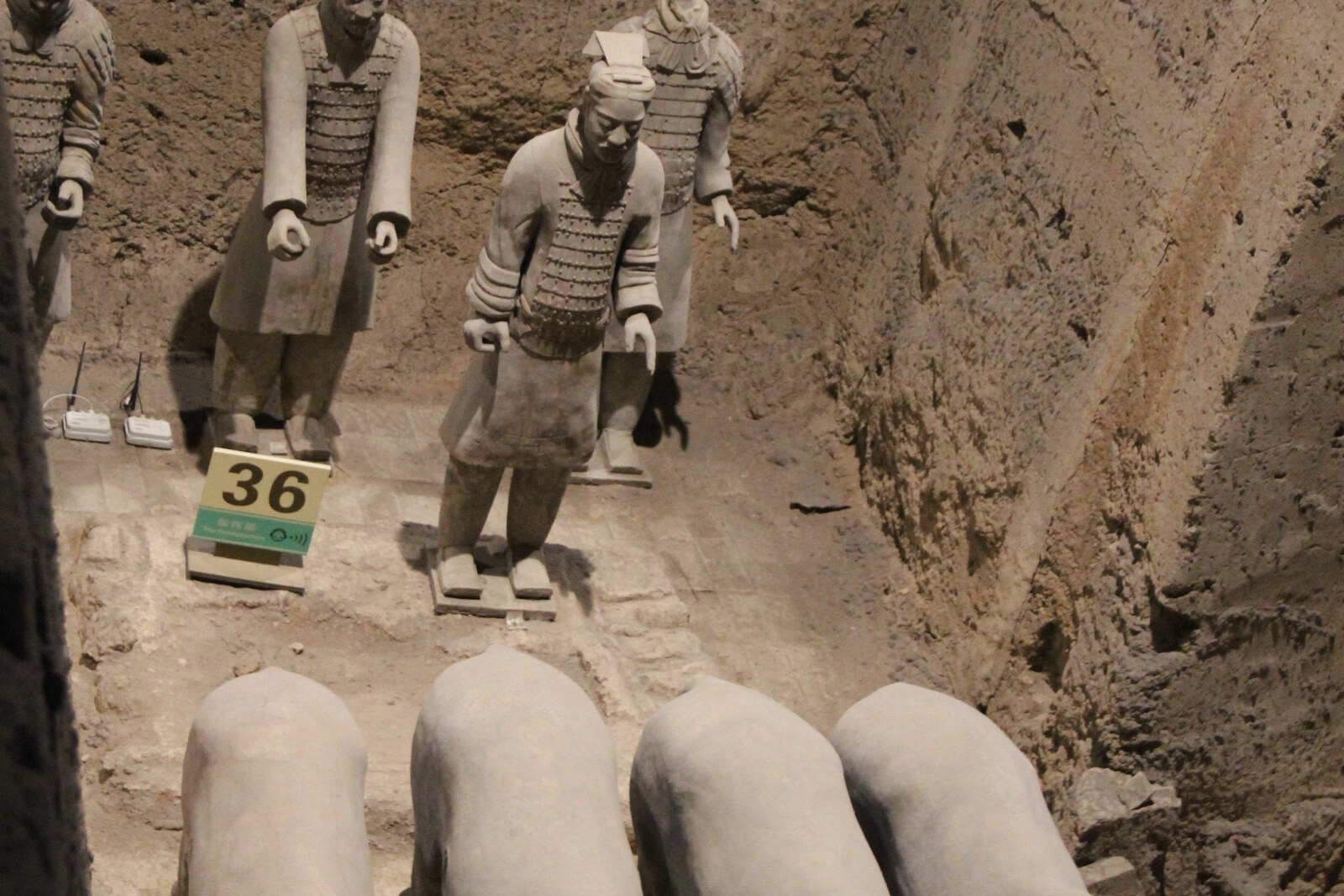
Look around first
What to notice
- Warriors along the walls
- Empty center
- Chariot
- Four horses
The story of the place
The small Pit 3 was not designed for battle: the clay warriors stand along the walls facing one another, leaving the middle free. A chariot stands ready nearby, while guards at the passageways recall the security of an enclosed room. Archaeologists link this layout to an army headquarters, where senior military officers prepared a campaign and performed rituals before it. Details of the ceremonial guard recall that, for Qin, war remained a matter of the ruler's authority.
In May nineteen seventy-six, archaeologists found this much smaller excavation—Pit 3—twenty-five meters from Pit 1. It contained sixty-eight warriors, four horses, and one chariot. The most important figure was missing: there was no supreme commander among the officers and guards.
The warriors' positions suggested the pit's purpose. They stand along the walls facing one another, as if guarding the passageways. Such a formation would be useless in battle. The chariot also differs from the fighting chariots in the neighboring pits: four people were placed beside it, one of whom probably represented a senior military officer. That is why archaeologists called this structure a “junmu”—an army headquarters.
The commanders here also dealt with things that would not appear on a headquarters map today. Deer antlers, animal bones, and traces of a curtain were found in the northern room. Before a campaign, military commanders made sacrifices, divined the outcome, and asked the spirits for a favorable decision. The bronze shafts of “shu” found near the guards are too short for ordinary combat and have no points. Most likely, they were signs of a ceremonial guard. For this reason, some researchers consider Pit 3 a military shrine attached to the headquarters.
The empty center is explained by the organization of the real Qin army. A soldier received rank, land, and a house for military merit; for a poor farmer, a campaign could change the position of an entire family. A general commanded thousands of such men, but could not regard them as his own army. An order was confirmed by a bronze token shaped like a tiger and divided into two halves. One was held by the military commander, the other by the ruler. A surviving Qin inscription forbade the deployment of fifty or more armed men until the halves were joined.
Qin Shi Huang, the first emperor of a unified China, needed generals capable of conquering states, but retained for himself the final right to move the army. The creators of the burial complex transferred this order underground: the guard waits, the chariot is ready, the ritual room is arranged, but there is no figure of the person who gives the order. According to one scholarly version, the chariot represented the presence of the emperor himself as supreme commander. This remains an interpretation, not an established fact.
Qin Shi Huang died in two hundred ten BCE and was buried beneath a burial mound about one and a half kilometers to the west. If the interpretation is correct, the empty place in Pit 3 has lost nothing: the one person whom the craftsmen did not place among the clay officers is at another point in the same burial complex.
Useful on site
Official ticket checks: 08:30-17:00 in high season; 08:30-16:30 in low season. Check holidays separately.
Opening hours by day
Do not rush because of the pit's size: here, the arrangement of the figures and the empty spaces between them matter more.