 Guide On Map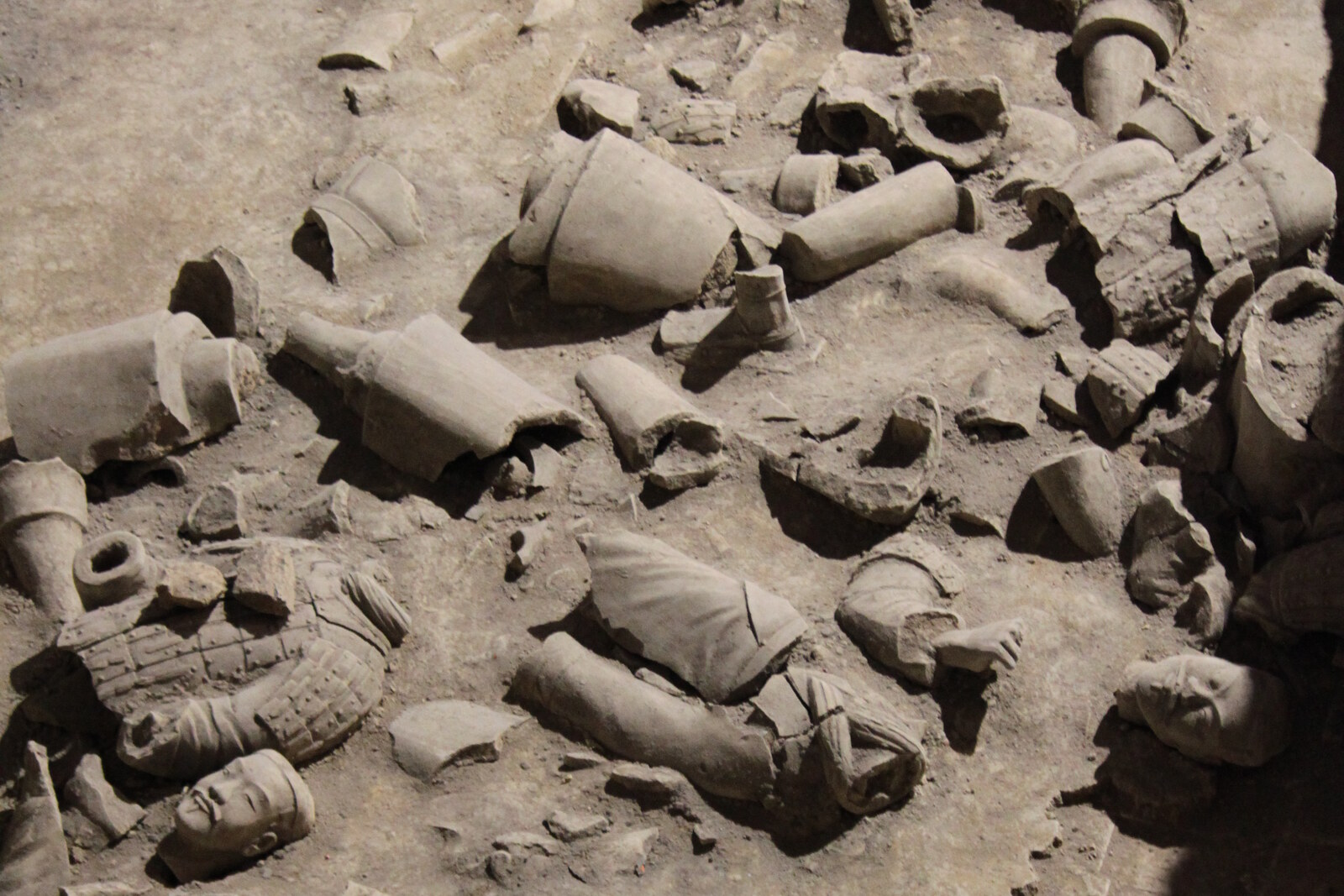
Look around first
What to notice
- Kneeling archer
- Green cheek
- Black beard
- Red straps and blue collar
The story of the place
Pit 2 brings several branches of the army together in a single underground formation. In the middle, kneeling crossbowmen stand as a separate unit, with standing archers around them; nearby are charioteers, cavalrymen, and infantrymen. Poses, armor, and hairstyles vary from figure to figure, showing different methods of combat. Among the kneeling warriors, notice an archer with a green cheek, a black beard, red straps on his armor, and blue trim on his clothing.
In nineteen ninety-four, Yuan Zhongyi, the head of the excavation, received permission to begin a systematic study of Pit 2. By then, archaeologists already knew the cost of hasty clearing. The first terracotta warriors were lifted from the ground with remnants of bright paint, but it was almost impossible to preserve it.
The craftsmen of the Qin era covered every figure with two thin layers of wood lacquer and then applied mineral paints on top. In damp soil, the lacquer retained water. After clearing, it dried quickly, shrank, and separated from the terracotta together with the pigment. The detached film could no longer be reliably returned to its place. The gray color now associated with the Terracotta Army appeared after most of the paint was lost.
The clearing of new figures was suspended for several years. From nineteen ninety-one, Chinese specialists and conservators from Bavaria studied the lacquer, the pigments, and the behavior of damp clay. Newly exposed areas were kept in moisture-saturated air, while the water in the lacquer base was gradually replaced with polyethylene glycol. Drying too quickly cracked the coating; working too slowly delayed the entire excavation. The archaeologist had to remove soil only as far as the conservator could secure the exposed paint.
Yuan began work on Pit 2 with a detailed plan for preserving the finds already in place. Four years later, in the eighteenth corridor, his team discovered eight figures with well-preserved paint. A year later, the strangest of the Qin warriors appeared here: a kneeling archer with a pale-green face.
His pose reveals the actual arrangement of this pit. At the center of a separate unit stood archers who had gone down on their right knee; standing archers were arranged around them. The hands of the green-faced warrior are positioned to the right of his torso, as if he were holding a crossbow. The wooden stock and bowstring decayed, but the position of his hands preserved the vanished weapon. Nearby in this same pit, archaeologists found charioteers, cavalrymen, and infantrymen. The craftsmen depicted different methods of combat, so the stances, armor, and hairstyles vary here.
Visible on the archer are red straps of his armor, pale rivets, blue trim on the collar and sleeves, green leg guards, black eyebrows, and a black beard. His green skin gave rise to the theory of an ancient sniper whose face was painted for camouflage. There is no evidence for it. Researchers have offered other explanations as well: a ritual mask, a special character, or a chance decision by the craftsman. None has yet been confirmed.
This face is also tied to a more familiar story: that every terracotta warrior represents a particular soldier in Qin Shi Huang’s army. The figures do indeed differ. However, the craftsmen used a limited set of molds for heads, arms, and other parts, then added beards, hairstyles, wrinkles, and expressions. When researchers created three-dimensional models of thirty ears, none were identical. The authors of the study themselves warned that such a sample shows diversity in the finishing work, but does not prove the existence of thousands of clay portraits.
The character “De” is incised on the chest of the green-faced archer. Museum staff consider it most likely to be the name of a craftsman. The name of the person whose face the figure supposedly reproduced is not recorded anywhere.
The archer found here retains a green cheek, a black beard, red straps, and a blue collar. They were saved by the slow clearing of Pit 2. On his chest remains the name of someone who took part in making the figure; the figure bears no name of the soldier depicted.
Useful on site
Official ticket check: 08:30-17:00 in high season; 08:30-16:30 in low season. Check holidays separately.
Opening hours by day
View the color only from the permitted distance: the ancient layers are fragile, and some details can be seen only in the exhibition.