 Guide On Map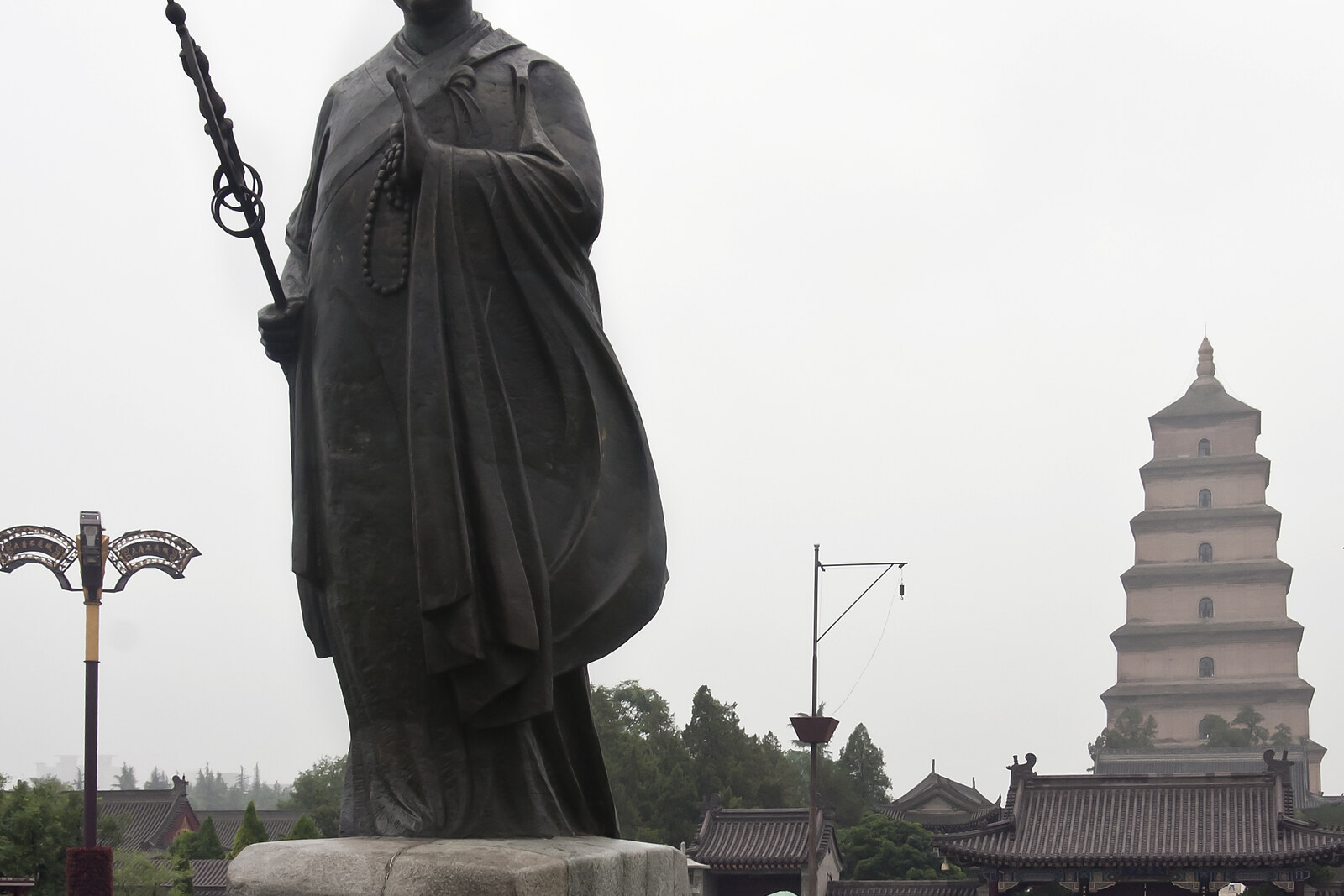
Look around first
What to notice
- Bronze figure of Xuanzang
- Staff
- Heavy folds of clothing
- Pagoda behind the statue
The story of the place
The South Square of Giant Wild Goose Pagoda was laid out in front of Daci'en Temple as an extension of the city, rather than as a courtyard behind the monastery wall. From here, a broad pedestrian route heads south, so people meet here before visiting the pagoda and the monastery. A bronze figure rises in the center, with the pagoda behind it: the designers carefully compared their proportions, raising balloons over the future pedestal.
The bronze Xuanzang is depicted after returning from India. The sculptor Chen Qing'an chose this very moment: the monk had already obtained the manuscripts, endured the journey, and was now heading to the place where they were to be translated. That is why the figure leans slightly forward, and the heavy folds of his clothing do not resemble a traveler's windblown cloak.
Xuanzang was a monk and translator who wanted to eliminate contradictions among Chinese versions of Buddhist texts. In India, his teachers urged him to stay. He refused: the knowledge had to be brought back and made accessible to those who did not read Sanskrit. At Daci'en Temple, he directed a translation workshop. Before dawn, he marked out the next passage in red ink; during the day, he translated with assistants; after the meal and in the evening, he explained the new texts to visiting monks; and at night, he answered his students. Behind Xuanzang stands the pagoda associated with the manuscripts he brought back; ahead of it, he is shown no longer as a seeker, but as a man who must sort through what he acquired and pass it on to others.
In two thousand, the architect Zhang Jinqiu was designing the new South Square of Giant Wild Goose Pagoda in front of the monastery. She proposed placing Xuanzang outside the monastery wall, in the urban space. Chen Qing'an, who was commissioned to create the monument, feared getting the scale wrong: a small figure would be lost before the pagoda, while one that was too large would compete with it. Architects and sculptors raised balloons over the future pedestal and decided from right here how tall the human figure should be between the square and the pagoda.
Chen assembled the image from historical evidence. He made the face calm and stern, compared the staff with the form of an ancient monastic staff found at Famen Temple, and built the pose as a slow step. When the square opened in early two thousand one, the statue became its center, and the South Square itself began to be called the South Square of Giant Wild Goose Pagoda. From here, pedestrian space was extended southward; people meet by the monument before visiting the monastery and take pictures of Xuanzang together with the pagoda.
In Zhang Jinqiu's original design, stones were to lie beside the statue, marking the monk's route through the Western Regions. They were not installed. The bronze Xuanzang remained alone: staff in hand, a step after returning, the pagoda behind him.
Useful on site
Open square; in the evening there can be a dense flow of people heading to the evening district of Datang Everbright City.
Checked: date not specified. Check the official source before visiting.People are constantly taking photographs in the square, so step away from the direct line between the statue and the pagoda before starting the audio. The best view does not require entering the monastery.