 Guide On Map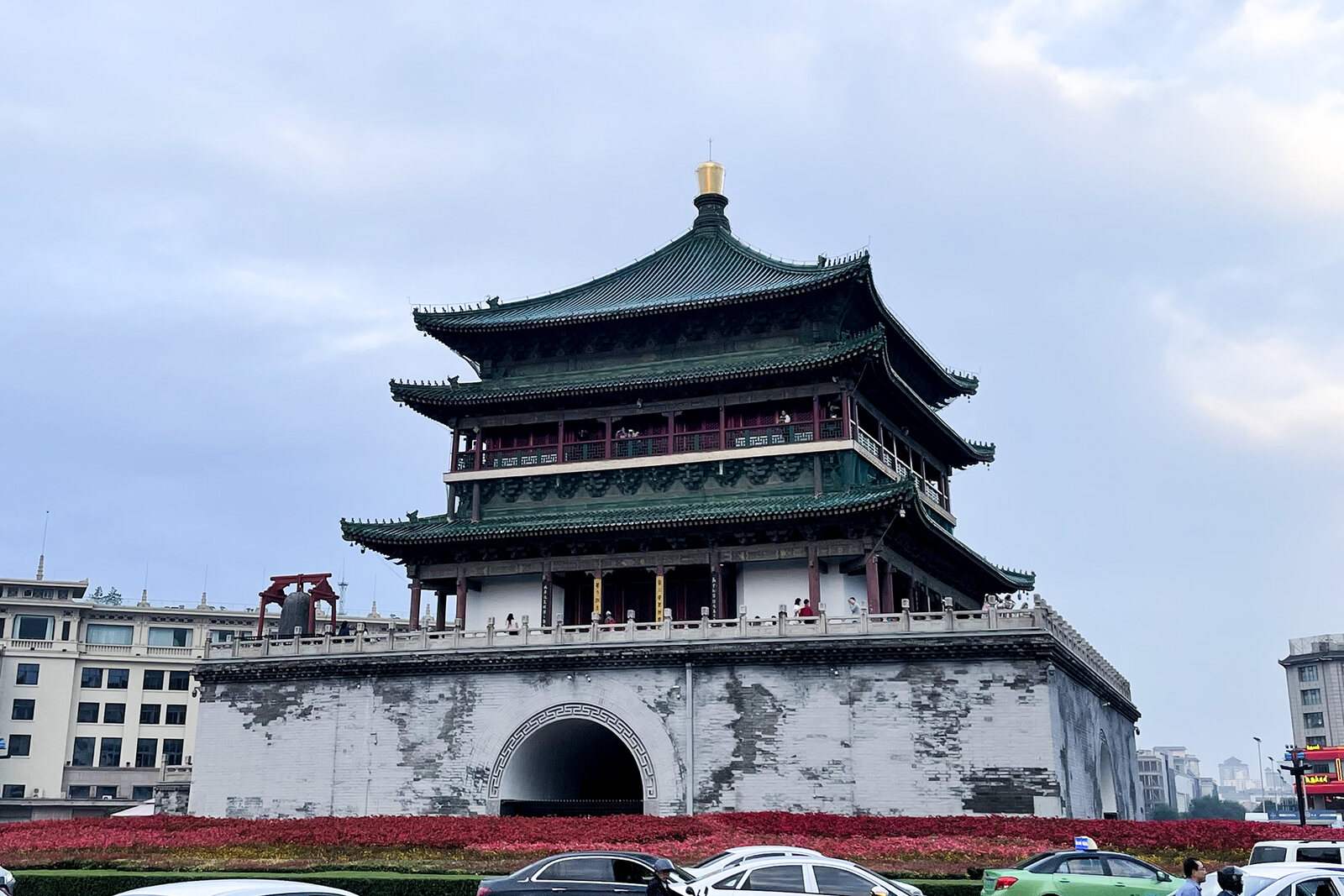
Look around first
What to notice
- Brick base
- Four arched passageways
- Two-tier wooden tower
- Copy of the bell
The story of the place
Two wooden tiers of Xi'an Bell Tower rise above a brick podium with four arches. Carts once passed through these arches; today the passageways are blocked, and traffic circles around the building. A museum has been installed inside, and a modern copy of the Jingyun Bell stands beside it. When the city extended its walls east and north, the former bell tower remained by Yingxiangguan Taoist Monastery; that site by Guangji Street is now occupied by an open parking lot.
In fifteen eighty-two, Gong Maoxian ordered the heads of two counties—Chang'an and Xian'ning—to build a city bell tower at this intersection. Gong was the chief imperial official in Shaanxi and wanted the time signal to once again come from the true center of Xi'an.
Almost two centuries earlier, Ming rulers had extended the city walls far to the east and north. The old bell tower remained by Yingxiangguan Taoist Monastery, near present-day Guangji Street. When it was built, the city center lay there. Now the four main streets met here and led to the four gates. The bell marked the beginning and end of the day and warned of alarm; for such a signal, its position within the city was part of its function.
Gong Maoxian's inscription says that the builders remade only the foundation and changed nothing else. From this phrase came the familiar story: the old wooden tower was dismantled, moved east, and reassembled here from its former parts.
Yet the documents give a different picture. The bell tower by the monastery was repaired in sixteen fifty-one and eighteen forty-eight. It was still photographed in the early twentieth century. Most likely, Gong Maoxian moved the city's service and the familiar appearance of the building here, while building the tower itself anew. For several centuries, two similar bell towers and one Xi'an Drum Tower stood in Xi'an at the same time.
By the time the work was finished, Gong had already left office and returned to his native Neijiang in Sichuan. He could not personally see the completed structure in its new location. In his place, he sent “Song of the Tower's Move to the East.” The text was carved in stone and placed inside—the official's report became part of the building he had constructed.
They also tried to transport the famous Jingyun Bell, cast in seven eleven, to the new location. An inscription from seventeen forty conveys the city's story: the bell did not sound here, so it was returned to Yingxiangguan Taoist Monastery, and another was found for the new tower. Later, people said that the ancient bell possessed a spirit and refused to leave its former place. This is a legend; the exact reason is unknown.
The old bell tower by Yingxiangguan Taoist Monastery collapsed in nineteen twenty-four. In nineteen fifty-three, the Jingyun Bell was moved to Xi'an Beilin Museum; a modern copy of it stands near the present tower.
The four arched passageways in the base once allowed carts to pass directly beneath the building. They are now closed, traffic circles around the tower, and a museum occupies the interior. An open parking lot remains on the site of the former bell tower by Guangji Street.
Useful on site
Peak season according to the official publication: 8:30–21:30, individual tickets sold until 21:00, combined tickets until 20:00. Check the sign and ticket office on the day of your visit; older English-language pages may show shorter hours.
Checked: June 29, 2026. Check the official source before visiting.An exterior view is enough to understand this stop. If you decide to go inside, ask about separate admission; approach the tower only through the designated underground passages.