 Guide On Map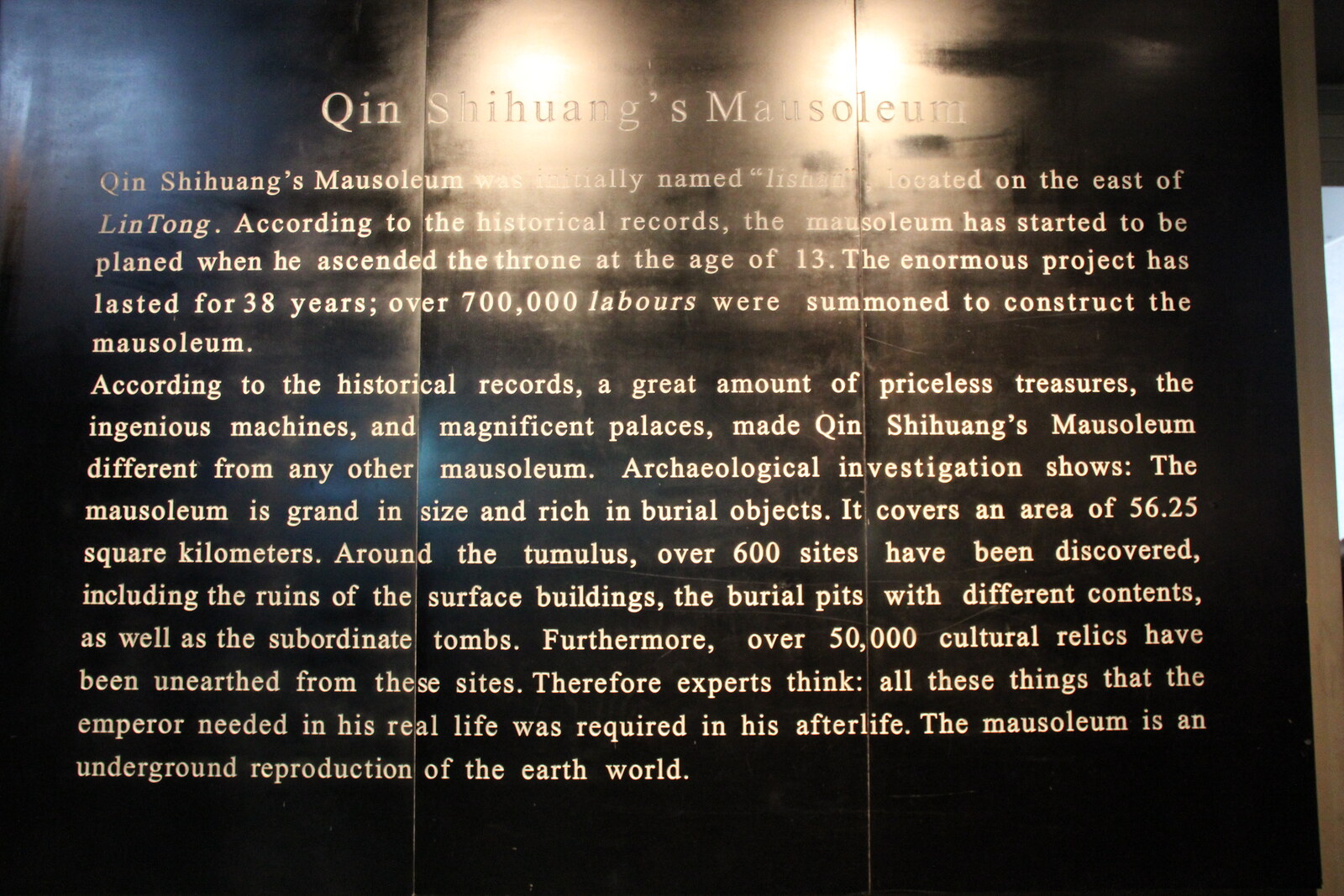
Look around first
What to notice
- The green burial mound
- The grass cover
The story of the place
Beneath the grass cover of the broad mound lies a nine-tiered structure of densely compacted earth. It was built over a burial pit, then concealed with soil, and the green hill became the upper part of an enormous tomb. Inside is the chamber of the first emperor of a unified China; the clay army stands about one and a half kilometers to the east, at the other edge of the same burial complex. Instruments outlined an underground space about eighty meters long and fifty meters wide, but they did not see what has survived inside.
In the early two thousands, archaeologist Duan Qingbo climbed this burial mound with a Luoyang spade—a narrow hollow tool that draws a column of soil from the ground. The expedition leader came here to disprove his own team's discovery.
Since nineteen ninety-eight, Duan had been studying the grounds of the Mausoleum of Qin Shi Huang. Qin Shi Huang was the ruler of the State of Qin, who conquered his rivals and, in two hundred twenty-one BCE, became the first emperor of a unified China. Duan intended to reconstruct the plan of his burial complex in ten years. At first, he excluded the central chamber from the work: the expedition could investigate the area around the burial mound, but opening the tomb itself required different resources and a different level of responsibility.
Geophysicists scanned the burial mound using various methods and reported a strange result to Duan. Within the mass of earth, above the ancient surface, stood a four-sided structure of compacted soil. It rose about thirty meters and had nine terraces on the outside. Archaeologists had regarded earlier Chinese burial mounds as successive layers of earth; Duan had never encountered such a construction before. He explained to the geophysicists why, in his view, their instruments had made a mistake. They repeated the measurements three times and each time obtained the same picture.
Duan then marked the spot calculated by the instruments, climbed the mound, and drove a Luoyang spade into the ground. About a meter below the surface, the tool struck dense artificial compacting—exactly where the geophysicists had predicted another terrace. Duan wanted to settle the dispute, but instead he confirmed the discovery himself.
Qin builders erected an enormous stepped structure over the burial pit, then covered it with earth. This is why the green hill forms part of the burial structure. Beneath it lies the emperor's chamber; the Terracotta Army encountered earlier stands about one and a half kilometers to the east, at the edge of the same complex. Instruments made it possible to outline an underground space approximately eighty by fifty meters and about thirty meters deep, but they did not show what has survived inside.
To reach the chamber from above, archaeologists would have had to remove the burial mound layer by layer and dismantle the nine terraces found by Duan. The expedition leader himself opposed such an opening: the methods available at the time could not guarantee the preservation of either the interior space or the mound itself. His team obtained the plan of the tomb but did not enter it.
This burial mound has no excavation like the pits of the Terracotta Army. Research continues around it and through it, using instruments and narrow probes. Beneath the grass still lies that very terrace of compacted earth that stopped Duan's Luoyang spade.
Useful on site
Official ticket checks: 08:30-17:00 in high season; 08:30-16:30 in low season. Check holidays separately.
Opening hours by day
Viewing is possible only from outside; do not look for an entrance or leave the permitted paths.