 Guide On Map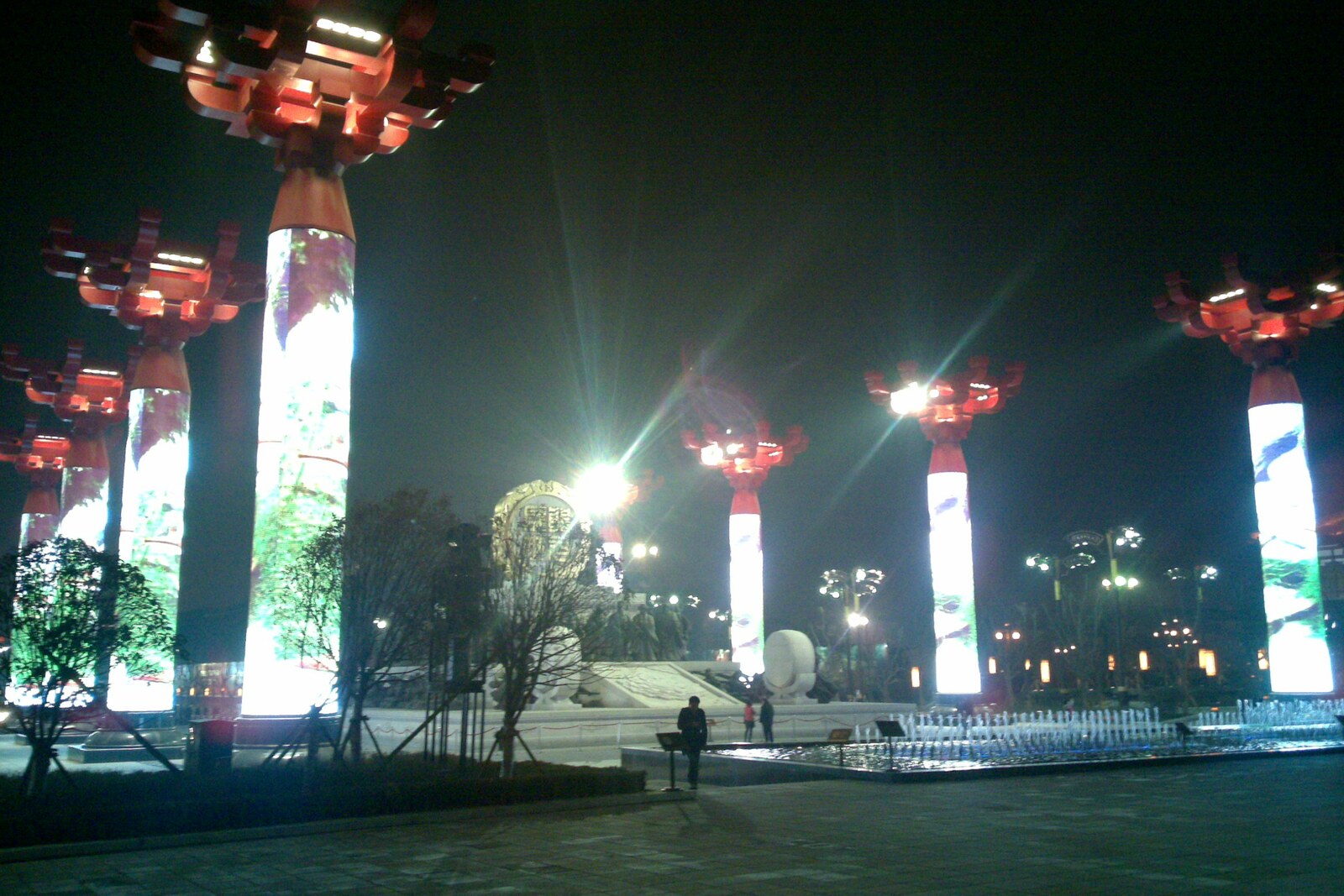
Look around first
What to notice
- Bronze figure of the emperor
- Eight red columns with screens
- Figures of officials, ambassadors, and musicians
The story of the place
The site was made into the final space of the pedestrian route: people stroll in the open middle, gather for large events, and watch performances. Eight red columns with screens rise along the edges, each twenty meters tall. Between them, bronze figures are arranged in tiers: the ruler at the top, and below him officials, ambassadors, and musicians. No ancient structures connected with this court scene have survived here; what remains are its modern embodiment and the square's name.
On the evening of September fifteenth, two thousand ten, installers hoisted a four-meter-fifty-nine-centimeter bronze figure of the emperor by crane. The figure of Li Longji slowly descended onto the top step of an almost thirteen-meter-tall composition. Eleven days later, builders opened Kaiyuan Square and completed a one-and-a-half-kilometer chain of sculptures from Giant Wild Goose Pagoda to this southern end of the pedestrian street.
The architects assigned the square the role of a final stage. They left space in the middle for strolling, performances, and large gatherings, and placed eight red columns with screens along the sides, each twenty meters tall. A court ceremony unfolds between them: the emperor stands at the top, below him are six officials and twenty foreign ambassadors, and below them are forty-two musicians. The main figure's height was chosen for the combination of nine and five—a traditional sign of imperial dignity. In this way, the designers immediately showed whom the square's name honored.
Kaiyuan era was the reign title of Li Longji, Emperor Xuanzong, from seven thirteen to seven forty-one. The most important episode from the beginning of this era took place at the Xinfeng postal fortress outside the capital. Li Longji offered the post of first minister to Yao Chong, an experienced official from whom he expected a correction of court practices. Yao Chong sought guarantees that he would be allowed to carry out reforms and set a condition: he would accept the appointment only if the emperor agreed to ten demands.
They included the rejection of unnecessary border campaigns, keeping eunuchs out of state affairs, limiting offices for imperial relatives, ending new palaces and temples, and one law for nobles and commoners. Xuanzong was silent at first, and Yao Chong decided that he had gone too far. Then the emperor replied that he accepted all ten points and appointed him first minister.
This agreement became the program of the Kaiyuan era's early years. Yao Chong cut unnecessary posts and tried to cut court families off from access to special favors. The consequences caught up with Yao Chong himself. Two of his sons accepted gifts from petitioners, and a close subordinate was caught taking bribes. About three years after his appointment, Yao Chong left the post and proposed Song Jing in his place; Song Jing continued the reforms already begun. Xuanzong himself ended up with an era that later historians called Kaiyuan Prosperity.
Neither this conversation nor Xuanzong's court was located on the square. Its creators assembled a modern bronze version of the era here: the emperor stands at the top, officials occupy the next step, and ambassadors and musicians fill the base. No ancient trace of their decisions remains at this spot; what survives is the name, the composition installed in two thousand ten, and the southern end of the pedestrian route for which it was hoisted by crane.
Useful on site
Open pedestrian area; the street program and crowds depend on the day and season.
Checked: date not specified. Check the official source before visiting.The square is best viewed from more than one point: walk along several columns, then step back for the overall view. In the evening crowd, choose a noticeable landmark before splitting up.