 Guide On Map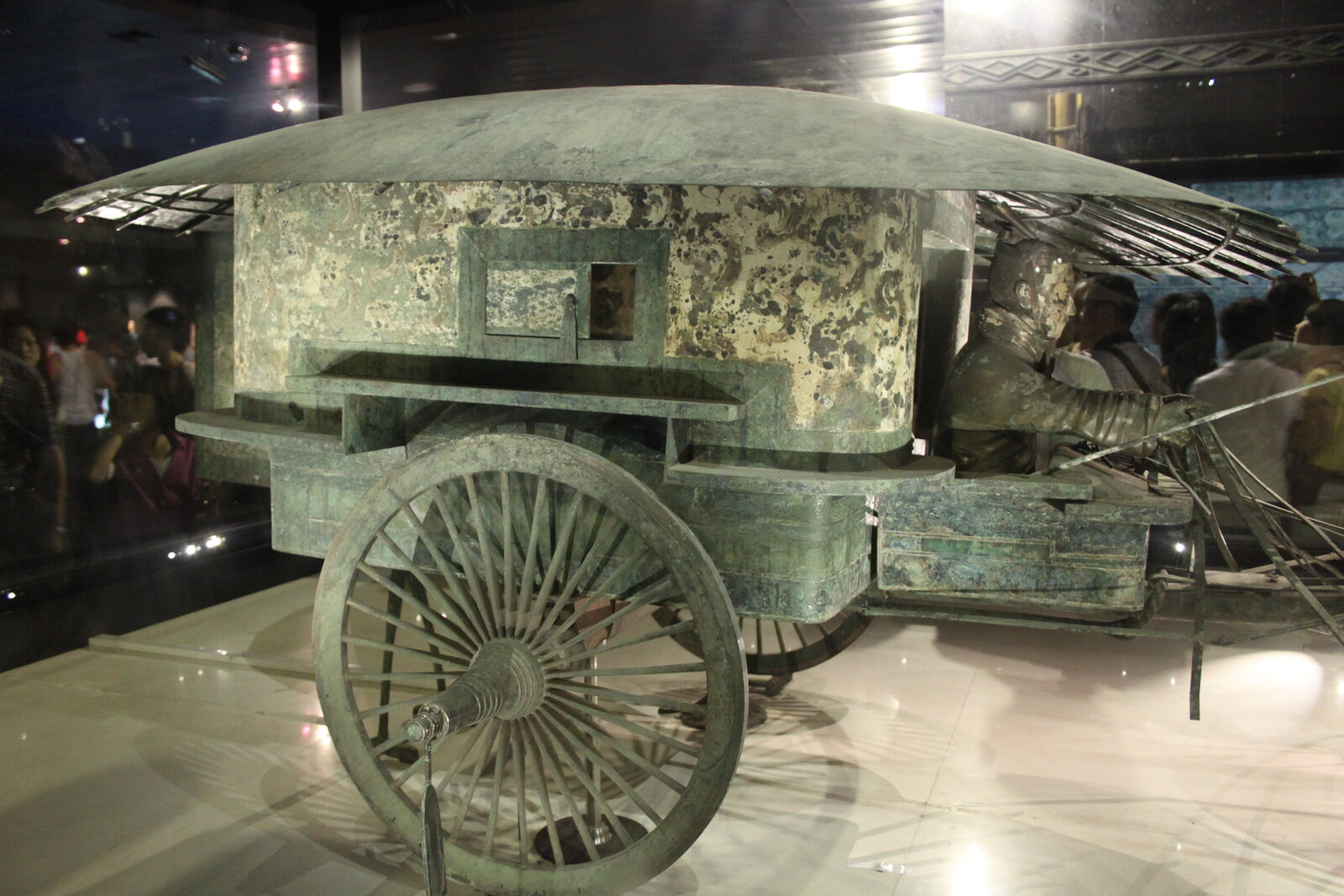
Look around first
What to notice
- Open bronze chariot
- Closed passenger cabin
- Small windows
- Knives on the officials’ belts
The story of the place
In this section of the burial complex beside the burial mound are gathered objects from a court journey: bronze carriages, charioteers, and officials. A closed cabin with small windows, walls, and a roof hid the passenger from the attendants, while the charioteer remained outside. Knives and whetstones can be seen on the belts of the clay officials; they were used to scrape incorrect characters from bamboo slips. The carriage and these small tools show how the court controlled the distance between a person, his retinue, and a written order.
Twenty meters from the burial mound, craftsmen buried two bronze chariots about half the size of real ones. An open carriage with an armed charioteer was placed in front; behind it stood a vehicle with a closed passenger cabin and windows. Southwest of the Mausoleum of Qin Shi Huang, they arranged another pit: eight figures whom archaeologists consider court officials, four charioteers, a wooden chariot, and horses. Knives and whetstones were molded onto the officials’ belts. Such knives were used to scrape erroneous characters from bamboo documents.
In two hundred ten BCE, Qin Shi Huang, the first ruler of a unified China, set out on another journey through the provinces. He sought to ensure that orders from the capital were carried out in the recently conquered lands as well. On the way back, the emperor died in Shaqiu, far from the capital of Xianyang.
Nearby was Chancellor Li Si, head of the civil administration. He feared a rebellion after the ruler’s sudden death and wanted to preserve his own position. Zhao Gao held the imperial seal and the last letter. Zhao Gao was head of the palace chariot service and tutor to Huhai, the emperor’s younger son. Zhao Gao sought the throne for his pupil, whom he hoped to control. Huhai himself agreed to become the next emperor.
A late chronicle, compiled about a century later, tells how Li Si ordered the death concealed. The body was placed in a closed carriage. Most of the entourage continued to believe that the ruler was alive: officials handed reports and food into the carriage, while close attendants answered on his behalf. When it became difficult to conceal the decomposition, a cart of salted fish was added to the procession.
Before us is a burial model of a closed imperial carriage from the same period. Its cabin shows why the deception was possible at all: walls, a roof, and small windows separated the passenger from the entourage. For orders to be considered genuine, all that remained was to stamp the document with the seal.
Before his death, Qin Shi Huang managed to seal a letter to his eldest son, Fusu: Fusu was to hand the troops over to General Meng Tian and come to Xianyang for the funeral. Zhao Gao did not send the letter. Together with Li Si and Huhai, he drafted a new decree: it declared Huhai the heir and ordered Fusu to take his own life. Fusu obeyed the document, which he considered his father’s will.
In Xianyang, the death was finally announced, Qin Shi Huang was buried here, and Huhai took the name of the Second Emperor of Qin. Two years later, Zhao Gao accused Li Si of treason and secured his execution. Another year later, he forced Huhai to take his own life. The next ruler ordered Zhao Gao killed, and soon the Qin dynasty ceased to exist.
The bamboo slips from that journey decayed. Beside the Mausoleum of Qin Shi Huang remain the closed bronze cabin and the knives on the belts of the clay officials: the carriage in which they concealed the dead man, and the tools of people required to correct what had been written.
Useful on site
Official ticket checks: 08:30-17:00 in high season; 08:30-16:30 in low season. Check holidays separately.
Opening hours by day
First examine how the carriages are constructed, then the small details of the harness and writing implements; not all of them are visible from afar.