 Guide On Map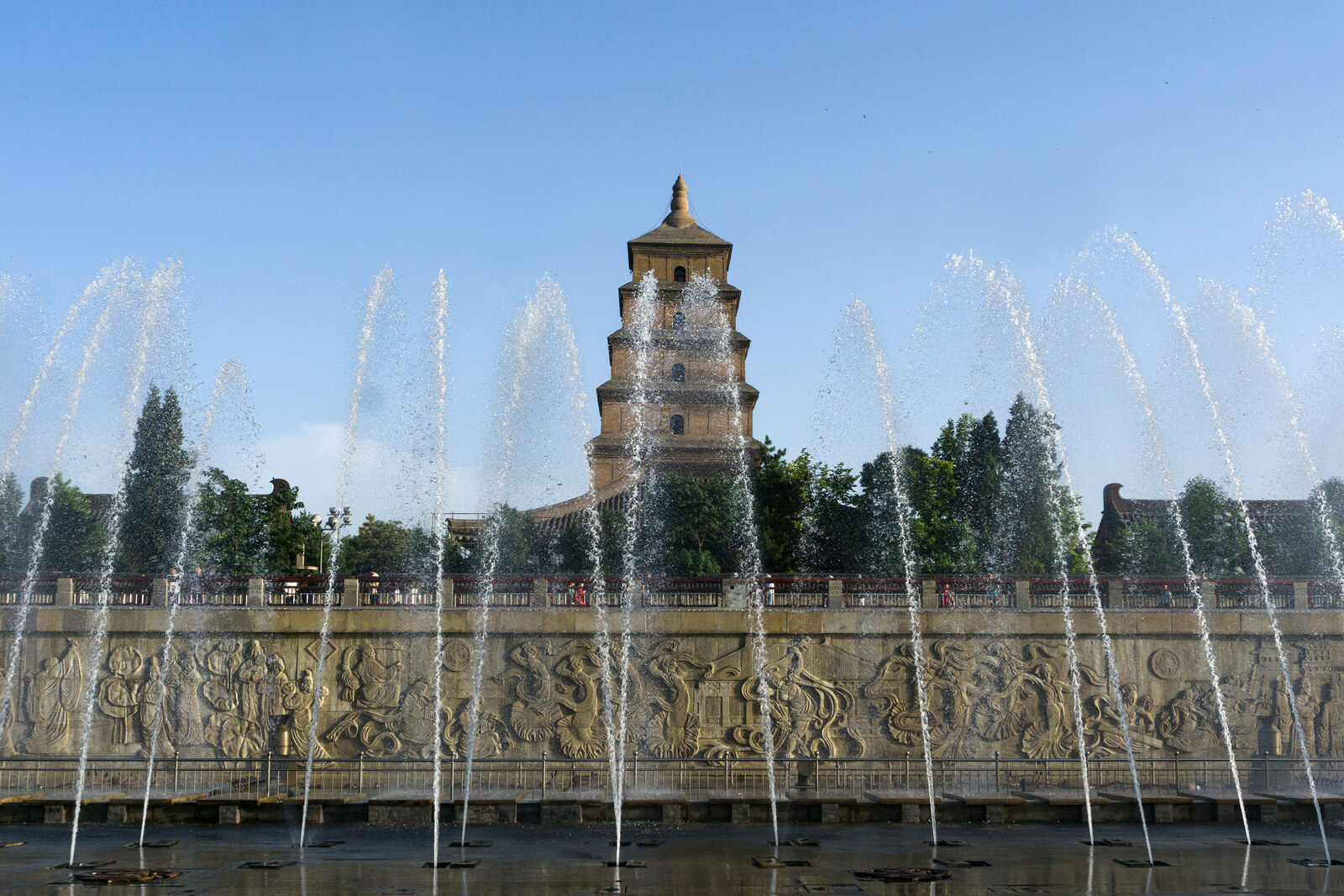
Look around first
What to notice
- Seven tiers of the pagoda
- Thick brick facing
- Two stone tablets by the southern entrance
The story of the place
The seven tiers of the present pagoda stand on the site of a much lower tower with five levels, an earthen core, and brick walls. When it quickly weathered away, it was dismantled and rebuilt at the beginning of the eighth century with money from the empress and the court; wars and repairs later changed its height more than once. The thick brick facing added by Ming Dynasty masters conceals much of this long reconstruction. Two Tang Dynasty stone tablets remain by the southern entrance, with imperial prefaces copied by the court calligrapher Chu Suiliang.
In six hundred fifty-two, Xuanzang, the abbot and translator at Daci'en Temple, asked Li Zhi of the Tang Dynasty to build here a stone tower about ninety meters high. It was needed neither for bells nor as a place of prayer. Xuanzang wanted to lock away inside it, safe from fire and damp, hundreds of Sanskrit manuscripts, Buddha statues, and relics brought from India.
He already knew how easily such a cargo could be lost. While crossing the Indus River on his return journey, Xuanzang lost about fifty bundles of manuscripts. The rest were carried across mountains and deserts on pack animals. The monk returned to Chang'an—what Xi'an was called then—in six hundred forty-five. Emperor Taizong offered him an official post: the information held by a man who had traveled through dozens of states was useful to the court. Xuanzang refused and asked to be allowed to translate.
He lived as a monk supported by imperial monasteries. The court provided rooms and assistants, but without the emperor's consent Xuanzang could not build a repository for his cargo. Li Zhi approved the tower, but the original stone plan proved too expensive. They built five tiers with an earthen core and a brick casing. A biography compiled by his disciples claims that Xuanzang himself carried bricks and stones at the construction site.
Inside each tier, chambers were made for manuscripts, images, and relics. Translators worked nearby: one read the Sanskrit original, while others worked out its meaning, chose Chinese words, checked the text, and copied it out. Before Xuanzang died, his group translated seventy-five works—one thousand three hundred thirty-five scrolls. He did not have time to finish all that he had brought, but the Chinese translations spread through the monasteries of East Asia. The pagoda arose as a protected repository beside a translation workshop.
There is no point looking for the first five tiers before your eyes. The earthen core and brick casing quickly weathered away. At the beginning of the eighth century, Wu Zetian and the court paid for the tower to be dismantled and rebuilt; later, wars and repairs changed its number of tiers again, and Ming Dynasty masters added a thick brick facing outside. The present seven-tier pagoda preserves the site of Xuanzang's repository, but not its original volume.
Its name, too, has not survived in its original form. At first the tower was called the Ci'en Temple Pagoda. The goose name is usually linked to a legend that Xuanzang recorded in India. Monks of one community ate meat, but one day they could not obtain any. Seeing a flock overhead, one of them said that the bodhisattva should remember their meal. At that moment, a goose fell before them and died. The monks took this as a rebuke, buried the bird, erected a stupa over it, and gave up meat. This is a Buddhist legend, not a documented incident in Chang'an. The pagoda became “Giant” later, when another, smaller Goose Pagoda appeared nearby.
The Sanskrit manuscripts for which Xuanzang initiated the construction have not survived here as a single collection; their later fate is unknown. But two Tang Dynasty stone tablets remain on either side of the southern entrance. One bears Emperor Taizong's preface to Xuanzang's translations, the other the text by Li Zhi. Both were copied by the court calligrapher Chu Suiliang. The tablets stand where imperial money, the labor of translators, and brickwork were meant to protect books that had once already fallen into the river.
Useful on site
Viewing from outside is easier; check separately whether climbing inside is permitted under the current rules.
Checked: date not specified. Check the official source before visiting.First, walk around the base and examine the masonry from the ground. Climbing inside may have separate access conditions; decide on it separately, and do not plan your route around that possibility.