 Guide On Map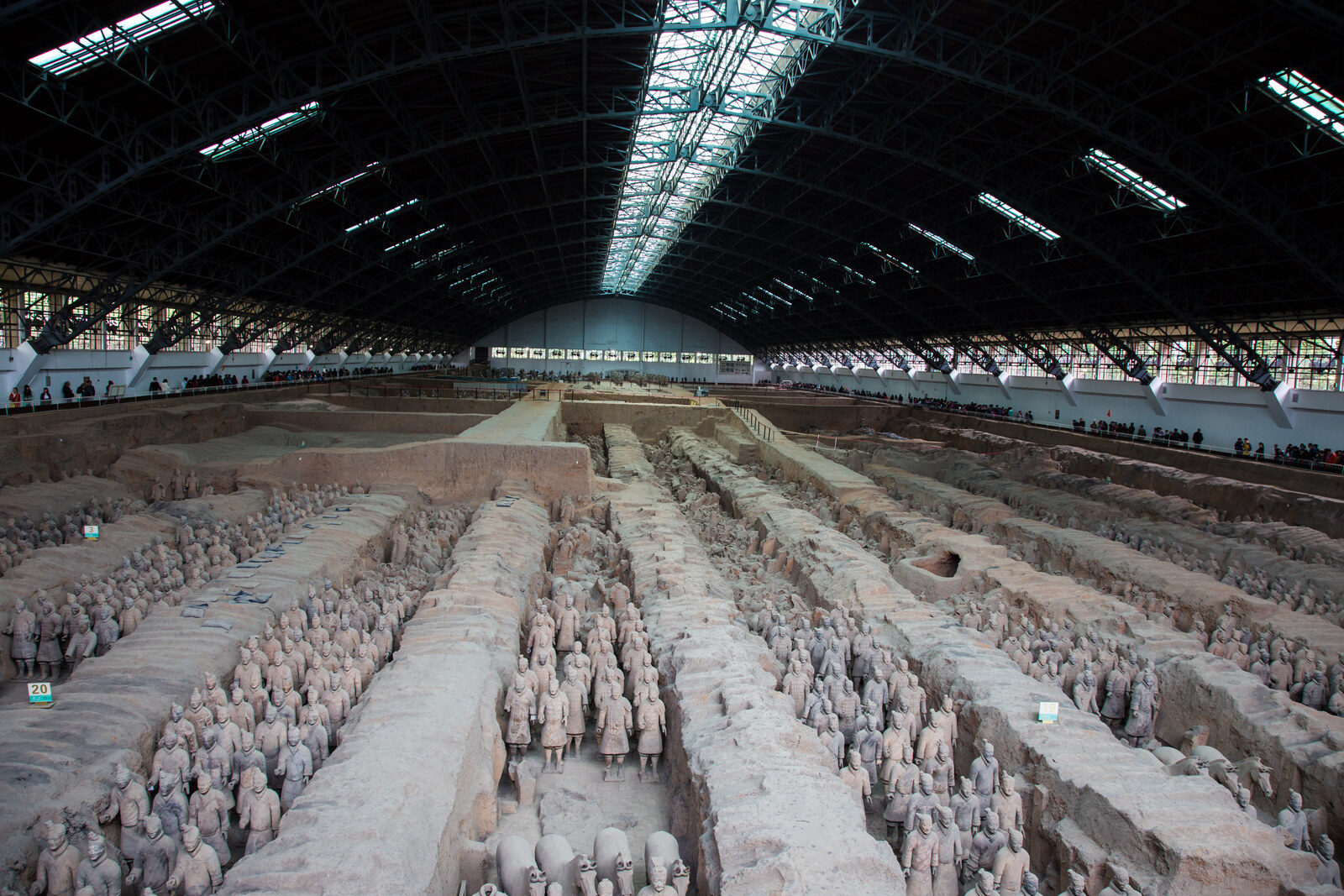
Look around first
What to notice
- Front rows of reassembled warriors
- Separate heads and torsos
- Scatterings of terracotta fragments
- The pit's long corridors
The story of the place
Behind the front rows of clay warriors, eleven corridors of the underground hall recede into the distance. They were once roofed with logs, mats, and a thick layer of earth, while infantrymen stood inside beside chariots and horses. This is how, about one and a half kilometers from the burial mound of the first emperor of unified China, the main part of his east-facing burial army was created.
The first archaeologists did not see orderly ranks of warriors here at all. Beneath the collapsed roof lay separate heads, torsos, horses' legs, and tens of thousands of fragments. Almost every intact figure standing in formation today was reassembled.
In the late third century BCE, craftsmen created an underground military unit about one and a half kilometers east of the burial mound of Qin Shi Huang, the first emperor of unified China. They roofed eleven long corridors with logs, mats, and a layer of earth. Inside, they placed infantrymen, chariots, and horses. From the density of finds, archaeologists estimate that there were about six thousand of them. This is the main body of the burial army, facing east. Why it was placed on this particular side of the Mausoleum of Qin Shi Huang is not known with certainty; the layout and direction of the formation are established, but the explanations remain hypotheses.
A few years after the emperor's death, the Qin dynasty perished in uprisings. People entered the pit, carried off some of the genuine bronze weapons, smashed the figures, and set fire to the wooden structures. Archaeologists found looters' tunnels, charcoal, and baked earth. The chief suspect is Xiang Yu, a rebel commander who was finishing off the remnants of the Qin state: an ancient chronicle reports that his army looted the burials and burned the structures of the Mausoleum of Qin Shi Huang. But there is no direct evidence that he himself ordered the fire to be set in Pit 1.
When the roof structures burned through, earth collapsed onto the warriors. The hollow clay bodies shattered, fragments became mixed among neighboring figures, and water and the pressure of the soil continued to damage them after the fire. The formation created for the emperor's burial remained intact for only a very short time.
Restorer Liu Jiangwei received Pit 1 as his first major independent assignment. Several rows of tens of thousands of sherds lay on long strips of film, each about a meter wide and seven or eight meters long. A mistake meant gluing a fragment to the wrong figure and damaging both figures while correcting it. Liu decided at first not to assemble anything. For six months, his team only sorted the fragments by body part and presumed figures.
After that, they began assembling each warrior from the legs upward. The recovered parts were temporarily held together with bands; adhesive was used only when the entire construction matched. If a suitable fragment was missing, Liu forbade filling the gap with guesswork. Such a figure remained unfinished and waited until the needed sherd was found in another pile.
In the front rows of Pit 1 stand warriors reassembled by restorers. Farther back, in open areas, separate heads, torsos, and scatterings of fragments are visible—the same formation before six months of sorting, bands, and adhesive.
Useful on site
Official ticket checks: 08:30-17:00 in high season; 08:30-16:30 in low season. Check holidays separately.
Opening hours by day
First take in the whole hall, then choose one section and examine the differences in faces, hairstyles, and armor.