 Guide On Map
The Temple Slopes of Higashiyama and Gion
From Kiyomizu-dera Temple through the old slopes to Gion Shirakawa
Guide On Map on your phone
Open the walk like a regular app
It takes about 10 seconds to install. No app store needed.
The whole path
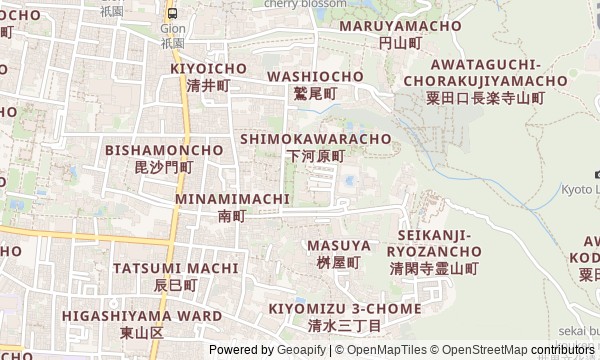
Route map
About the walk
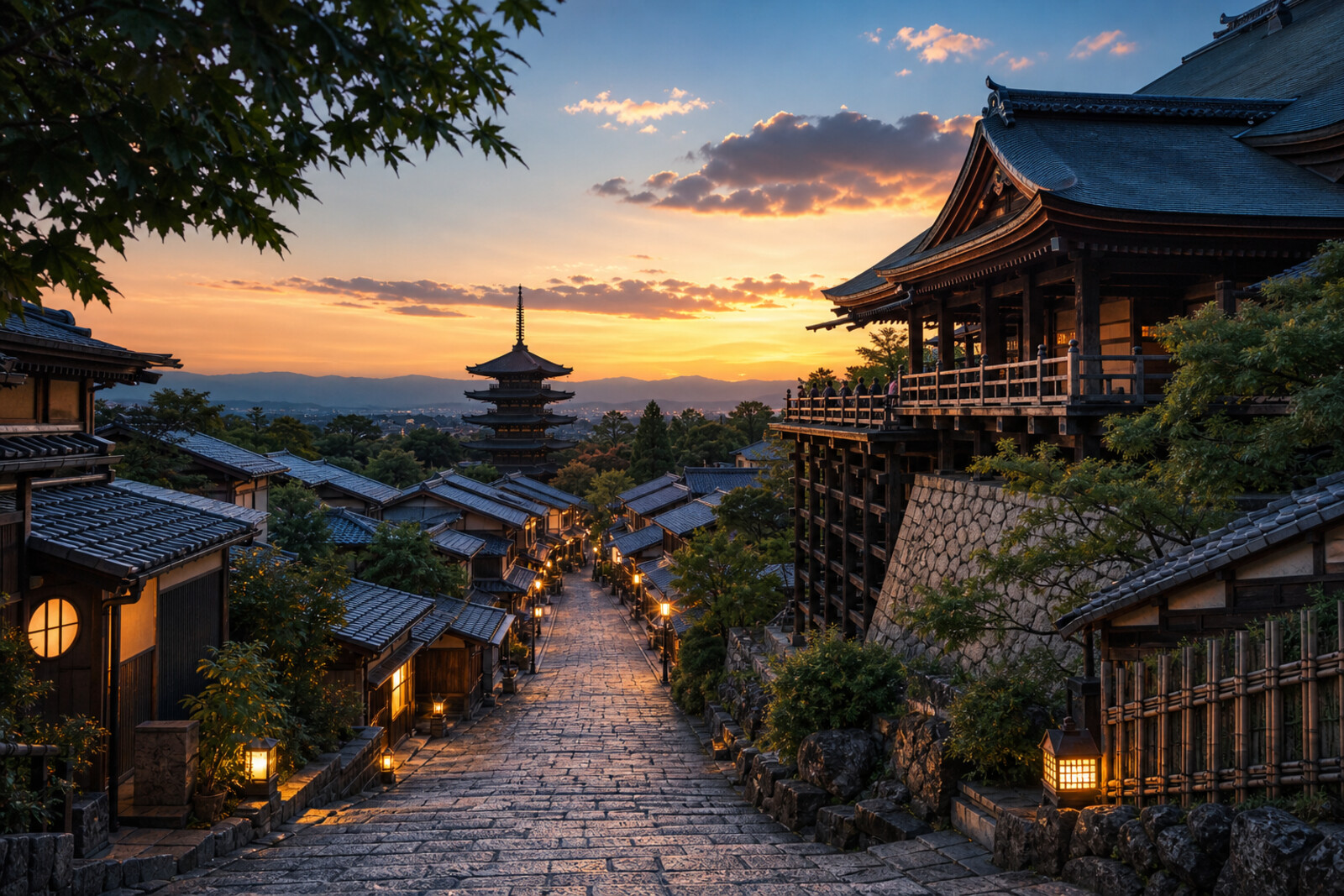
You will begin high up, at the wooden stage of Kiyomizu-dera Temple, then descend the shopping slopes toward the pagoda, Nene-no-Michi, and the gates of Yasaka Shrine. After that, you will walk Hanamikoji-dori and finish by the water at Gion Shirakawa.
First come the temple grounds and a view over Kyoto. Below lie stone steps, shops in old houses, a five-story tower, and neighborhoods of private tea-house gatherings.
You will need to work out why a pilgrim climbs over the stage railing, what an empty gourd is meant to save people from, and for whom an artist rents two rooms. Later, a Buddhist attendant changes robes, while a stone by the river recalls a room above the water.
The story will separate legends from recorded cases and connect major changes to everyday decisions. By the end, you will be able to tell apart the old pilgrimage road in eastern Kyoto and the urban order people built around it.
Why this order
Kiyomizu-dera Temple places you at the high point of the pilgrimage road: the stream of people heading for the temple is exactly what explains the shops of Sannenzaka below. From the slope, Yasaka Pagoda appears between the communities of Gion and Kiyomizu, so a story about a preserved street gives way to the conflict over it. From the tower, you return to Ninenzaka, where rooms above the shops show that this protected ensemble was once a lived-in street. The northern exit from the slope brings you to Nene-no-Michi, where the site of Nene's house, Kodaiji Temple she built, and the road to Yasaka Shrine all lie close together. Through the shrine's western gate, you reach Shijo-dori, the street that linked it with Gion. From there, Hanamikoji-dori leads between tea houses to the theater and school, while the return north along Shijo-dori ends the route at Shirakawa River, where the neighborhood's literary story is tied to one vanished house.
For a first visit to Kiyomizu and Gion For anyone who wants human stories behind familiar views For lovers of urban history, temples, and old shopping streets
For anyone looking for a walk without steps and descents For anyone who only wants an overview of temple architecture For anyone who prefers to spend most of the route indoors
Before you go
Choose shoes with reliable grip: the stairs and smooth stone need attention, especially after rain. Leave extra time for Kiyomizu-dera Temple and Kodaiji Temple—their inner grounds are not just a quick backdrop along the way, and visits to temple areas are arranged separately from the street walk. Access inside Yasaka Pagoda can be limited, so plan mainly to view it from outside. In Gion, watch for signs marking private property, do not go beyond barriers, and do not point a camera at people on their way to work.
When to go
The route works best when you start in the afternoon: you can still see the structure of Kiyomizu-dera Temple, the steps, and the facades in detail, then reach Gion in soft light and under lit lanterns. Do not start too late if you want to see the inner grounds of Kodaiji Temple rather than only walk along Nene-no-Michi.
Backup plan
If the crowds are heavy, do not linger for one viewpoint: hear the story, take in the wooden structure, and keep descending—the route reveals itself through changing spaces, not a single frame. In rain, shorten stops on the stairs and pause on level stretches, without rushing across wet stone. If the temples' inner areas are closed or time is short, keep the full street route: the pagoda from outside, Nene-no-Michi, the grounds near Yasaka Shrine, Hanamikoji-dori, and the bank of Shirakawa River still make a coherent ending.
Route conditions
Surface. Paved — 1.3 km (data covers 53% of the route)
Stairs. Flights: 4, 152 m in total
Access. Wheelchair — no; stroller — limited (stairs)
Facilities. Toilets — 14
Elevation. Ascent — 2 m; descent — 70 m
OpenStreetMap extract of June 18, 2026: database data, not a check on the ground. Data © OpenStreetMap contributors, ODbL licence
Walk plan
Open in maps ↗- 1
Kiyomizu-dera Temple
This stop will show how the pilgrims' dangerous vow came to be connected with Kannon, temple oversight, and an expression that still lives on. - 2
Sannenzaka
It explains why merchants and homeowners first improved the route for customers, then agreed to preserve its facades. - 3
Yasaka Pagoda
This will connect the five-tiered tower with a dispute between two religious communities and the people who erected it again on its original site. - 4
Ninenzaka
It will return to the residential street the two rooms rented by an artist for a shared life that never began here. - 5
Nene-no-Michi and Kodaiji Temple
It will show how Hideyoshi's widow established a home, a memorial temple, and her own mausoleum nearby under the new government. - 6
Yasaka Shrine
It will explain which names, images, and structures had to be removed for a mixed complex to become a Shinto shrine. - 7
Hanamikoji-dori
It explains how an annual dance, a school, and a theater turned former temple land into Gion's main street. - 8
Gion Shirakawa
It connects the stone by the water with an ochaya room, a poetic line, and a house that is no longer there.
Route features
Everything you need stays in the browser
Progress, saves and your trip plan are stored on this device.
Add Guide On Map to your home screen so the walk opens outside the browser.
How we handle sources, maps and corrections: our editorial standards