 Guide On Map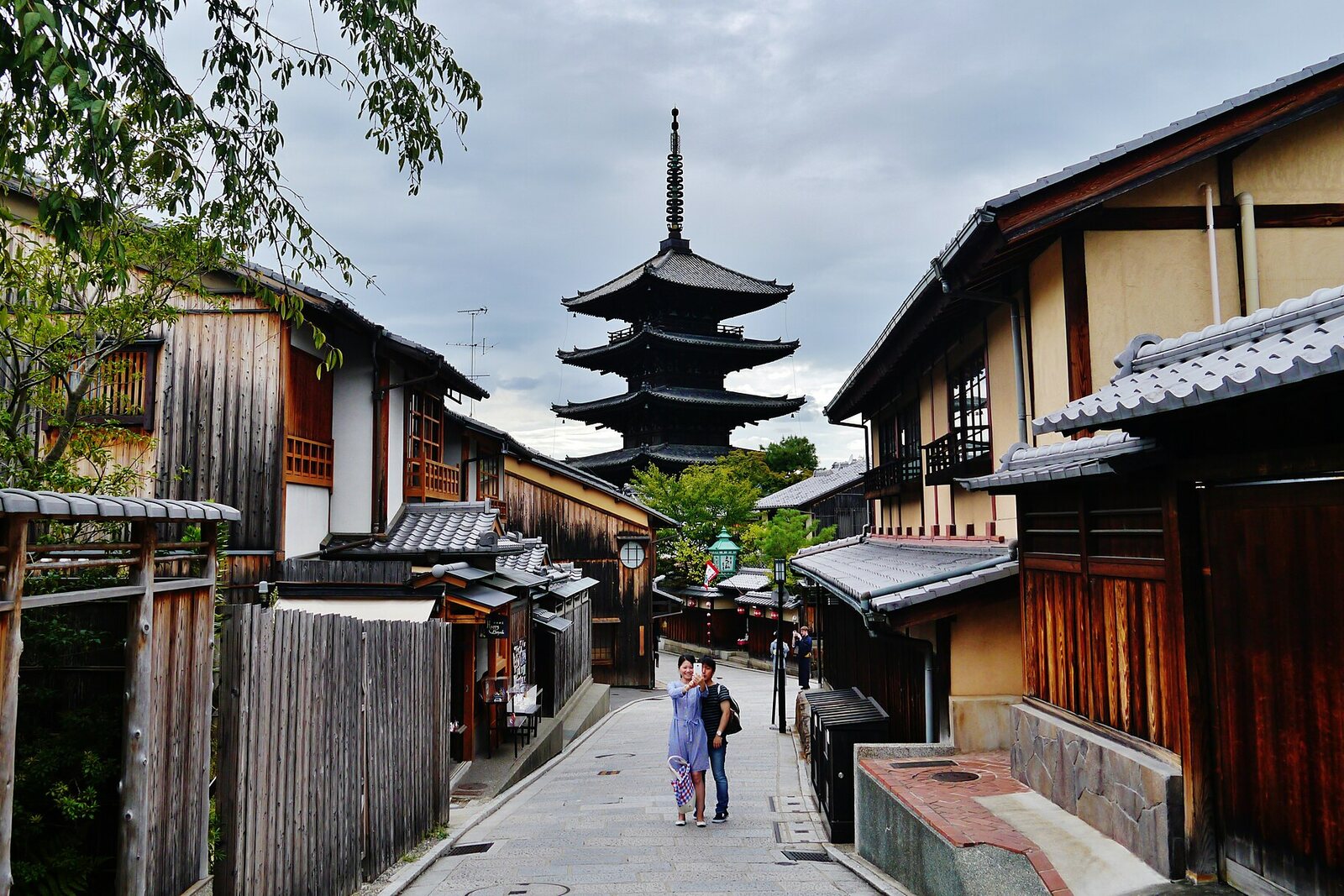
Look around first
What to notice
- Five wooden tiers
- Tiled roofs
- Central post
The story of the place
Yasaka Pagoda is the main surviving structure of Hokan-ji Temple. Its name is older than the present tower: a temple called Yasaka-dera was mentioned here as early as eight hundred thirty-seven. Researchers link its foundation to the Yasaka-no-miyatsuko, a lineage of settlers who made their home on this slope. Temple tradition attributes the first pagoda to Prince Shotoku and a prophetic dream; it is only a tradition. Finds of ancient roof tiles confirm only that the temple already stood here in the seventh century.
The pagoda stood almost midway between two large religious communities. To the north was Gion Shrine, now Yasaka Shrine; to the south was Kiyomizu-dera Temple. Shashaku lived along the road, carriers who earned their living delivering cargo by cart along the steep Kiyomizuzaka.
In eleven fifty-seven, Emperor Go-Shirakawa imposed bajo-yaku, a levy for the annual procession of Gion Shrine, on prosperous urban households. The name meant “horse service,” but it was primarily about money: designated townspeople paid for part of the festival. For Gion's community, the procession depended on it; for the carriers, the levy took away part of their earnings.
On May fourteenth, eleven seventy-nine, the dispute over this obligation turned into a clash. People from Gion Shrine moved toward Kiyomizu-dera Temple, while temple monks and carriers from the slope came out to meet them. The chronicle does not identify a single culprit: both sides set buildings on fire. Temple buildings and homes burned down, and the five-tiered Yasaka Pagoda was reduced to ashes.
The abbot of Hokan-ji Temple, named Shoa, began seeking its restoration. He appealed to Minamoto no Yoritomo, leader of the eastern warriors, who was soon to become the first shogun of Kamakura. Twelve years after the fire, Yoritomo provided the funds, and the pagoda was rebuilt. For the communities in dispute, the clash thus ended with a burned-out neighborhood; for Shoa, with a new patron and a restored tower.
Yoritomo's tower burned down in twelve ninety-one. The next one was destroyed by fire in fourteen thirty-six. The present wooden pagoda was built in fourteen forty by order of Shogun Ashikaga Yoshinori. After every fire, people erected it on the same site: beneath the central post, the buried foundation stone of the earliest tower has survived. The wood above ground dates to the fifteenth century, while the spot for the pagoda was chosen by the people of Yasaka some eight centuries earlier.
Useful on site
It is best viewed from the street as an urban landmark; interior access and special openings should not be considered guaranteed without a separate check.
Checked: June 16, 2026. Check the official source before visiting.Plan to view it from the street: access inside is not continuous. Do not block the roadway or house entrances while choosing a spot for the overall view.