 Guide On Map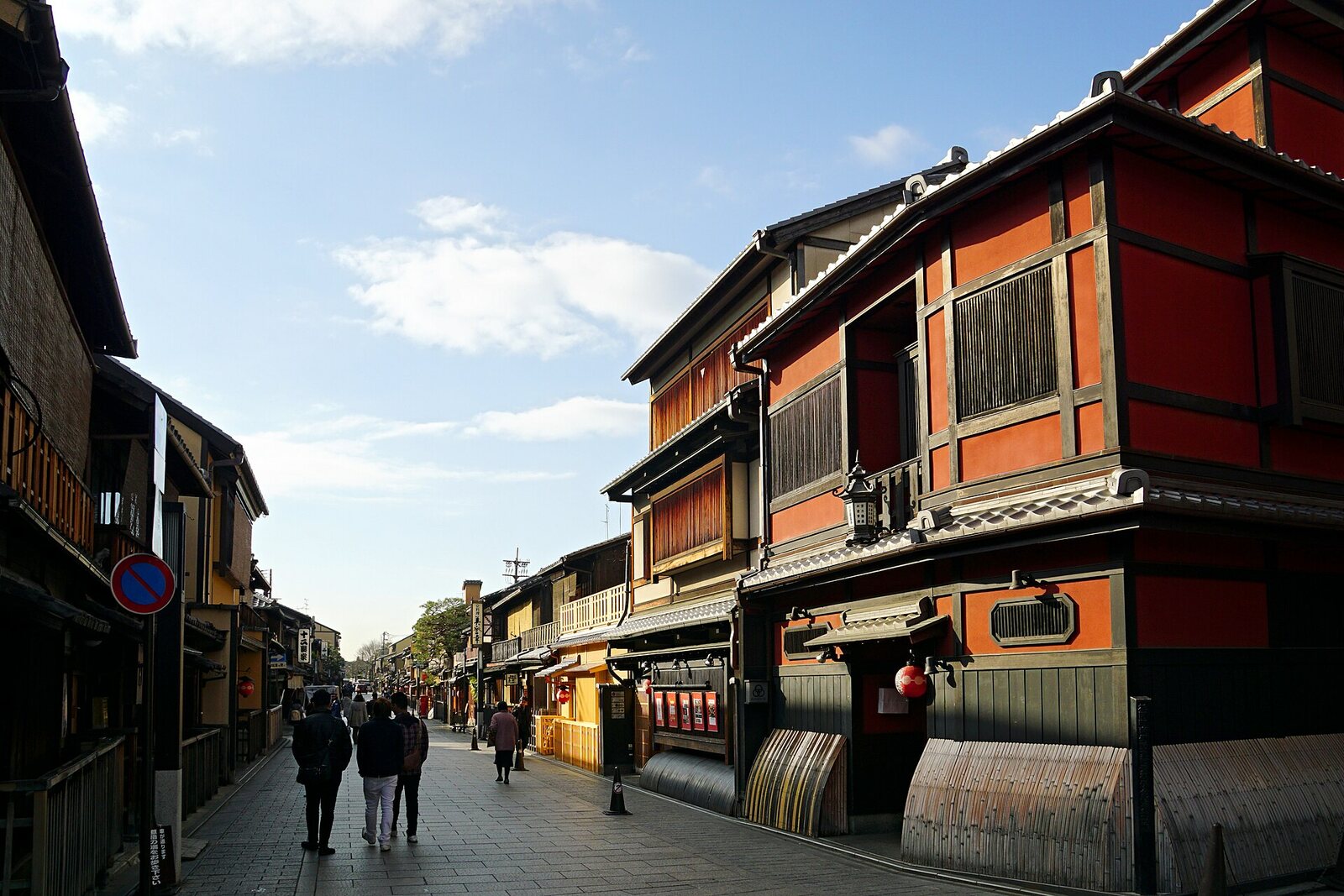
Look around first
What to notice
- Lattice façades
- The red fence of Ichiriki Chaya
- Gion Kobu Kaburenjo
- The school building
The story of the place
Between Shijo-dori and the gates of Kennin-ji Temple, Hanamikoji-dori crosses former temple land. Until the eighteen seventies, this stretch of street did not exist: the fences and small residences of Kennin-ji Temple stood here.
After the imperial court moved from Kyoto to Tokyo, officials, courtiers, and their families left Kyoto. Deputy Governor Masanao Makimura decided to bring visitors back to the city with a major exhibition. For its entertainment program, he turned to Jiroemon Sugiura, the head of the local district and the ninth proprietor of the tea house Mantei, present-day Ichiriki Chaya at the intersection of Shijo-dori and Hanamikoji-dori. Sugiura earned his living from private receptions: the number of guests determined the fortunes of both his house and neighboring establishments.
Sugiura enlisted Haruko Katayama, the third head of the dance school under the name Inoue Yachiyo III. Instead of the usual small-scale performance in a room, they devised a group dance by geiko and maiko for a large public. They called it Miyako Odori, “Dances of the Capital.” The first performance took place in the spring of eighteen seventy-two in another part of Gion. Audiences received it so well that the following year a former residence of Seijuin near the future Hanamikoji-dori was converted for the performance. The dance became annual, and the Inoue School received the exclusive right to train the performers of Gion Kobu in it.
In those same years, the authorities were abolishing the former system of debt contracts that had allowed women to be kept at establishments. The Women's Handicraft Company, created with Sugiura's involvement, was meant to provide geiko and other women of the district with occupations they could live on: at first, sewing, weaving, sericulture, and tea preparation were taught here; then dance, music, and the rules of receiving guests took up more and more space. This is how Gion Kobu Nyokoba emerged—a women's school and, at the same time, an organization of tea house owners.
After part of Kennin-ji Temple's land was expropriated, the government transferred this plot to the nyokoba. In eighteen seventy-four, the owners laid out Hanamikoji-dori and several cross alleys here, divided the land into plots, and established tea houses. In nineteen thirteen, the present Gion Kobu Kaburenjo was built for Miyako Odori, and Hanamikoji-dori became the main route between Shijo-dori, the theater, and the school.
Behind the lattice façades, the division of responsibilities that arose then still operates. A tea house arranges a private reception, selects geiko and maiko, and orders food; an okiya, the residence house for performers, provides them with lodging, teaches them the rules of the district, and sends them to performances; the nyokoba conducts lessons; the theater opens their art to the wider public. A maiko walking along Hanamikoji-dori is usually heading from an okiya to a lesson or to a booked reception.
At the northern end of the street, the red fence of Ichiriki Chaya, Sugiura's house, remains. Closer to Kennin-ji Temple stand the theater and school that grew out of the company founded with his involvement. A significant part of the land between them is still managed by its successor, Yasaka Nyokoba.
Useful on site
The street is public and passable during the day and evening, but it is not an open interior of the district: tea houses and private façades do not amount to an invitation inside.
Checked: June 16, 2026. Check the official source before visiting.Hanamikoji-dori is open for passage, but neighboring alleys may be private. Do not follow people in kimono, hold them up for a photograph, or try to enter a private tea house without an invitation.