 Guide On Map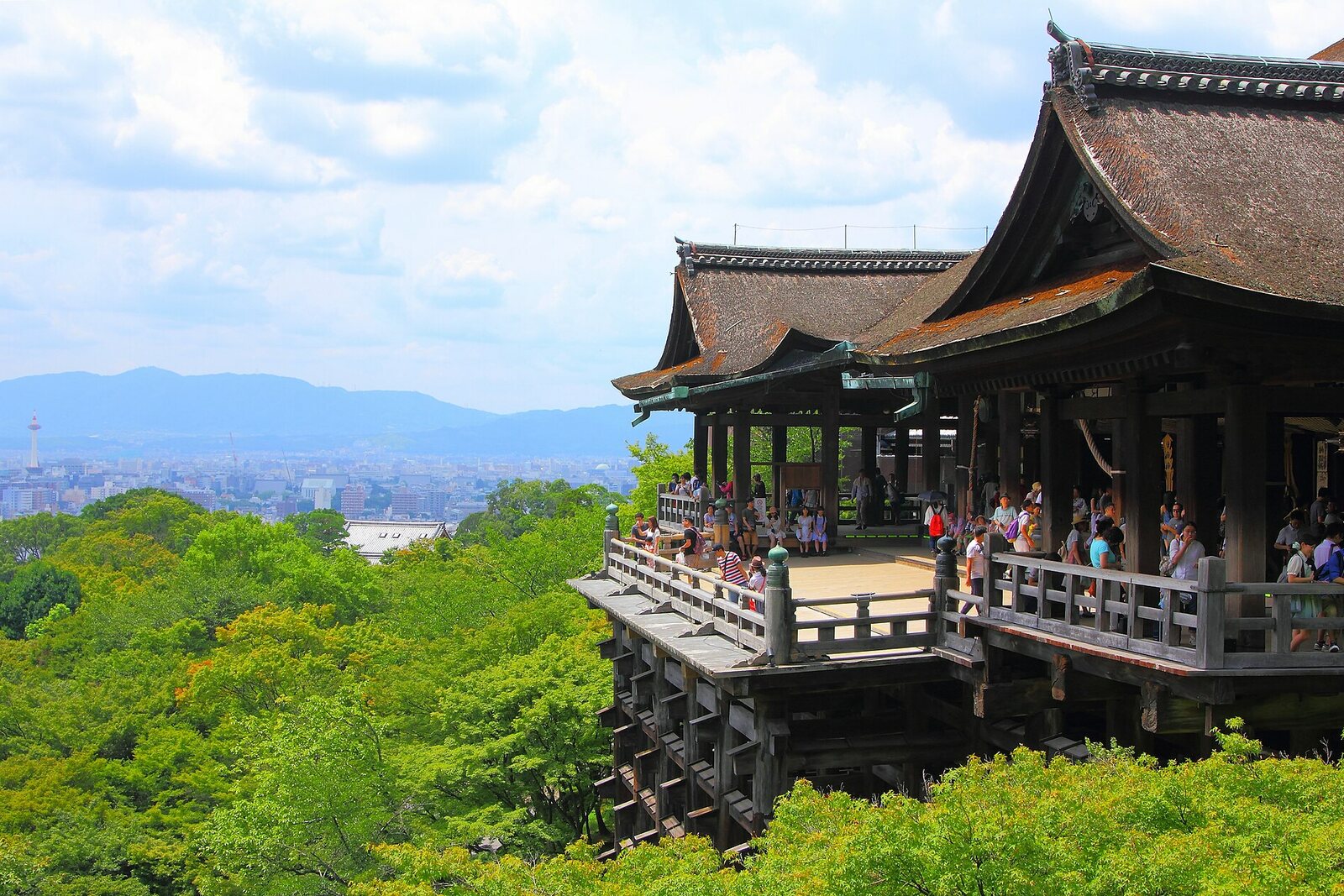
Look around first
What to notice
- Wooden stage
- Main hall
- Three streams of Otowa Waterfall
- Long-handled ladles
The story of the place
On February eighth, eighteen thirty-four, twenty-three-year-old Oe Shuntetsu climbed onto the wooden stage in front of the main hall of Kiyomizu-dera Temple. He had come from the island of Kyushu and was studying medicine in Kyoto. The student wanted to become a skilled physician himself and decided to ask the bodhisattva Kannon, an enlightened intercessor of mercy, for this. After praying, Shuntetsu climbed over the railing and jumped from a height of about twelve meters.
He did not intend to die. In Japan at that time, people believed that if someone entrusted himself to Kannon, jumped from the Kiyomizu stage, and survived, his dearest wish would come true. A mistake cost a life, but survival could be taken as an answer from the deity.
Shuntetsu was lifted up by a gatekeeper, a temple attendant, and workers from tea shops. After the fall, no injuries were found on him. The incident was supposed to be reported to city officials, so the student's mentor and companion were urgently summoned. The mentor asked that no inquiry be started and gave a written undertaking to watch over the young man; the companion added his signature beside it. After that, they were allowed to take Shuntetsu away. The record does not say whether he became a good physician. The stage tested him before his first patient.
This case was preserved in the diary of Jojuin, a temple residence whose attendants kept detailed records of incidents. Between sixteen ninety-four and eighteen sixty-four, they recorded two hundred thirty-four people and two hundred thirty-five attempts to jump. Women made up about seventy percent of those who jumped. More than half were teenagers and young people; the youngest was twelve, the oldest eighty. Almost all belonged to the common people. About fifteen out of every hundred died.
The attendants of Kiyomizu-dera Temple did not consider these jumps an acceptable part of the ritual. They repeatedly asked the city administration to permit a protective barrier and stop the pilgrims. In August eighteen seventy-two, Kyoto Prefecture finally banned jumping, and the stage was surrounded by a bamboo fence. The custom ended, but it entered the language: the expression “to jump from the stage of Kiyomizu” still means to decide on an action whose outcome cannot be guaranteed.
The stage itself was intended for another form of offering. At the back of the main hall stands an image of Kannon with eleven faces and a thousand arms, hidden from ordinary view. Court music, dances, plays of the Noh and Kyogen theaters, and later Kabuki were performed before it. The performers faced the image, leaving the panorama of Kyoto behind them. Pilgrims turned a performance dedicated to Kannon into their own dangerous vow.
The temple's name, too, begins with Kannon, but leads down to water. “Kiyomizu-dera Temple” means “temple of pure water.” Temple tradition dates the beginning of its history to seven seventy-eight. The monk Kenshin, seeking the place shown to him in a dream, found Otowa Waterfall on Mount Otowa and the hermit Gyoei. Gyoei gave Kenshin a sacred tree, told him to carve Kannon from it, and disappeared. Kenshin remained by the water, created the image, and later took the name Enchin.
Two years later, the warrior Sakanoue-no-Tamuramaro came to the mountain to hunt deer and met Enchin. After that meeting, he and his wife Miyoshino Takako built a temple here for Kannon. It was named for the clear water of Otowa. The present main hall with its stage was restored in sixteen thirty-three. The image of Kannon is still inside, and below the stage Otowa Waterfall divides into three streams: visitors draw water from them with long-handled ladles and ask for their wishes to be fulfilled.
Useful on site
Opens at 06:00; closing time varies by season and special evening viewings.
Checked: June 16, 2026. Check the official source before visiting.The platform and the waterfall can be crowded; do not block the passage for a photograph. If you decide to approach the water, choose one stream in advance and do not hold up the line.