 Guide On Map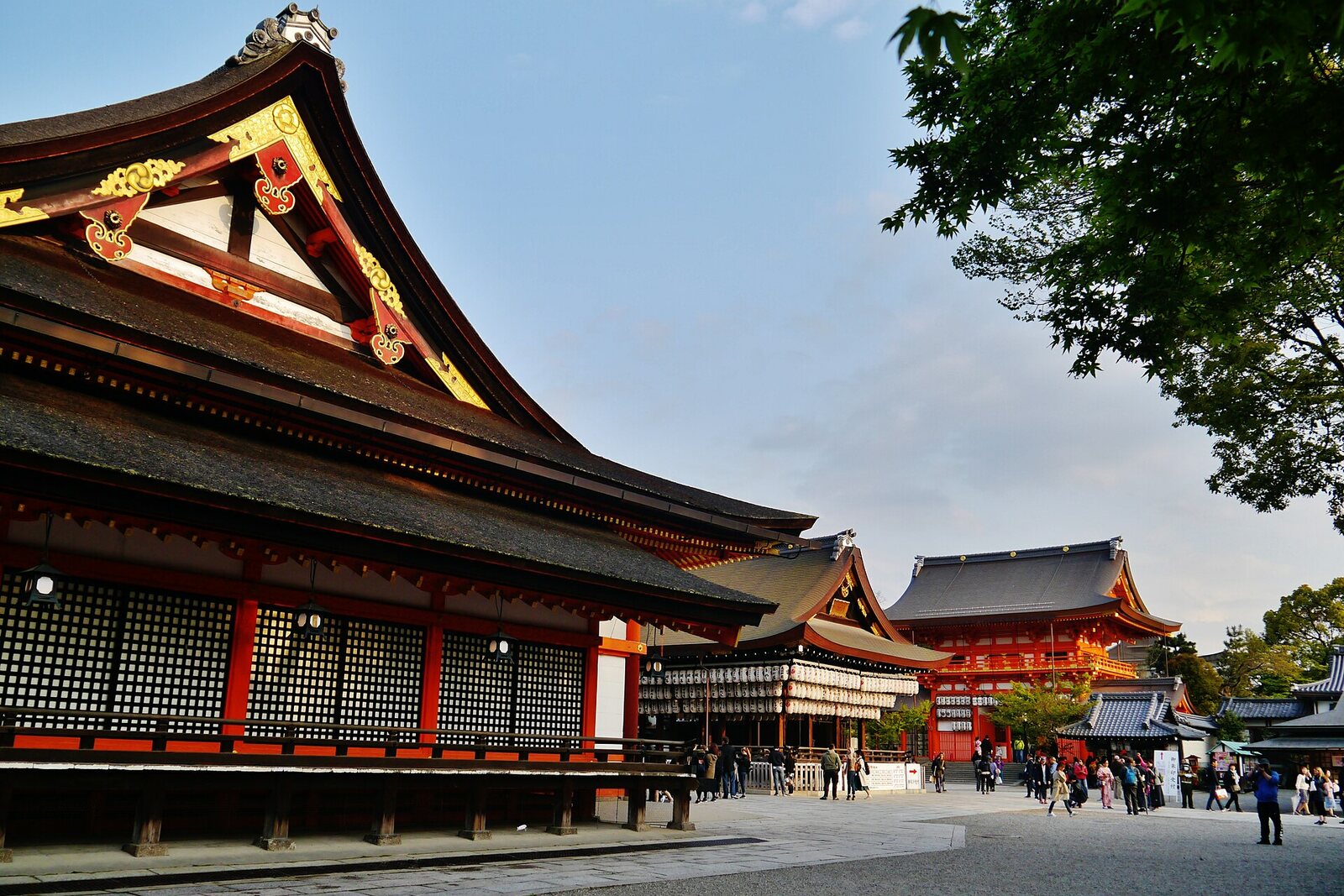
Look around first
What to notice
- Western gate
- Stone basin with the inscription “Kanjin-in”
- Shrine courtyard
The story of the place
Beyond the western gate opens the large courtyard of Yasaka Shrine, from which three portable shrines leave for the city in July and return a week later. For a long time, Gion Kanjin-in stood here, with monks, a hall for Yakushi, the Buddha of medicine, and a bell tower. The townspeople expected the deity here to protect them from epidemics, and Gion Matsuri grew out of this rite. The old name is still carved on the stone basin by the gate, although the hall and bell tower disappeared long ago, and Susanoo officially became the chief deity.
At the beginning of eighteen sixty-eight, the chief Buddhist attendant of the local complex took off his monastic robes and declared himself a Shinto priest. He did so in advance: the new imperial government was preparing to separate Buddhist temples and shrines, while his post and livelihood depended on a place where the two religions had existed together for centuries.
It was then called Gion Kanjin-in. Monks served here, and the courtyard contained a hall for Yakushi, the Buddha of medicine, and a bell tower. Its chief protector was considered to be Gozu Tenno, a deity capable of sending epidemics and guarding against them. He was identified with the Shinto Susanoo.
It was protection from epidemics that linked this place to Gion Matsuri. According to a record compiled many centuries later, in eight hundred sixty-nine the court diviner Urabe Hiramaro was ordered to set up sixty-six spears—one for each of Japan's provinces—and bring a portable shrine from Gion to the imperial garden of Shinsen-en. The townspeople were trying to appease the spirits they believed caused the pestilence. The rite began to be repeated, and Gion Matsuri later grew out of it.
In eighteen sixty-eight, the name Gozu Tenno was banned as Buddhist. The names Gion and Kanjin-in did not suit the new order either: the first went back to an Indian monastery of the Buddha, while the second directly recalled a mixed temple complex. The attendant, now a Shinto priest, chose another name—Yasaka, after the old name of this area found in ancient Japanese texts. He thus kept his post, but could not preserve the former Gion Kanjin-in in its entirety. Buddhist statues were transferred to neighboring temples, Buddhist names were removed even from minor shrines, and the Yakushi hall and bell tower disappeared. Susanoo officially became the chief deity.
On July seventeenth, three mikoshi bearing deities leave Yasaka Shrine, remain in the city for a week, and return here on the twenty-fourth. The festival is still called Gion Matsuri. At the western gate, the name “Kanjin-in” remains carved on a stone ablution basin.
Useful on site
The grounds read as a freely accessible urban sanctuary; the office is open 09:00–17:00. In July, Gion Matsuri changes the entire rhythm of the place.
Checked: June 16, 2026. Check the official source before visiting.The shrine remains a place of prayer even at the busiest hour: do not stand in the line of approach to the altar or interfere with rituals. Festival structures and processions are visible only on the relevant days.