 Guide On Map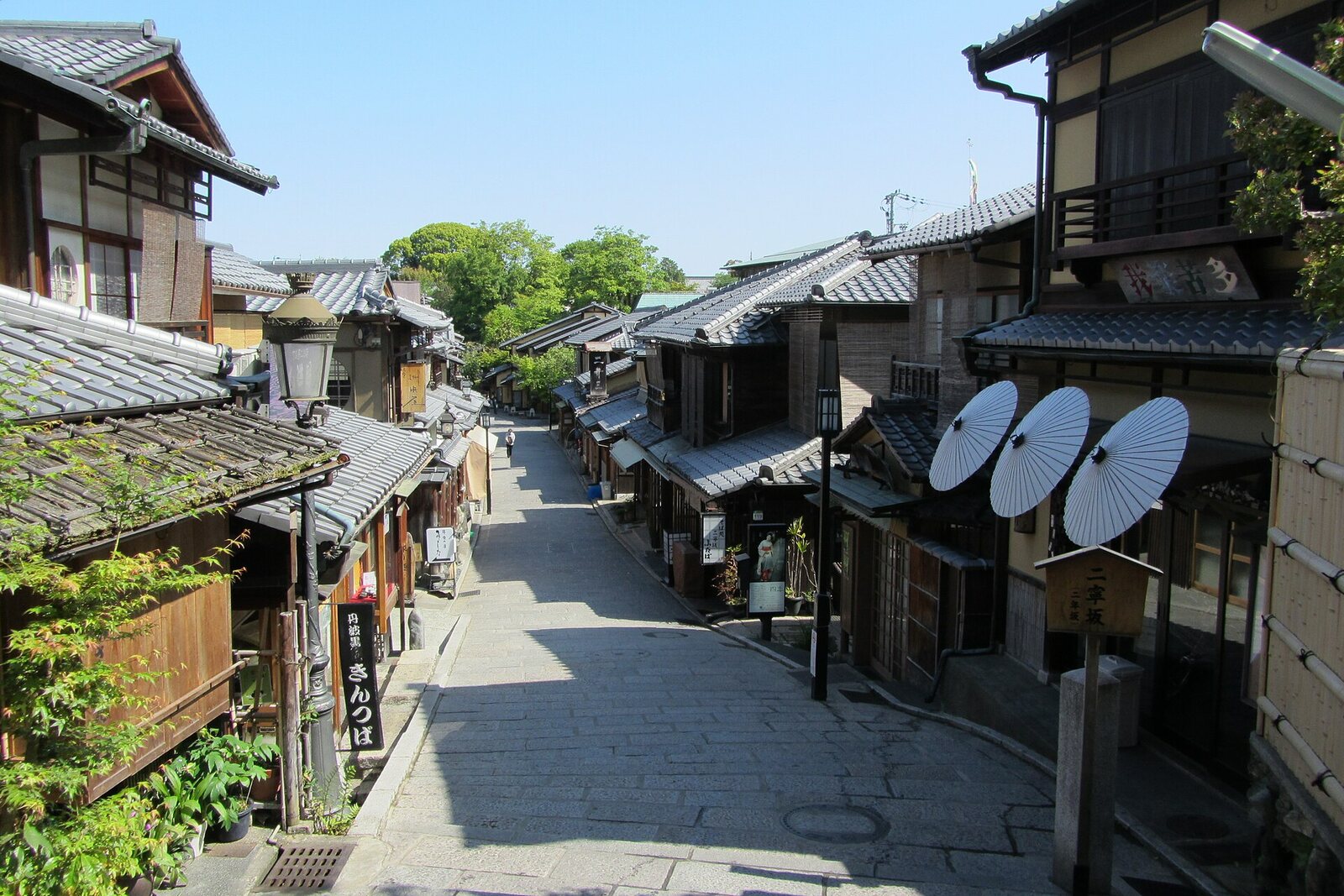
Look around first
What to notice
- Stone pillar
- Stone steps
- Wooden facades
- Second-floor windows
The story of the place
In the middle of Ninenzaka stands a low stone pillar marking the temporary home of the artist Yumeji Takehisa. At the beginning of the twentieth century, this slope served both as the road to Kiyomizu-dera Temple and as a residential shopping street. Shops and teahouses occupied the lower floors, while the rooms above were rented to lodgers. Yumeji Takehisa rented two such rooms here.
The name of the slope is written in two ways: as the “slope of the second year” and as the “slope of double repose.” There is no single proven explanation. According to a common version, it was named after neighboring Sannenzaka, the “slope of the third year”: this road lay before it, so the number was reduced by one. Tradition also links the name to the construction of the road in eight hundred seven.
Yumeji Takehisa came here for Hikono Kasai, an aspiring artist who wanted to study with him and live with him. They met in Tokyo when eighteen-year-old Hikono Kasai came to his shop. It sold postcards, paper, fabrics, and books with Yumeji Takehisa’s drawings; he earned money and became famous through this mass-produced art. The shop was managed by Tamaki, his former wife, the mother of his children, and his long-term business partner. Yumeji Takehisa wanted to break this bond, while Hikono Kasai’s father, the owner of a paper company, watched over his only daughter and refused to let her go to the artist. In their letters, the lovers called Hikono Kasai Mountain and Yumeji Takehisa River.
In the autumn of nineteen sixteen, Yumeji Takehisa left the Tokyo shop and went to Kyoto. In February of the following year, an acquaintance arranged for him to stay in a house on Ninenzaka. The artist settled into two rooms on the second floor with his young son Fujihiko. He brought the child with him and began keeping house, expecting Hikono Kasai to join them soon.
Meanwhile, Hikono Kasai was persuading her family that she was going to Kyoto to study Japanese painting. The negotiations dragged on. Yumeji Takehisa lived on Ninenzaka for about two months and moved out without ever seeing her arrive. Hikono Kasai reached Kyoto only in June; they began living together farther north, by the southern gate of Kodaiji Temple.
In March nineteen eighteen, Hikono Kasai’s father came for his daughter and took her to Tokyo. Yumeji Takehisa was preparing a major Kyoto exhibition and hoped to show its success to Hikono Kasai’s father as proof that he could support a family. With the help of friends, Hikono Kasai briefly returned for the opening, but soon became seriously ill. She was taken to a Tokyo hospital, and her father refused Yumeji Takehisa visits. During their separation, the artist published a collection of poems dedicated to her, “To the Mountain.” In January nineteen twenty, Hikono Kasai died.
Only the name of Yumeji Takehisa is carved on the stone pillar. The inscription is accurate: Hikono Kasai never lived in the rooms on Ninenzaka.
Useful on site
The street is always open; in the morning and late in the day, it is easier to feel the rhythm of the houses here, rather than just the flow of shoppers.
Checked: June 16, 2026. Check the official source before visiting.Do not treat the legend of falling as an excuse for a stunt or a staged photograph: the steps really do require caution. Respect the entrances to occupied homes and businesses.