 Guide On Map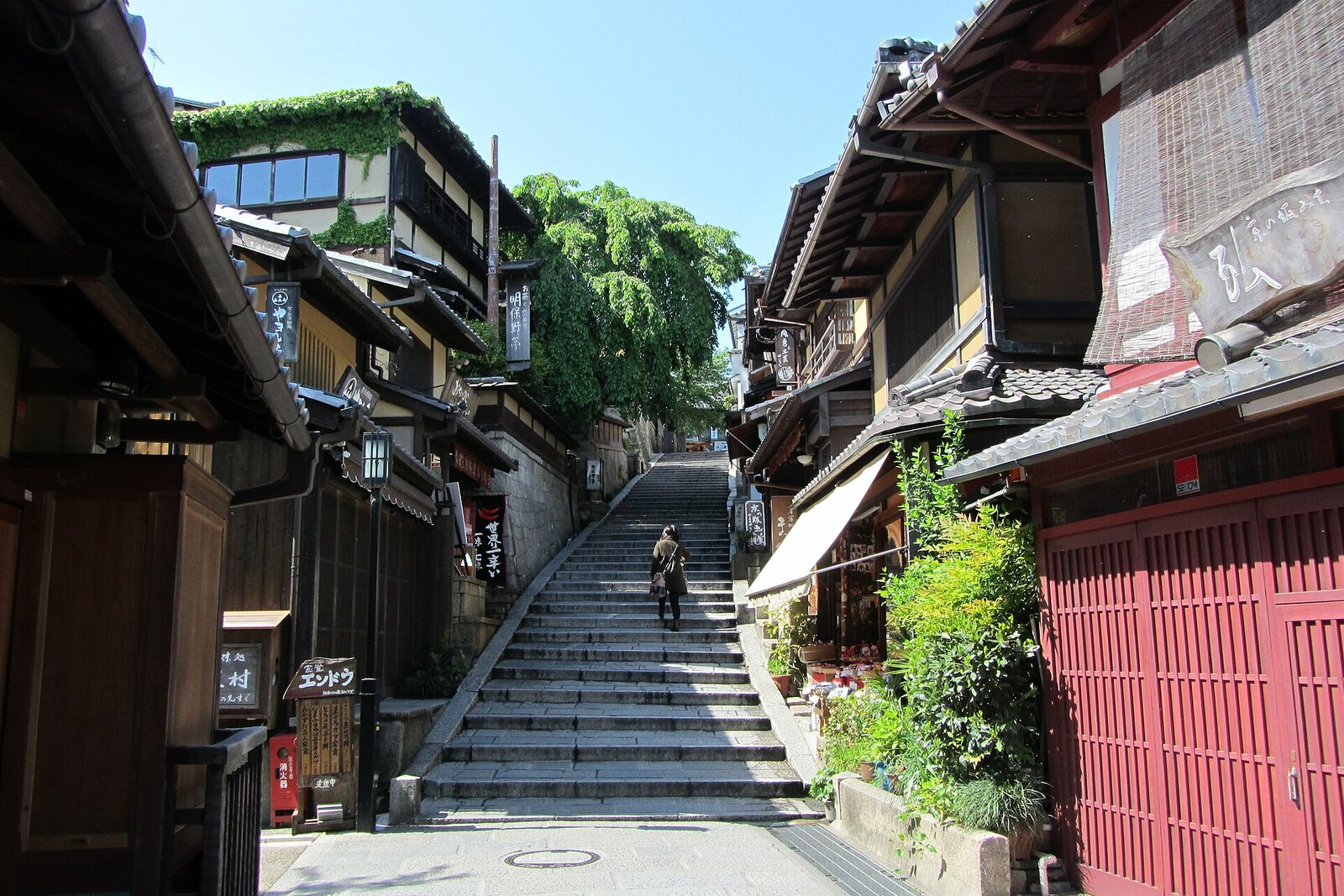
Look around first
What to notice
- Stone steps
- Townhouse facades
- Dried bottle gourds
- Hyotan-ya shop
The story of the place
In nineteen fifty-five, residents of the Kiyomizu neighborhood submitted a petition to city officials: pave the road from Sannenzaka to the neighboring descent. The petition stated plainly why they wanted stone underfoot. People walking between the temples were meant to linger at teahouses, ceramics shops, and souvenir sellers. Many families here lived on pilgrims' money; a good pedestrian route meant customers for them. The city accepted the petition.
Trade appeared on the slope long before modern tourism. People climbed it to Taisan-ji Temple, a small temple within Kiyomizu-dera Temple, where Koyasu Pagoda was believed to help with childbirth. Women went there to pray for a safe delivery. Hence one old interpretation of the name: “san” means birth, “nei” peace and well-being; Sanneizaka became “the road of safe childbirth.”
This is a legend, not the established history of the name. As early as guidebooks from sixteen fifty-eight, three versions appear side by side: Sannenzaka, “the slope of three years”; Sanneizaka, “the slope of safe childbirth”; and Sainenzaka, “the slope of repeated prayer.” A later reference book claimed that the road was laid out in eight hundred eight, the third year of the era then in use, and was therefore called Sannenzaka. No document from that time confirms this date.
But the old belief about three years is recorded precisely. A city description from sixteen seventy-nine already says that anyone who falls on these steep stairs will die before living another three years. Vendors found a remedy for such a sentence. They offered pilgrims small dried bottle gourds: it was believed that when someone falls, the soul slips out of the body, and a hollow gourd catches it and returns it to its owner. A whole row of such shops stood along the steps. A person feared losing their life, a merchant earned money from the charm, and the name “the slope of three years” received a convincing explanation with every purchase.
After the war, the owners of local shops again placed their hopes on pedestrians. In nineteen seventy-one, they joined together in the Higashiyama Pedestrian Road Preservation Society and secured restrictions on cars on Sundays and holidays. The city then proposed preserving not just one staircase, but the entire row of houses. Owners would have to coordinate alterations to their facades; in return, they were promised help with repairs.
Residents feared that after such a decision they would no longer be able to repair their own homes freely, and that the promised money would run out. Officials and homeowners held several rounds of meetings before reaching an agreement. In nineteen seventy-two, Sannenzaka became Kyoto's first special preservation district for historic buildings. Four years later, it was included in the first group of historic ensembles protected by the state.
Since then, the contents of the houses have been much freer to change than their street-facing appearance. This is the slope's arrangement today: new shops open behind the facades of old townhouses, but the staircase remains a commercial passage. At its lower end, Hyotan-ya, a bottle-gourd shop founded in eighteen thirty-seven, has survived. The other sellers of this charm have disappeared; the steps where their customers feared falling became part of the protected ensemble.
Useful on site
The street is always open; it is quietest in the early morning and late afternoon, while the shops keep their own schedules.
Checked: June 16, 2026. Check the official source before visiting.Watch your step, especially on wet stone, and move to the side before stopping: the staircase remains a busy passage, not a viewing platform.