 Guide On Map
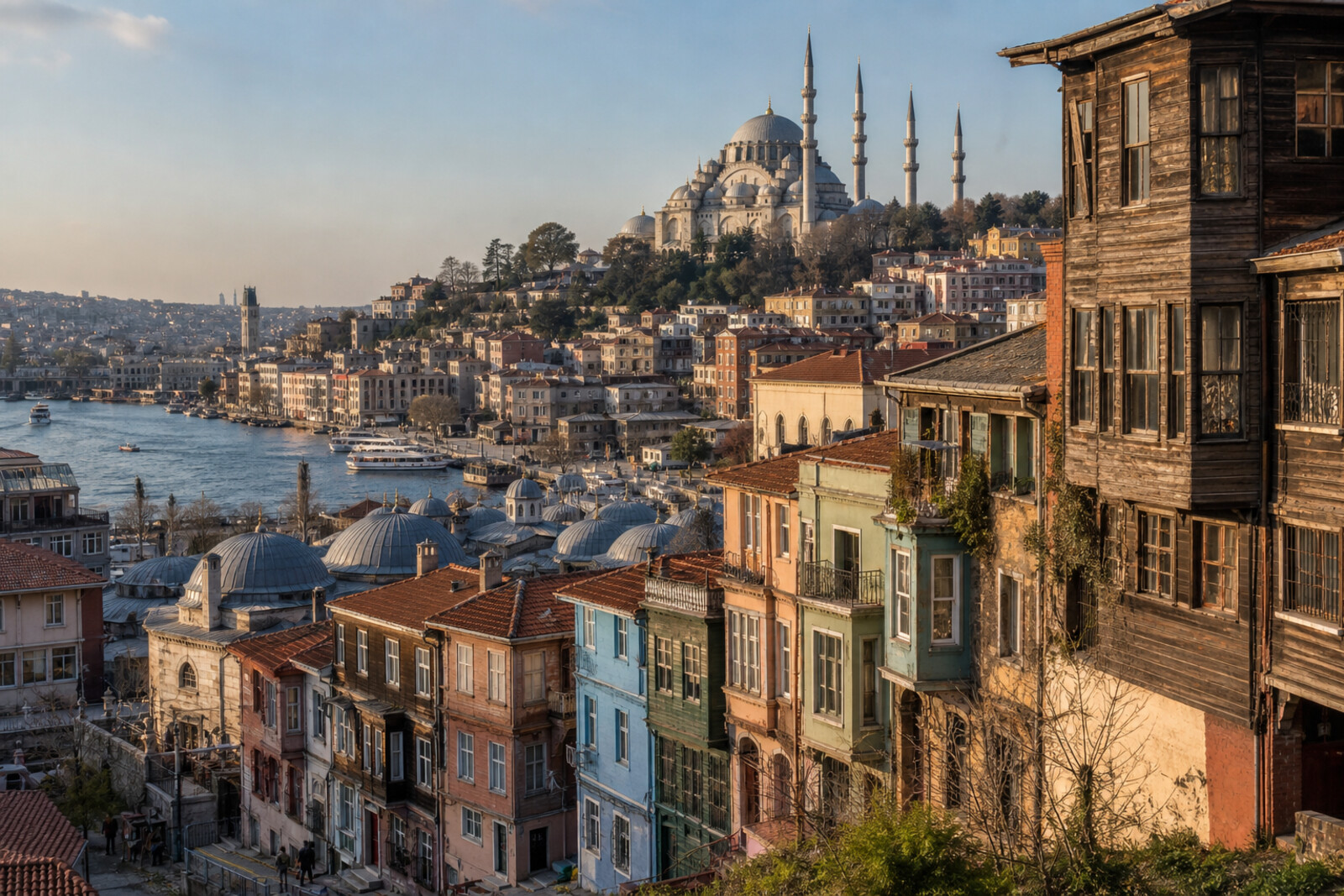
From Süleymaniye Mosque to Balat: Hills of the Golden Horn
From Süleymaniye Mosque through Zeyrek and Fener to the streets of Balat
Guide On Map on your phone
Open the walk like a regular app
It takes about 10 seconds to install. No app store needed.
The whole path
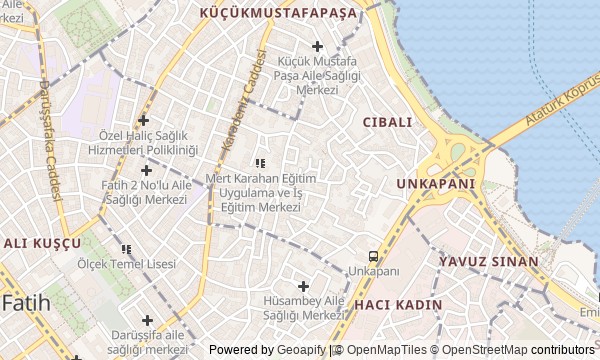
Route map
About the walk
You will begin on the ridge beside Süleymaniye Mosque and make your way through old neighborhoods toward the Golden Horn: past an aqueduct, a Byzantine church, a tobacco factory, Greek and Bulgarian sacred sites, and on to Balat. The road first follows the hills, then drops to the water before climbing again toward the red Phanar Greek Orthodox College. You will see Istanbul not as a sequence of grand landmarks, but as a city of institutions. Here, people built kitchens and hospitals, kept schools going, divided earnings, and argued over whose name should be spoken during a service. The story moves through private decisions and small pieces of evidence. Why were the walls dismantled only formally? Why was the school cleared in four days? Why do some gates remain closed? The answers wait at the stops themselves. By the time you reach Balat, you will be able to recognize the community funds, foundations, and rules behind the facades that helped residents hold on to their place in Istanbul for centuries.
Why this order
Süleymaniye Mosque sets the high point and the scale of an imperial institution; the descent to the Aqueduct of Valens reveals the urban system without which such a complex could not have existed. From the arches, you will climb to Zeyrek, where a more ancient Byzantine way of joining church, hospital, and commemoration becomes visible beside the water conduit. The road then descends to the Cibali Tobacco Factory, where sustaining an institution depended not on a monastic rule but on wage labor and weekly pay. Along the shore, you will reach Fener and climb to the Phanar Greek Orthodox College, the next large building maintained by a community with its own funds. The descent from the school to Bulgarian St. Stephen Church shows how closely institutions of different Orthodox communities stood here. That is why the next stop is the Ecumenical Patriarchate of Constantinople: after the Bulgarian dispute, you will arrive at the center whose authority it opposed. From the closed gates, the route continues along Vodina Street into Balat, where the Jewish community used the same means—donations and a fund—to create not a church or a school, but a hospital.
Those who have already seen the main squares of historic Istanbul Fans of Byzantine and Ottoman history without a sightseeing rush Those interested in the stories of urban communities and institutions
Those looking for a level walk without climbs and descents Those who want a route limited to the city's best-known postcard sights Those who prefer brief facts to human stories
Before you go
Wear comfortable shoes with non-slip soles: between the hills and the shore, there are steep stretches, stairs, and uneven surfaces. For active mosques and churches, choose clothing that covers your shoulders and knees; it is best to bring a scarf with you. Access to interiors depends on services, school activity, and each institution's rules, so check the museum and any nonpublic spaces separately. Bring water, but leave time for an unhurried stop in Balat.
When to go
It is best to set out in the first half of the day and leave several hours of daylight for Fener and Balat. Do not plan the route too tightly: prayers, services, a museum visit, and breaks on the climbs can change the pace.
Backup plan
All eight stops still make sense from outside: the silhouette of Süleymaniye Mosque, the aqueduct's arcade, the mass of Zeyrek Mosque, factory facades, the patriarchal courtyard, the Red Castle, and the metal church can all be read from the street. If a church is closed, do not wait at the entrance or try to enter with parishioners; look at the accessible details and continue on. Treat a visit to Rezan Has Museum and the premises of the active school as separate possibilities, not required parts of the walk. In rain, it is easier to pause by the waterfront or in a Balat café than to shorten the route by taking a dangerous descent down wet streets.
Route conditions
Surface. Paved — 350 m (data covers 8% of the route)
Facilities. Toilets — 3
Elevation. Ascent — 67 m; descent — 67 m
OpenStreetMap extract of June 18, 2026: database data, not a check on the ground. Data © OpenStreetMap contributors, ODbL licence
Walk plan
Open in maps ↗- 1
Süleymaniye Mosque
You will learn who supported the schools, hospital, kitchen, and inn attached to the sultan's mosque, and how they did so. - 2
Aqueduct of Valens
You will examine the tradition about the stones of Chalcedon and understand why the water channel needed a bridge across the valley. - 3
Zeyrek Mosque
You will see the surviving framework of a memorial in which caring for the sick paid for the commemoration of the imperial family. - 4
Kadir Has University and Rezan Has Museum
You will connect the preserved factory workshops with the people who set out from here to demand their withheld pay. - 5
Phanar Greek Orthodox College
You will learn how a small community preserved its school by temporarily leaving its most conspicuous building. - 6
Bulgarian St. Stephen Church
You will learn how a pause in the liturgy turned a wooden church into the site of an open church dispute. - 7
Church of St. George
You will understand why people have entered the patriarchal complex through another opening for two centuries. - 8
The Streets of Balat
At the end, you will see how street vendors' donations became lasting community support.
Route features
Everything you need stays in the browser
Progress, saves and your trip plan are stored on this device.
Add Guide On Map to your home screen so the walk opens outside the browser.
How we handle sources, maps and corrections: our editorial standards