 Guide On Map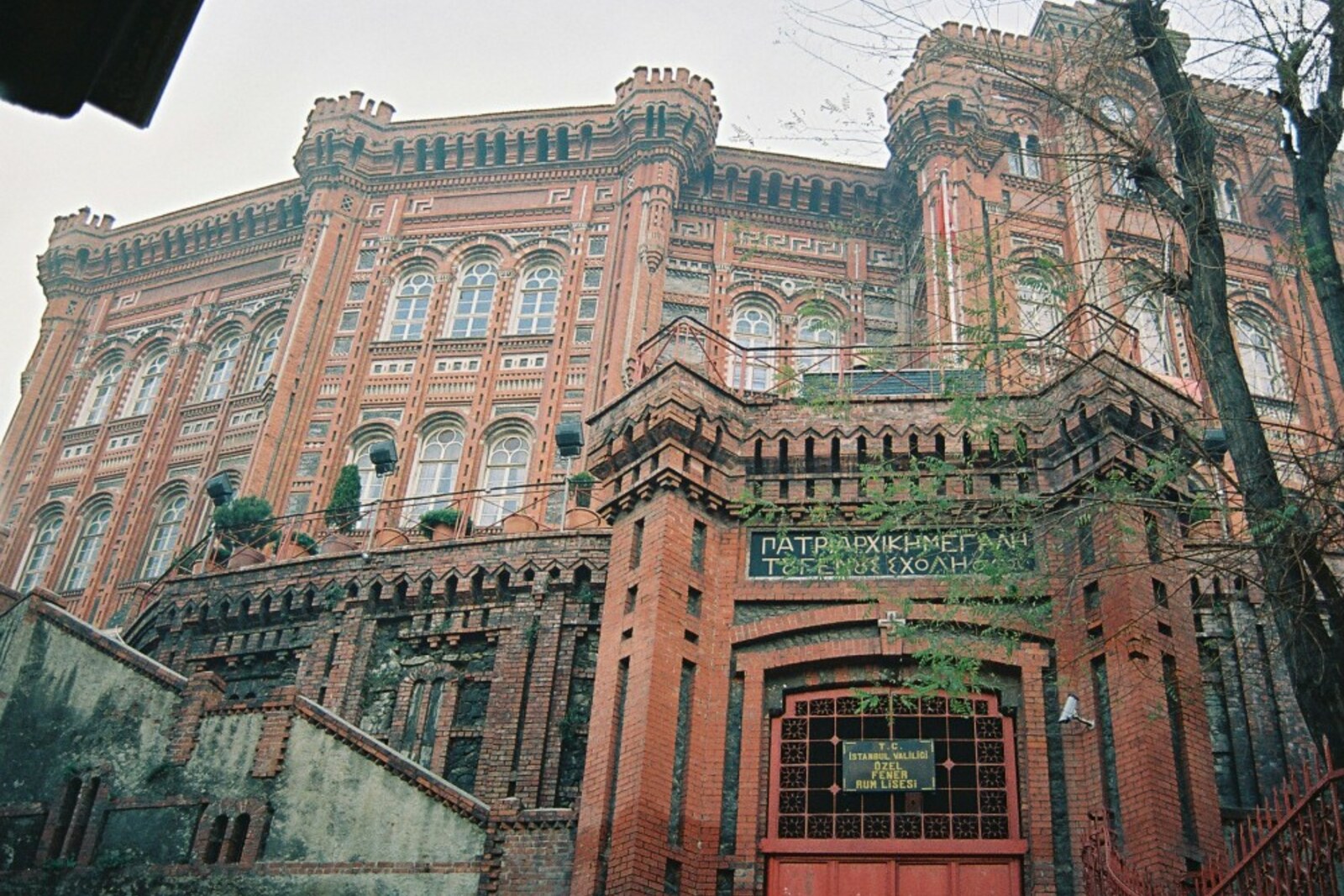
Look around first
What to notice
- Red-brick façade
- Pale stone trim
- Side wings
- Central domed tower
The story of the place
The red façade, banded with pale stone, rises above the Golden Horn; the side wings spread along the slope, while a domed tower rises in the center. An astronomical observatory once operated in the dome. The school grew out of a patriarchal school that, after the fall of Constantinople, was tasked with training priests and educated laypeople for the Orthodox community. Its graduates later became teachers in Greek schools in different cities of the Ottoman Empire.
In early July two thousand twenty-six, school belongings were moved out of the red building on the hill. The move took four working days. There will be no new occupants here: the rooms were emptied because the old masonry needs reinforcing against earthquakes. The students and teachers temporarily moved to another Greek school building in the Kurtuluş neighborhood.
The institution is called the Phanar Greek Orthodox College. The Turkish word “Rum” in its official name refers to the Romans—the Greek-speaking Orthodox Christians of Istanbul. They themselves call the school the Phanar Greek Orthodox College. Here, “nation” meant not a state, but the Orthodox community of the Ottoman Empire.
Its history began after the conquest of Constantinople. In fourteen fifty-four, Gennadius Scholarius, the first Orthodox patriarch appointed after the fall of the city, entrusted the scholar Matthaios Kamariotis with reorganizing the patriarchal school. It was meant to train clergy and educated laypeople for a community that would have to negotiate with the Ottoman administration, conduct correspondence, and run its own institutions. The school changed premises many times; for a while it was in Kuruçeşme on the Bosporus, and in the middle of the nineteenth century it returned to Fener, near the Ecumenical Patriarchate of Constantinople.
Patriarch Joachim III, who set about restoring Istanbul’s Greek educational institutions, decided to give it a permanent home. The school itself had lacked money for years. So Joachim collected donations from monasteries and wealthy parishioners. The largest share came from Georgios Zariphis, an Istanbul Greek banker who made his fortune through loans and financial operations. Other benefactors gave a plot at the top of the hill. That is how the school came to stand here: near the Ecumenical Patriarchate of Constantinople, but higher up and visible from all over the Golden Horn.
The design was chosen through a competition. It was won by Konstantinos Dimadis—an architect and graduate of this very school, who had sought the commission for its new building. The contract specifically required a façade “in the Byzantine style.” Dimadis combined red fired brick and pale stone, set the side wings along the slope, and raised a domed tower above the center. An astronomical observatory was installed inside the dome. When classes began in September eighteen eighty-two, instruments were bought for the classrooms; about one hundred thirty of them later became part of the school collection. Two decades later, about four hundred fifty people studied here, most of them having come from other parts of the empire. Teachers graduated from here and were then sent to Greek schools in different cities.
In the autumn of two thousand twenty-five, an inspection showed that the building needed seismic reinforcement. The administration was given ninety days to vacate the premises. The work was estimated at more than ten million euros—money the school foundation did not have. Dimitris Zotos, the headmaster, needed to preserve classes for thirty-one students, so he began looking for vacant space within Istanbul’s small Greek community. The foundation of three Orthodox churches in the Kurtuluş neighborhood gave the school, free of charge, a building that had been closed since two thousand two, through the end of June two thousand twenty-nine.
There are now no classrooms behind the red walls. The school continues to exist in Kurtuluş, money for the reinforcement is still being raised, and on the tower in Fener there remains a stone inscription by a graduate: “architect Konstantinos Dimadis, eighteen eighty-one.”
Useful on site
The school operates during the academic term and is closed to visitors; access is possible only with special permission or on rare open days.
Checked: June 17, 2026. Check the official source before visiting.This is a working school, not an open museum. View the building from the street, do not enter without permission, and do not photograph students.