 Guide On Map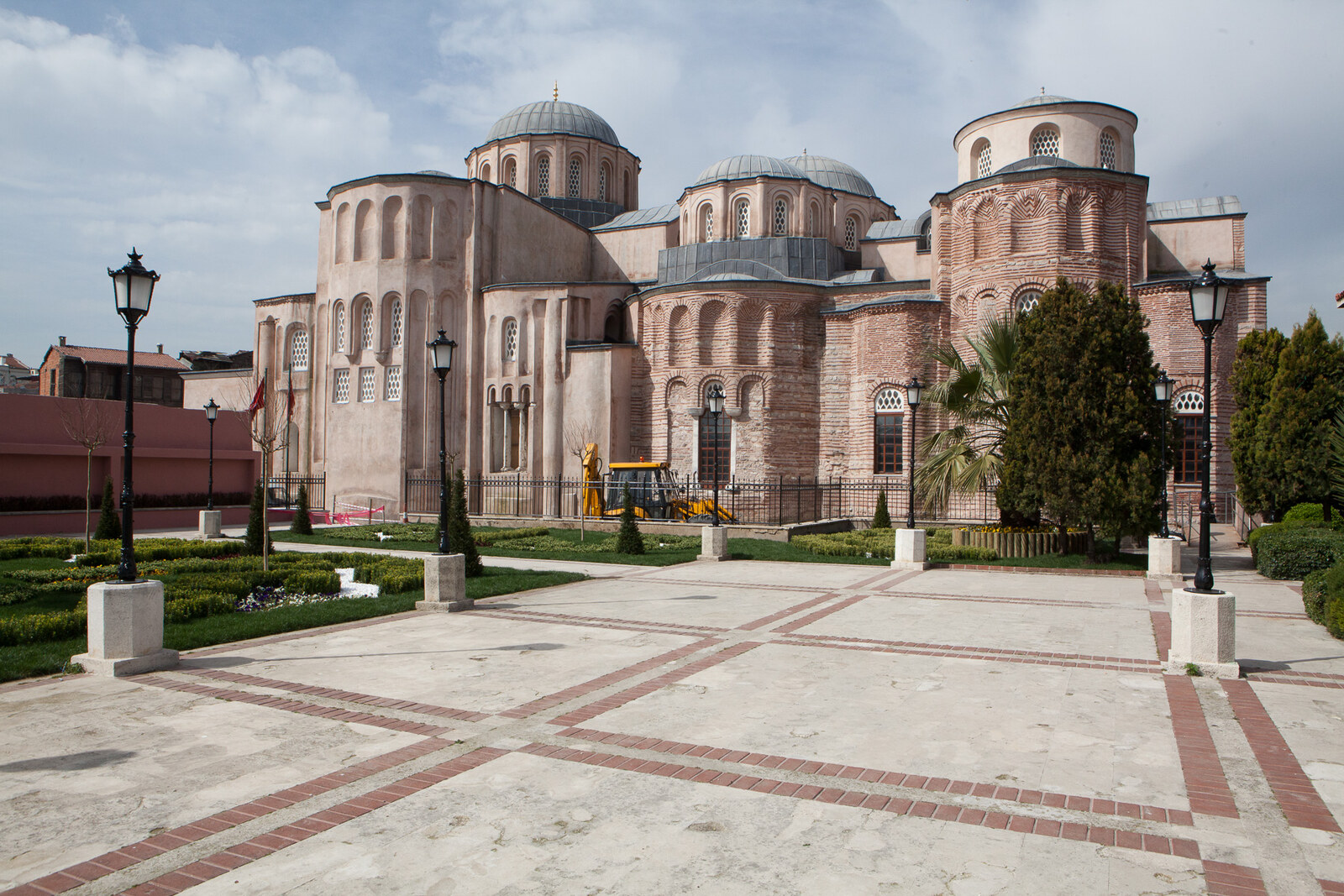
Look around first
What to notice
- Three connected parts of the building
- The southern Church of Christ Pantokrator
- The northern Church of the Theotokos
- The two-domed central chapel
The story of the place
From outside, the mosque is made up of three adjoining Byzantine church sections; two domes rise above the middle one. The side churches are linked by a chapel where the rulers’ tombs were once placed. During the Ottoman period, the monastery rooms were temporarily occupied by a school of theology and law, and its teacher’s nickname gave its name to the mosque and the whole neighborhood. Muslim prayer is now held here, but the boundaries of the three separate sections can still be read in the walls and domes.
In October eleven thirty-six, the Byzantine emperor John II Komnenos signed a detailed charter for the Monastery of Christ Pantokrator. Pantokrator means “Almighty”: that was the dedication of the southern church of today’s mosque. John wanted to ensure that two things would continue after his death—care for the sick and the permanent commemoration of the family that had founded the monastery.
The first to invest in this undertaking was his wife, Empress Irene of Hungary, the Hungarian princess Piroska before her marriage. She gave the monastery income-producing properties; among them, the charter lists an estate with wharves, rights to sea fisheries, and fishing grounds. Prayers, beds, bread, and staff wages were paid for with income from a thoroughly earthly economy.
Irene died two years before the charter was signed. John ordered a narrow, two-domed chapel of Archangel Michael to be built between the two large churches. His wife’s tomb already stood there, and the emperor prepared a place beside it for himself. Lamps were to be kept burning continuously before both tombs, liturgy was to be celebrated three times a week, and on commemoration days the venerated Constantinopolitan icon of Theotokos Hodegetria was to be brought here. The monks received support on condition that this order would not be interrupted after the founder’s death.
With the same purpose in mind, John established a fifty-bed hospital at the monastery. The charter divided it into five wards: for the wounded and people with fractures, for patients with severe internal and eye ailments, for women, and for other patients. A woman doctor worked in the women’s ward. Four separate doctors treated those who came in, two of them surgeons. Every day, the head of the hospital made the rounds of the beds and asked each patient whether they were being treated and fed well.
John anticipated a threat to this arrangement from his own court. Doctors were forbidden to leave the hospital to attend a nobleman, even if he was related to the emperor. Nor could they be taken away for unpaid service by the sovereign’s own order. While on duty, a doctor who received wages and food here belonged to the patients.
The sick also took part in commemorating the founders. Those who could get out of bed went to church together with the staff, and after the service each patient received a coin. In this way John tied the fate of his tomb to the people for whose benefit the hospital was maintained: as long as the institution followed the charter, its staff and patients spoke the names of John and Irene.
In eleven forty-three, John died in Cilicia from an accidental wound received while hunting. His body was brought to Constantinople, then Istanbul, and laid beside Irene. Their son, Emperor Manuel I Komnenos, and other Byzantine sovereigns were buried here later. The hospital buildings and imperial tombs have disappeared. What remains is the memorial’s very arrangement: the southern Church of Christ Pantokrator, the northern Church of Theotokos Eleousa, and the burial chapel squeezed between them still form three connected parts of one building.
The present name appeared after the Ottoman conquest of the city in fourteen fifty-three. Sultan Mehmed II intended to revive higher education in captured Constantinople, but his own medreses had not yet been built. He temporarily turned the monastery rooms into a medrese—a school of theology and law—and entrusted it to a teacher named Mehmed. He was called Molla Zeyrek: molla here means a scholar-theologian, and the nickname “Zeyrek,” meaning “perceptive,” was given to him by his mentor Hacı Bayram Veli.
The teacher was assigned a salary of fifty akçes a day, and his nickname came to be used for the school, the mosque, and then the whole neighborhood. After the medrese at Fatih Mosque opened, the students left, and the monastery’s classrooms eventually disappeared. Today all three Byzantine sections are used for Muslim prayer; above the entrance stands the name of the Ottoman teacher who worked within these walls in the first years after the conquest.
Useful on site
Open daily from 8:00 to 18:00; visits are possible between the morning and evening prayers.
Checked: June 17, 2026. Check the official source before visiting.The mosque is active, so observe the same dress and behavior rules inside as at Süleymaniye Mosque. If entry is restricted, the building’s complex structure is clearly visible from outside.