 Guide On Map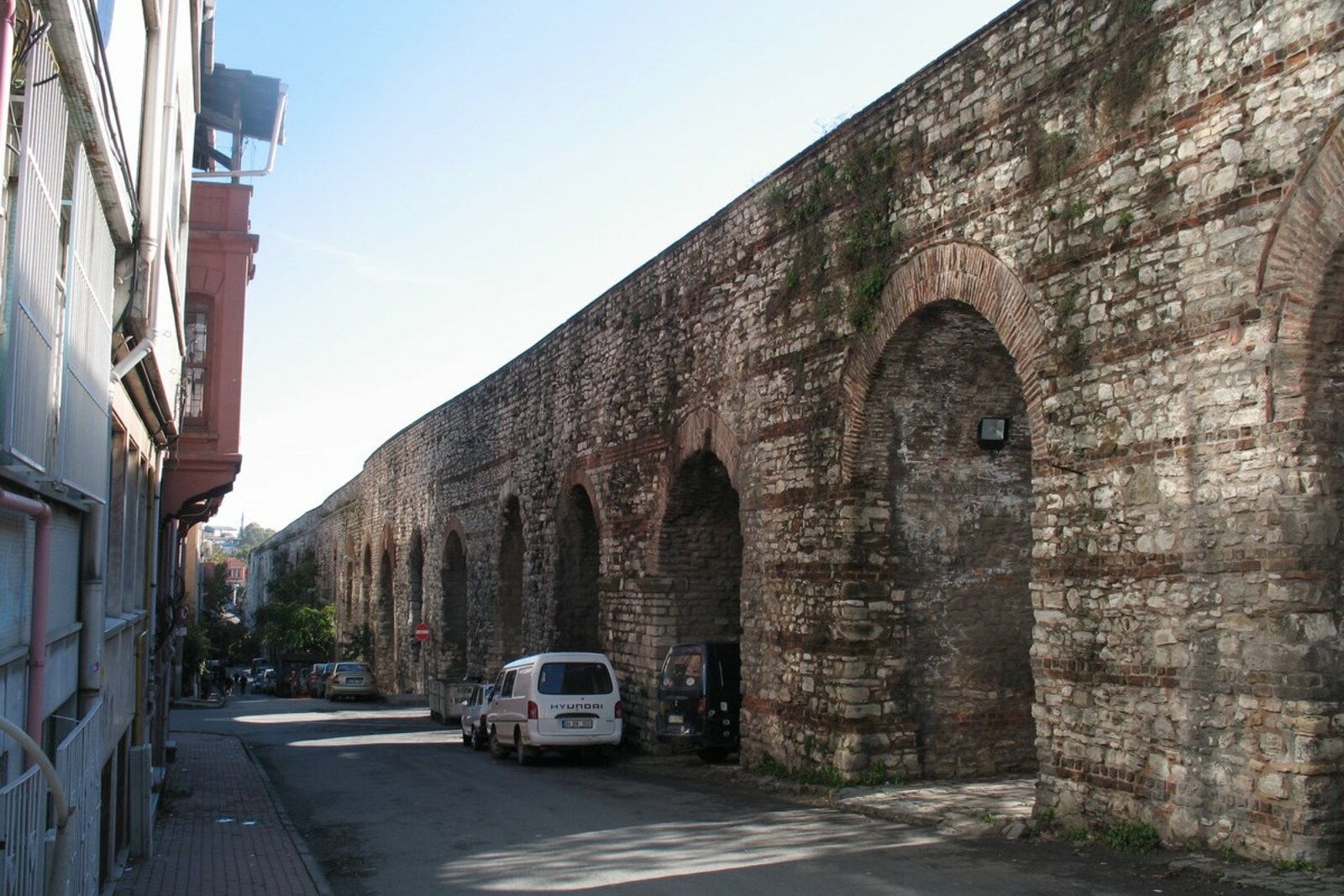
Look around first
What to notice
- Two tiers of arches
- Large stone blocks
- Filled sections of masonry
- The boulevard beneath the lower arches
The story of the place
Two tiers of arches rise above Atatürk Boulevard: a surviving section of an ancient city water channel. The upper tier carried a covered channel through which water from Thracian springs reached the distribution basins, fountains, baths, and cisterns of Constantinople. Large blocks and filled sections of masonry are still visible in the stone, while the channel itself has long been empty. Instead of water, a stream of cars passes beneath the lower arches.
In three hundred sixty-six, the Eastern Roman emperor Valens ordered the fortification walls of Chalcedon—present-day Kadıköy on the Asian shore of the Bosporus—to be dismantled. In this way, he was making the city pay for a defeat that had nearly cost him his throne and his life.
A year earlier, Procopius, a former courtier and military commander seeking the imperial title, had seized Constantinople. He was related to the late emperor Julian. A rumor that Julian had wanted to leave him the throne made Procopius dangerous to the rulers who followed. He had to hide in a friend's house in Chalcedon; he lost his former position, sometimes had no food, and secretly crossed the Bosporus to learn the news from the city.
When Valens left the capital with his army, Procopius decided that open rebellion was better than being hunted any longer. In September three hundred sixty-five, several legions proclaimed him emperor. To convince the soldiers of his claim to the throne, he appeared before them carrying the young daughter of the late emperor Constantius II. Chalcedon supported Procopius and shut its gates against Valens.
Valens besieged the city. From the walls, the defenders called him a “sabaiarius”—a lover of the cheap barley drink that the poor in his native Pannonia used to quench their thirst. The mockery struck at the emperor's origins: Valens had been raised to power by his older brother Valentinian I, whereas Procopius claimed kinship with the previous dynasty. Soon the besieging army ran out of supplies, and a rebel detachment nearly cut off Valens' route of retreat. The emperor withdrew from Chalcedon, and all of Bithynia went over to his opponent.
The outcome came through betrayals in Procopius' army. His commanders began defecting to Valens, and his last two companions bound the fugitive and brought him to the imperial camp. Valens immediately ordered Procopius beheaded. The people who had betrayed him were then executed as well.
After his victory, the emperor fulfilled his oath to punish Chalcedon. The people of Constantinople, Nicomedia, and Nicaea asked him to preserve the city's fortifications. Valens agreed only to a literal loophole: the large blocks were removed from the walls, and the remaining breaches were filled with small stone. The wall was thus considered dismantled, though Chalcedon was not left entirely without protection.
Ancient authors explained differently where the removed blocks were taken. Historians of the fourth and fifth centuries linked them to the construction of the capital's baths. Later Byzantine chroniclers claimed that the Aqueduct of Valens was built from the stones of Chalcedon. So the story that the old blocks in these arches came from Kadıköy remains a tradition, not a proven feature of the masonry.
The water channel itself was indeed completed under Valens. The arches before us were a city bridge for a covered channel: builders carried it over the hollow between the third and fourth hills so that water from Thracian springs could continue flowing by gravity to the distribution basins, fountains, baths, and cisterns of Constantinople. Water no longer flows through the upper channel; Atatürk Boulevard passes beneath the lower arches.
The structure's Turkish name—Bozdoğan Kemeri—appeared later, and its exact origin has not been established. The other name retains Valens' name: the water channel was completed under the very emperor whom the defenders of Chalcedon had driven away from their walls with a joke about cheap barley drink.
Useful on site
Open around the clock; viewed from the street.
Checked: June 17, 2026. Check the official source before visiting.View the structure from the safe side of the street, and cross only at designated crossings. There is no need to climb onto the aqueduct.