 Guide On Map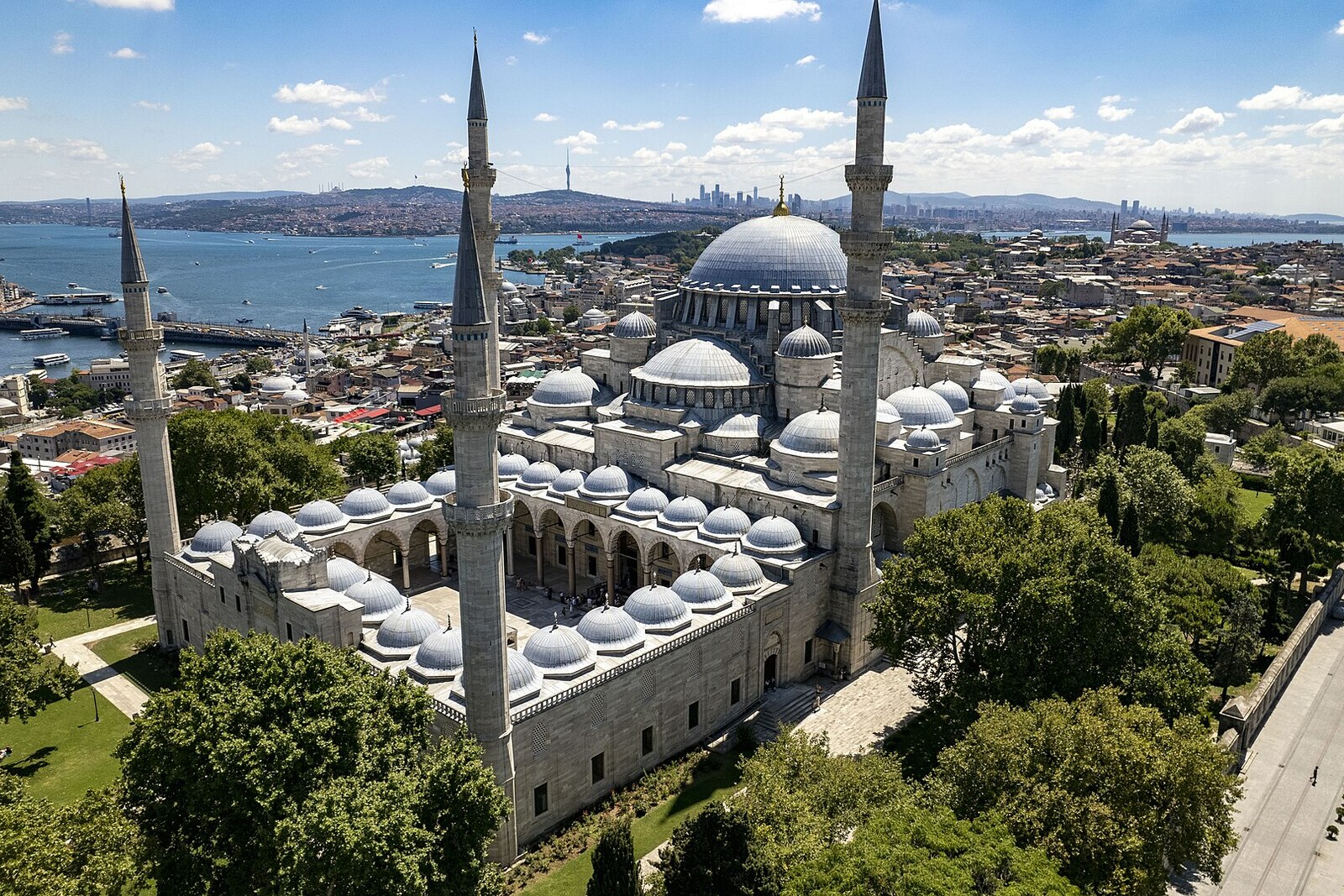
Look around first
What to notice
- Main dome
- Terraces of the complex
- Mihrab wall
- Suleiman's octagonal mausoleum
The story of the place
On November twenty-third, fifteen sixty-six, the body of a sultan whom the army had escorted for more than a month as if he were still alive was brought here. It was Suleiman I, the patron of the mosque. The Ottomans called him Kanuni—the Lawgiver—and Europeans called him the Magnificent. He ruled for forty-six years. The complex was built at his command and in his name; this is why it was named Süleymaniye Mosque—Suleiman's mosque.
Suleiman set aside for construction part of the land of the Old Palace, on the ridge above the Golden Horn. Architect Mimar Sinan placed the mosque at the center, then laid out schools, a hospital, a medical school, a free kitchen, an inn, a bathhouse, and shops in terraces descending the slope. Income from property assigned to a charitable foundation paid the teachers, doctors, and cooks, as well as the upkeep of the buildings. Here, people prayed, taught theologians and physicians, treated the sick, fed the poor, and received travelers. The mosque was the main hall of a large urban institution.
When the complex was founded in the summer of fifteen fifty, Ebussuud Efendi—the Sheikh al-Islam, the chief interpreter of Islamic law at the sultan's court—laid the first stone by the future mihrab wall. Seven years later, Mimar Sinan, who directed the entire court building service and was answerable to the sultan for its work, presented Suleiman with the key to the completed mosque. According to the architect's recollections, the sultan asked the courtiers who should open the doors. They named Mimar Sinan. Suleiman returned the key to him, saying that the man who had built the temple should open it himself. Mimar Sinan said, “Ya Al-Fattah”—“O Opener”—and turned the key.
Nine years later, Suleiman left Istanbul for the last time. He was over seventy, suffered from gout, and moved with difficulty. After the unsuccessful siege of Malta, the sultan wanted to show personally that he was still capable of leading an army. The target of the campaign was the fortress of Szigetvár in Hungary.
On the night of September sixth to seventh, fifteen sixty-six, Suleiman died in his campaign tent, a few hours before the decisive assault. Grand Vizier Sokollu Mehmed Pasha, who directed the government and the siege itself, feared that the news would destroy order in the army before the heir reached it. He ordered the death to be kept secret.
A few initiates removed the internal organs, treated the body with ambergris and musk, placed it in a coffin, and temporarily buried it beneath the platform of the campaign throne. The fortress was taken. Forty-two days later, the coffin was secretly raised from the ground and placed in a wagon. On the return journey, orders continued to be issued as though the sultan remained in the tent. Only after his son and heir Selim II arrived in Belgrade was the death officially announced. Selim II took the throne, and Sokollu remained grand vizier throughout his reign.
The final funeral ceremony was held at Süleymaniye Mosque. Ebussuud Efendi read the prayer—the very man who had laid the first stone here sixteen years earlier. Suleiman was buried beside the mosque, and Mimar Sinan built an octagonal mausoleum over the grave. It stands behind the mihrab wall with its prayer niche: inside lies the body that was carried from Szigetvár while the army pretended that its sultan was still alive.
Useful on site
Open daily from 9:00 to 18:00; closed during the five prayers; admission is free, and donations are welcome.
Checked: June 17, 2026. Check the official source before visiting.This is an active mosque: remove your shoes before entering, observe the dress code, and do not enter the prayer area during services. The panorama and the layout of the complex are accessible without visiting the interior.