 Guide On Map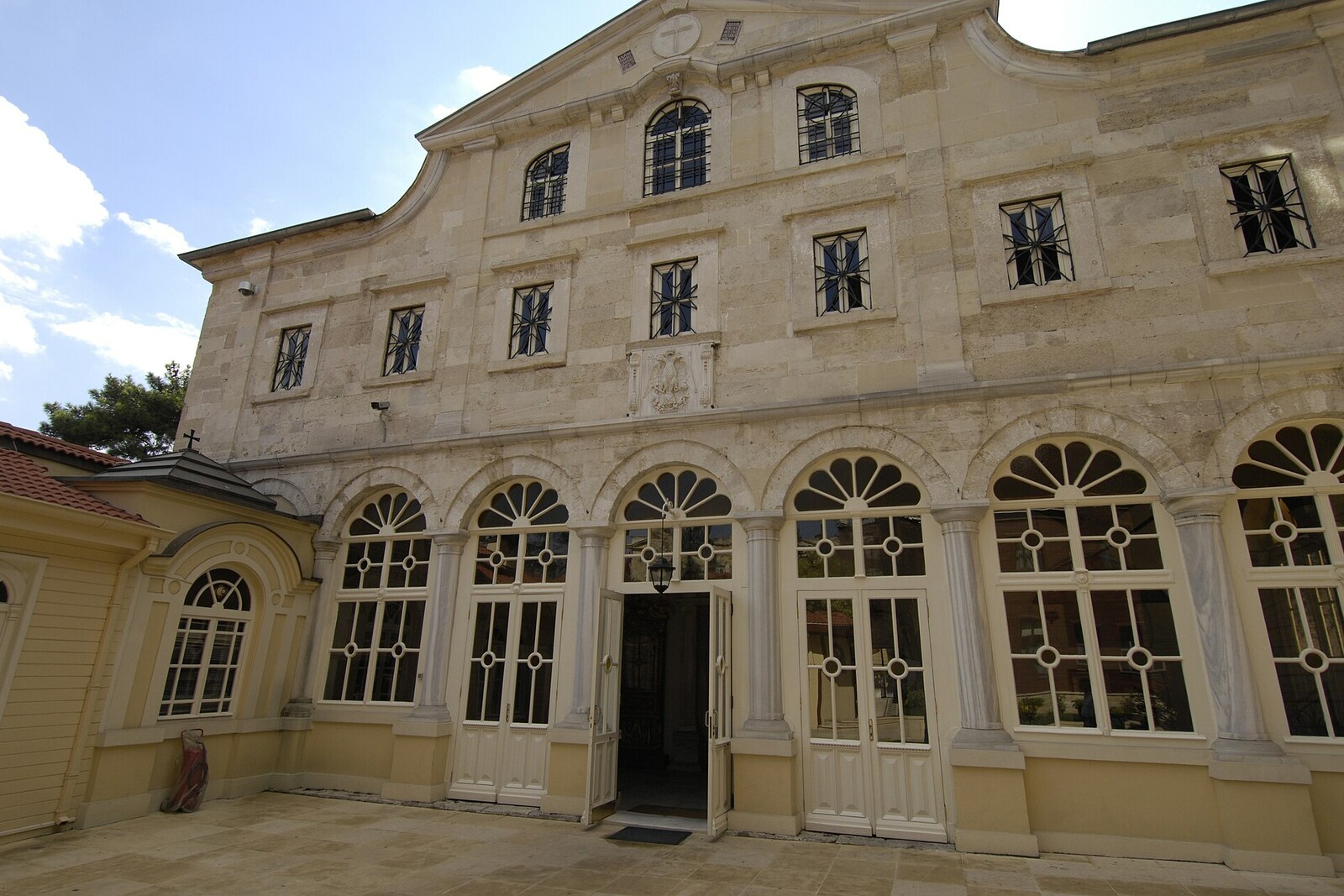
Look around first
What to notice
- Black double gates
- Facade of Church of St. George
- Enclosure of the patriarchal complex
- Side entrance
The story of the place
Behind Fener's enclosure stands a former monastery church that became the cathedral church of the Ecumenical Patriarch. In the early seventeenth century, Patriarch Matthew II moved the services here from the previous residence: after the conquest of the city, the see had already changed churches several times and found its fifth home here. The modest facade of Church of St. George leads to a church where services are held in the mornings and evenings, the liturgy is celebrated on Sundays, and the administration of the Ecumenical Patriarchate of Constantinople is based nearby. Visitors now enter through a side entrance in the same enclosure.
Black double gates remain in the wall of the patriarchal complex. No one has entered through them since Easter of eighteen twenty-one. The reason this door is closed explains why the relatively small church behind it is called patriarchal.
After the Ottoman conquest of Constantinople, the patriarch could no longer hold services in Hagia Sophia. His see was moved several times from one church to another. In sixteen oh one, Patriarch Matthew II took over a former convent in Fener, the quarter of Orthodox Greeks, established his services here, and made the monastery church his new cathedral church. It was already the fifth residence of the Ecumenical Patriarchate of Constantinople after the fall of the city.
The church inherited its dedication from the monastery. According to church tradition, Saint George was a Roman soldier executed for the Christian faith and venerated as a great martyr. His name remained when the monastery church became the cathedral of the Ecumenical Patriarch, first in honor among Orthodox patriarchs. Morning and evening services are held here daily, the liturgy is celebrated on Sundays, and the administration of the Ecumenical Patriarchate of Constantinople is housed in the neighboring buildings.
In the spring of eighteen twenty-one, Greek rebels began a struggle for liberation from the Ottoman Empire. The uprising spread through Morea, as the Peloponnese was then called. The Ottoman government expected the Ecumenical Patriarch of Constantinople to keep Orthodox subjects from joining the revolt.
Gregory V, serving as patriarch for the third time, had to demonstrate the loyalty of his flock to the sultan and protect the church from reprisals. His position was not for life: he had previously been deposed twice, after which he returned to monastic life on Mount Athos. Now, at the government's demand, Gregory sent out letters excommunicating the participants in the uprising and called on the Orthodox not to support them. Ottoman officials warned him directly: if he did not stop the revolt, punishment could fall upon the entire community.
The letters had no effect. When reports reached the capital that local bishops in Morea had joined the rebels, officials decided that the patriarch either knew about the preparations for the uprising or had proved incapable of carrying out the duty entrusted to him. The minutes of the meeting cited Gregory's origins as a separate basis for suspicion: he himself had been born in Morea. No evidence of his involvement in a conspiracy was presented there.
Sultan Mahmud II, seeking to suppress the uprising and prevent it from spreading to the capital, ordered that a new patriarch be elected first. Eugenius II was released from imprisonment and elevated to the see. Only afterward was Gregory defrocked. On Easter Sunday, April twenty-second, eighteen twenty-one, according to the current calendar, after the festive service he was led out of the cathedral church and hanged on the main gates of the Ecumenical Patriarchate of Constantinople. A placard was left on his body, accusing him of treason and of failing to keep the Orthodox from the uprising.
The new patriarch was ordered to send the rebels further letters demanding that they end the struggle, but they refused to obey. Gregory was later canonized, and his remains were transferred to the cathedral in Athens.
The main gates in Fener were closed forever after the execution. Every April tenth, the patriarch lights a candle before them. Services continue in Church of St. George, but entry is through another opening in the same enclosure.
Useful on site
Approximately 8:00–16:30; free entry, though access may be limited during services.
Checked: June 17, 2026. Check the official source before visiting.Keep quiet in the courtyard and the church, do not block passageways, and do not photograph people without permission. During a service, remain only in the areas where visitors are clearly allowed.