 Guide On Map
Genoa's Palaces and Debts: Via Garibaldi, Via Balbi, and the Port
From Piazza delle Fontane Marose, along the palace streets, to Palazzo San Giorgio
Guide On Map on your phone
Open the walk like a regular app
It takes about 10 seconds to install. No app store needed.
The whole path
Route map
About the walk
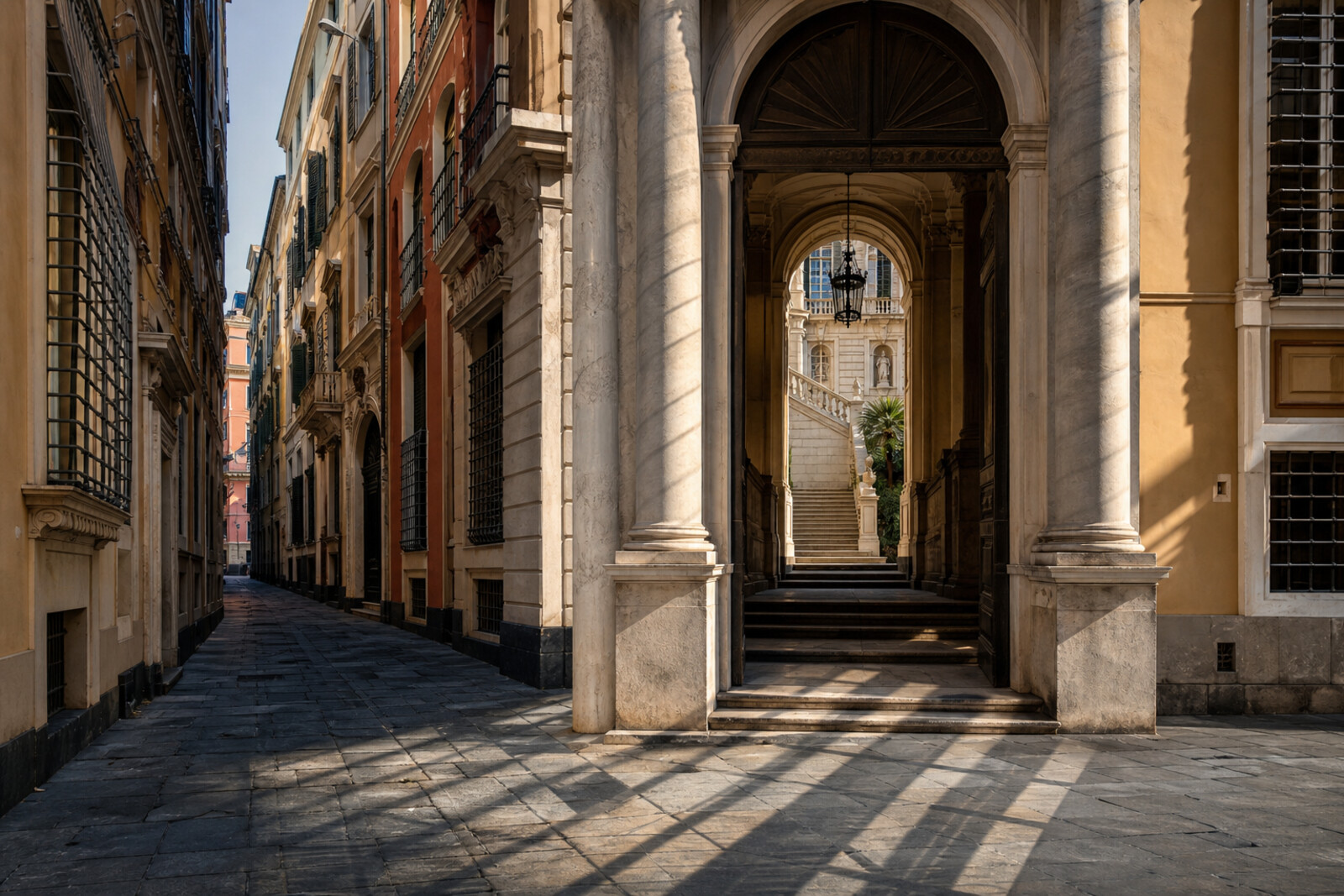
You will begin at Piazza delle Fontane Marose and walk along ceremonial Via Garibaldi, then Via Balbi, finishing at the old harbor. The route follows palaces that wealthy families built as private homes, but that the Republic of Genoa used to receive its guests.
Behind their orderly facades await family accounts, wills, court papers, and carefully concealed traces of quarrels. You will see stone porters without noses, hear about a ceiling lost for centuries, and a portrait that needed a different face—but the answers come only inside the stories.
The tone stays calm and documentary: legend will not become fact, and the shine of marble will not hide the price of a palace.
By the end, you will read the Rolli as a mechanism of the Republic of Genoa: private drawing rooms received rulers, while family capital depended on kings, courts, and city debts.
Why this order
Via Garibaldi comes first, before the individual palaces, because this is where the idea of a private street turned by the Republic of Genoa into a network of state reception rooms becomes clear. The Lercari portal is the first family answer to that order, where a claim to influence was supported by ancestral legend. Nearby Palazzo Nicolosio Lomellino shifts the conversation from an outward emblem to an inner dispute between artist and patron. Then the street's longest facade leads to the money that paid for such scale, and to the risk of lending to a king. The next Palazzo Bianco grew out of debt and an attempt to place heirs in separate homes; Palazzo Rosso opposite shows that separate residences did not end family disputes. Through Piazza della Meridiana and Via Cairoli, the route moves to Via Balbi—the second street financed by a banking family—where a family's reputation was corrected directly in a portrait. Farther on, the Royal Palace of Genoa marks the next turn: after the republic disappeared, a private home became a residence for monarchs. From there, the route descends to the harbor and ends at Palazzo San Giorgio, where the financial foundation of the whole chain comes into view: public debt, taxes, and port administration.
Those who want to understand the Republic of Genoa through the fates of its palaces Architecture lovers who want human choices and conflicts behind the facades Those who prefer documents to beautiful urban legends
Those looking for an overview of medieval lanes and maritime quarters Those interested only in interiors and art history Those who do not want to hear about money, inheritance, and legal disputes
Before you go
Decide in advance which interiors you truly want to enter: the Strada Nuova Museums and the Royal Palace of Genoa can easily take more time than the walk itself. Palazzo Nicolosio Lomellino remains a private home, so visiting its rooms and garden must be checked and arranged separately. The buildings on Via Balbi are used by the University of Genoa: an open door does not mean free access to every room. Wear comfortable shoes for stone paving, slopes, and stairs; do not linger in doorways along the narrow street or block residents, staff, and students.
When to go
Allow around two and a half hours for the stories, facades, and walking between them. One chosen museum or palace interior adds about an hour; a thorough look at several collections takes considerably more. It is better to preserve the thread of the story and return for the paintings separately than turn the walk into a succession of tiring rooms.
Backup plan
If the palaces are closed, the route still works from the outside: portals, plot widths, facade colors, and the shift from aristocratic streets to the harbor carry the main thread of the story. At Palazzo Nicolosio Lomellino, focus on the stucco work; at Palazzo Doria-Tursi, on the scale; at Palazzo Bianco and Palazzo Rosso, on the paired facades; and on Via Balbi, on the way the buildings rise up the slope. Do not try to enter working University of Genoa rooms. After the Royal Palace of Genoa, you can descend toward the port side of the city and finish the walk at the exterior facades of Palazzo San Giorgio.
Route conditions
Surface. Paved — 2.7 km
Facilities. Toilets — 7; drinking water — 10
Elevation. Ascent — 8 m; descent — 30 m
OpenStreetMap extract of July 3, 2026: database data, not a check on the ground. Data © OpenStreetMap contributors, ODbL licence
Walk plan
Open in maps ↗- 1
Beginning of Via Garibaldi
Here, a private residential district first appears as part of the state reception system. - 2
Palazzo Franco Lercari
The portal will show how a family turned a disputed legend into visible proof of its own influence. - 3
Palazzo Nicolosio Lomellino
The history of the commission will explain why some frescoes were preserved, others destroyed, and the work that was accepted was later accidentally concealed. - 4
Palazzo Doria-Tursi
This stop will connect the scale of the residence with banking risk and the debts of the Spanish king. - 5
Palazzo Bianco
Here, a family division of property will lead to the creation of a public city gallery. - 6
Palazzo Rosso
A court case will show that a separate palace did not end the heirs' struggle for primacy within the family. - 7
Via Balbi and Palazzo Balbi-Senarega
Here, family memory will turn out to have been quite literally rewritten over the portrait of a disgraced relative. - 8
Royal Palace of Genoa
The sale of a family home shows how, after Genoa's annexation, a private residence became royal. - 9
Palazzo San Giorgio
The finale will trace the palatial wealth back to its foundation—public loans, taxes, and port trade.
Route features
Everything you need stays in the browser
Progress, saves and your trip plan are stored on this device.
Add Guide On Map to your home screen so the walk opens outside the browser.
How we handle sources, maps and corrections: our editorial standards