 Guide On Map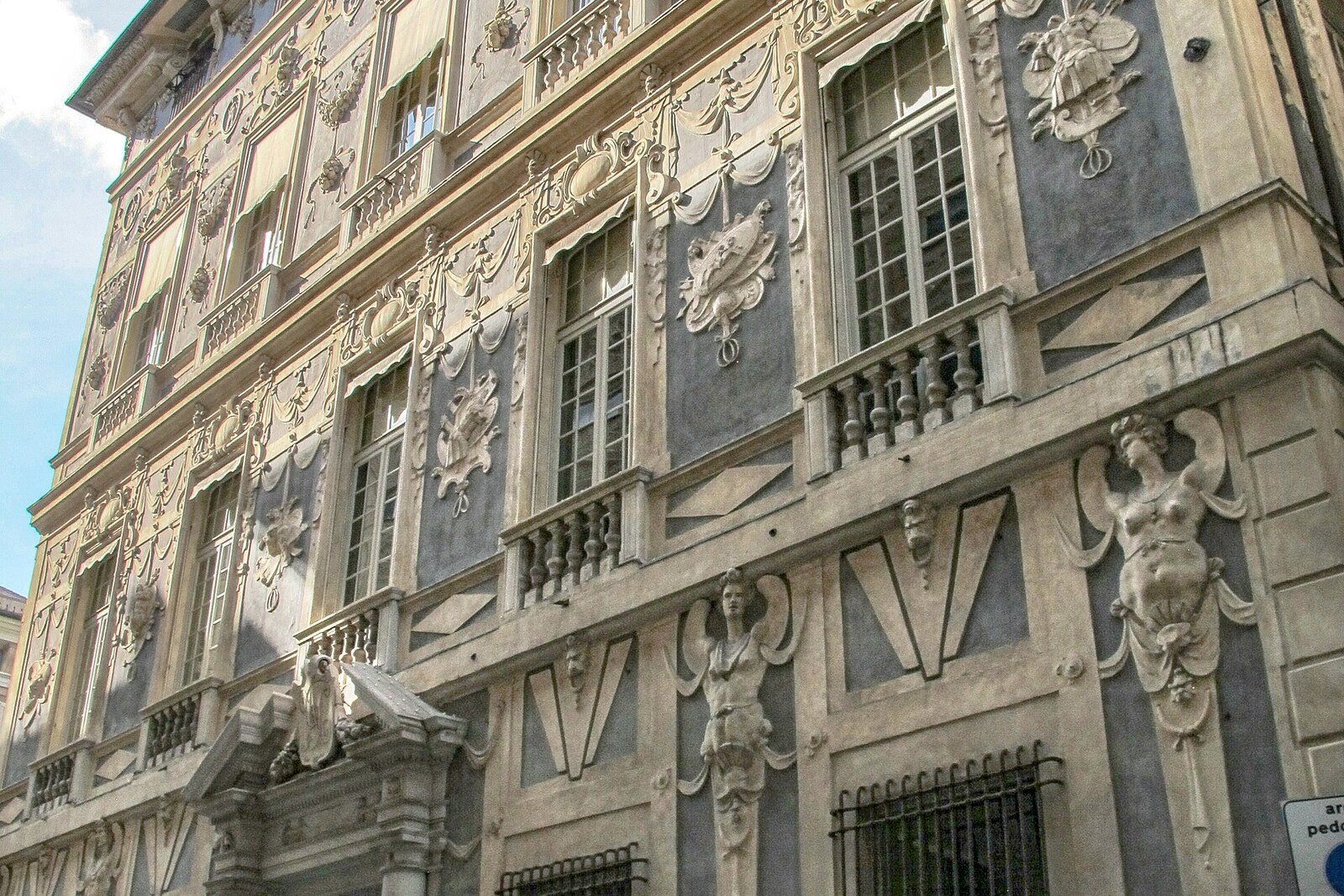
Look around first
What to notice
- White stucco facade
- Oval vestibule
- Stucco decorations
The story of the place
The white stucco facade and oval vestibule were created here on the commission of Nicolosio Lomellino, a Genoese merchant who needed a new family residence on the newly laid-out Strada Nuova. Together with his brother and business partner Francesco, he invested money in coral fishing and trade off the island of Tabarka, near the Tunisian coast. In fifteen sixty-three, Lomellino acquired this plot and began construction. His name remained with the palace, although he sold the house as early as December sixteen oh nine.
The buyer was Luigi Centurione, the new owner, who wanted to decorate the ceremonial rooms. In sixteen twenty-three, he hired Bernardo Strozzi, an expensive Genoese painter who earned his living through commissions for paintings and frescoes. Painting on wet plaster brought the artist especially good income, but it required him to work directly in the patron's house and depend on the patron's payments.
Under the contract, Strozzi was to decorate the staircase, the loggia, the ceilings of three halls, and two small rooms within eighteen months. Two years later, the staircase remained untouched, while the artist had worked on the ceilings above the three halls, in his own words, far more than had been agreed. On November twenty-fourth, sixteen twenty-five, he appealed to the Senate of the Republic of Genoa: Centurione, Strozzi claimed, had still not paid him properly for the extra work.
The owner replied the next day. He accused the painter of violating the contract in both timing and scope: instead of everything promised, he had decorated only three ceilings. A documented legal dispute began. The commission ended, the staircase and loggia remained without paintings, and traces of the conflict survived in the rooms themselves.
Centurione liked the central ceiling and kept it. The two side paintings were, apparently on his orders, scored by workers and covered with limewash. In one hall, beneath layers of mortar, a female figure with red wings is barely discernible—an allegory of Astrology. Strozzi did not manage to finish her, so beside her the grid and black lines of the preparatory drawing are visible.
At the beginning of the eighteenth century, the new owners, the Pallavicini, enlarged the staircase. Builders erected a load-bearing wall, reduced the central hall, and covered its old ceiling with a new suspended one. Beneath it, Strozzi's bright painting lay for almost three centuries. In two thousand two, researchers made a test opening and discovered the colors in unexpectedly good condition: the lightweight cane structure had separated the fresco from the room and preserved it.
Now, behind the palace facade, two different outcomes of a single legal dispute remain. In the central hall is the preserved painting that Centurione accepted and later owners unknowingly concealed. In the neighboring one are Astrology's red wings, the scoring, the limewash, and Strozzi's unfinished grid.
Useful on site
The facade is accessible at all times; the interiors and garden are only open according to the current calendar. For individual visitors, the first Saturday of the month is usually listed.
Checked: date not specified. Check the official source before visiting.The facade can be viewed from the street, but the halls, frescoes, and garden require a separate visit to this private palace. Check access in advance.