 Guide On Map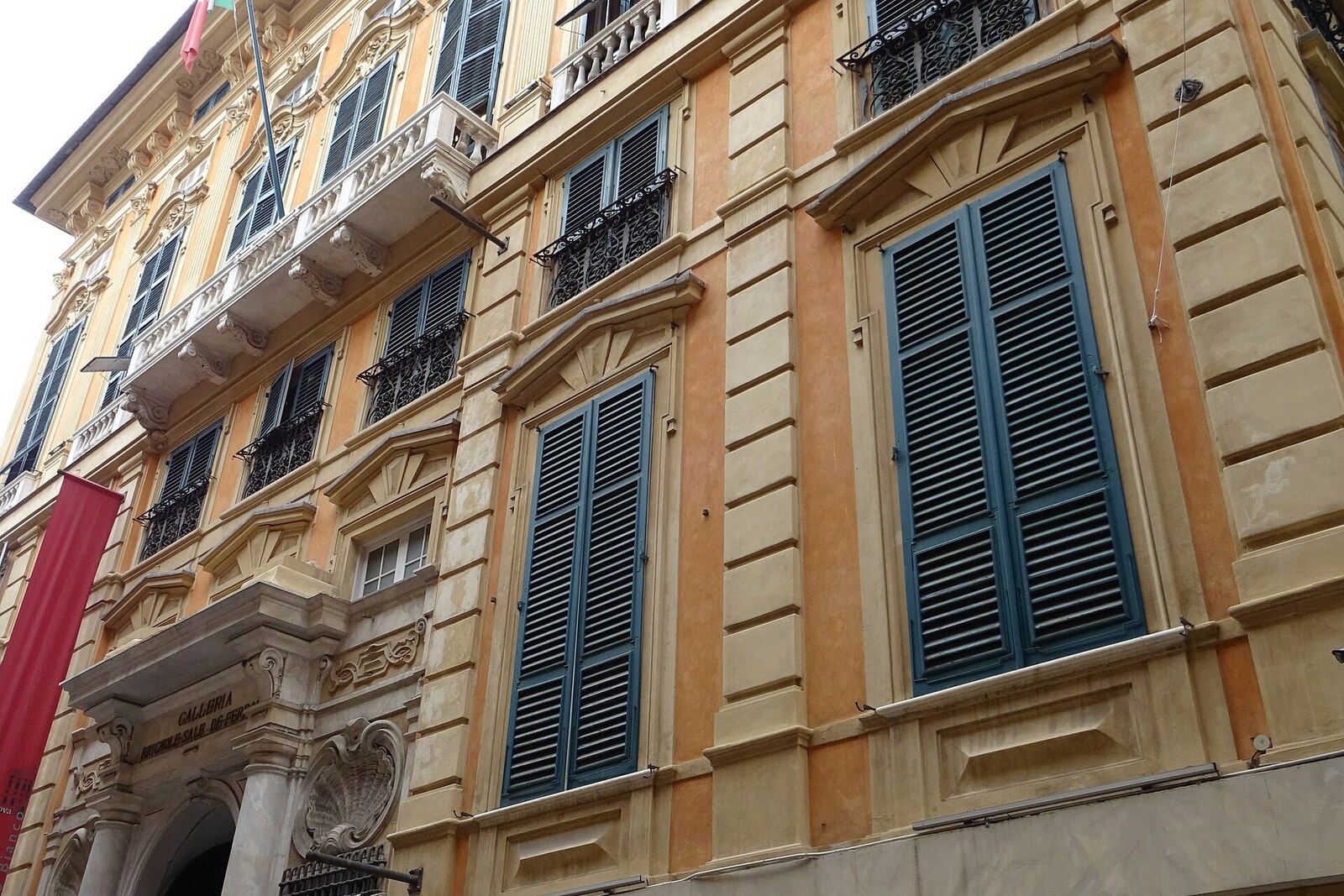
Look around first
What to notice
- The pale facade
- The statue of Jupiter
- The statue of Janus
- The entrance from Via Garibaldi
The story of the place
Behind the pale finish of the facade on Via Garibaldi stands a palace that now serves as the city's painting gallery. Jupiter and Janus survived in the courtyard by the entrance: everything else had to be built anew when the entrance was moved to the new street. This gave the house its white name alongside the Red Palace opposite and made it a separate residence for the family's younger branch. Later, together with its collection of paintings, it was given an income fund so that the museum could acquire new works rather than merely preserve what it inherited.
In seventeen eleven, Maria Durazzo Brignole-Sale bought this house at a public auction. The heirs of Federico De Franchi, who owned it, owed her large sums; Maria was their principal creditor. The De Franchi family lost the residence, and the widow of Giovanni Francesco Brignole-Sale acquired the building opposite the family's Palazzo Rosso.
She specifically needed a second palace. Palazzo Rosso had been built for two Brignole-Sale brothers, and the order of inheritance again threatened to divide one residence between two branches of the family. Maria secured the Senate of the Republic of Genoa's consent to another arrangement: the eldest and second grandsons were each to receive a whole house. All that remained was to make the acquisition equal in value to Palazzo Rosso.
The house she bought was not suitable for that purpose. It had been built before Strada Nuova appeared, its entrance was on the San Francesco slope, and its main facade did not face the new street. Maria invested her own money, ordered the old building dismantled, and had the present one erected in its place. The entrance was moved to Strada Nuova, and the facade was covered with a pale finish. The family began to call the new residence Palazzo Bianco—the White Palace—to distinguish it from the Red Palace opposite.
Maria's instructions were carried out. Her eldest grandson, Giovanni Francesco II Brignole-Sale, received Palazzo Rosso in its entirety. The second, Giovanni Giacomo Brignole-Sale, was given Palazzo Bianco. Of the house taken from the De Franchi family by debt, only two marble statues at the entrance to the courtyard remained: Jupiter and two-faced Janus, sculpted in fifteen eighty-five. Everything else here belongs to the house Maria intended for the younger heir.
Almost two centuries later, the palace's fate was determined by another Maria from the same family—Maria Brignole-Sale de Ferrari, Duchess of Galliera. She was the family's last heir. Her only son to outlive her, Filippo de Ferrari, renounced the family name and fortune, and the Duchess decided to give Palazzo Bianco to the city.
In her will of eighteen eighty-four, she gave the municipality the building, along with paintings and sculptures from her collections. They came with real estate whose income the city was obliged to spend on new works. The Duchess had previously established a different arrangement for Palazzo Rosso: the family home and its collection were to remain unchanged. Here, she required the creation of a public gallery that could be expanded.
After her death, the municipality opened the museum in eighteen ninety-two. The pale facade still marks the palace of the younger Brignole-Sale branch, while inside is the city's painting gallery, for whose purchases the last heir had already left a source of income.
Useful on site
20 April–30 September 2026: Tuesday–Sunday 10:00–19:00; closed Monday. Last admission one hour before closing.
Checked: date not specified. Check the official source before visiting.You can understand the story of the house's transformation into a museum from the street. Set aside separate time for the collection, and do not try to rush through it between stops.